

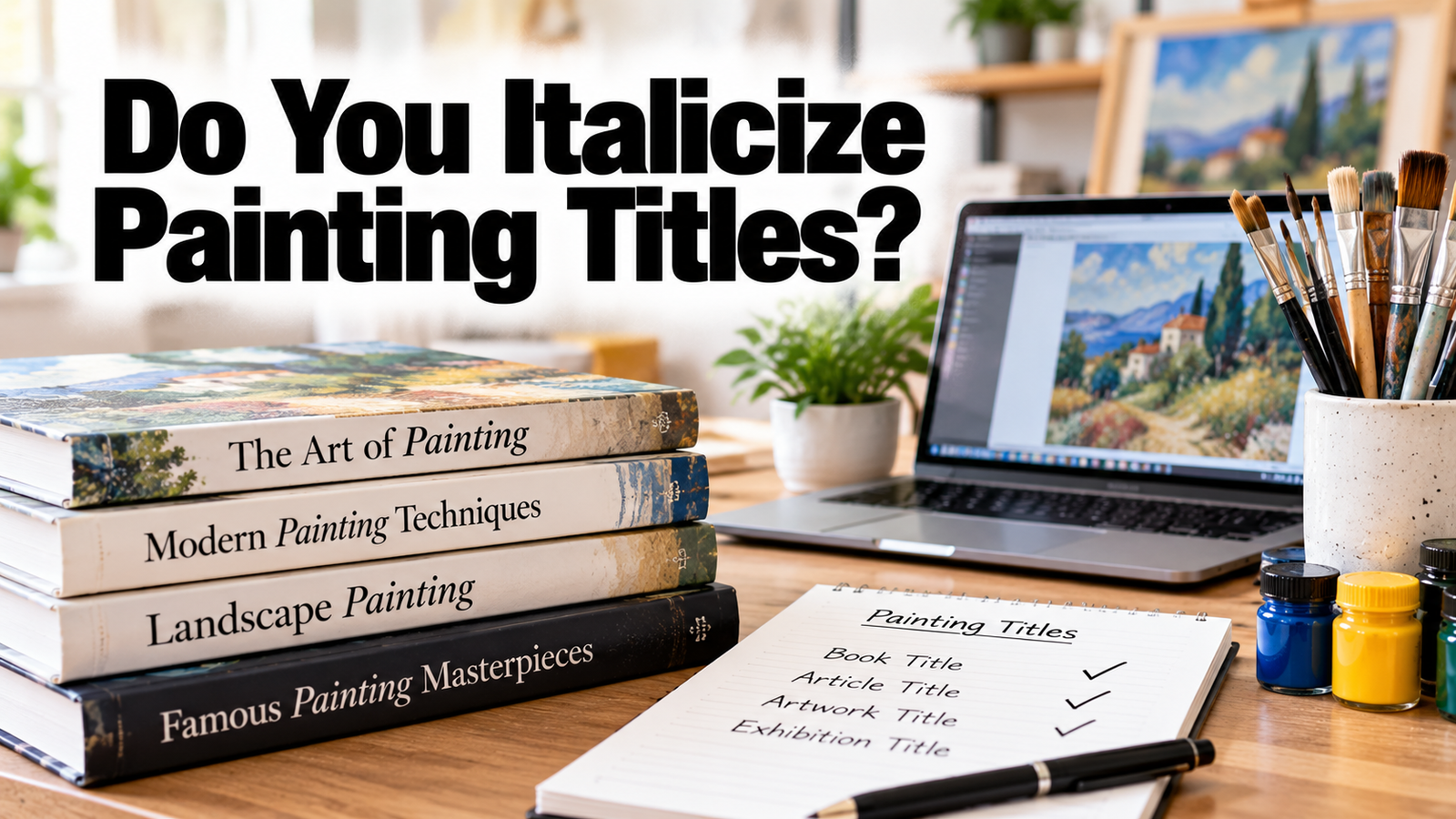

Yes, in almost every context you should italicize the title of a painting. Write The Starry Night, not “The Starry Night” or plain The Starry Night. The three major academic style guides, MLA, APA, and Chicago, all agree on this: a painting is a standalone work of art, and standalone works get italics. The one notable exception is AP style, used by most newspapers and magazines, which puts painting titles in quotation marks instead. So the short rule is: italicize, unless you’re writing in AP style.
That covers most situations, but a few details trip writers up: which guide applies to you, how to capitalize the title, and what not to italicize around it. Here’s the full picture, with examples, so you can format any painting title with confidence.
Why painting titles are italicized
The reason comes down to a simple principle that runs through English formatting: titles of large, standalone works are italicized, while titles of shorter works or parts of larger works go in quotation marks. Books, films, albums, and plays are italicized; articles, poems, songs, and single episodes get quotes. A painting is a complete, self-contained work, so it sits with the italicized group alongside books and films.
Italics also do practical work: they signal to the reader that a string of ordinary words is actually a title, preventing confusion. Without them, a sentence like “I love the persistence of memory” is ambiguous, but “I love The Persistence of Memory” clearly refers to Dalí’s painting. The title is a proper name for a unique creative work, and italics mark it as such.
The underlying rule: standalone works (paintings, books, films) are italicized; parts of larger works (poems, articles, songs) get quotation marks. A painting is a standalone work, so it’s italicized.
This large-versus-small logic is the key to remembering it, and it extends well beyond paintings. A book is italicized, but a single chapter or short story inside it takes quotation marks; an album is italicized, but one song on it is quoted; a television series is italicized, but a single episode is quoted. Paintings almost always exist as complete, independent works rather than as a component of something larger, which is why they land firmly in the italics camp. Once you internalize that a painting is the visual-art equivalent of a whole book rather than a single chapter, the formatting stops feeling arbitrary and starts to feel obvious.
What each style guide says
Most confusion about painting titles isn’t really about painting titles; it’s about which style guide you’re following. Here’s where the major ones stand, so you can match the rule to your context.
| Style | Format | Example |
| MLA | Italics | Van Gogh’s The Starry Night |
| APA | Italics | Vermeer’s Girl with a Pearl Earring |
| Chicago | Italics | Botticelli’s The Birth of Venus |
| AP | Quotation marks | da Vinci’s “Mona Lisa” |
The pattern is clear: the three academic styles used in essays, research papers, and books all italicize, while AP, the journalism standard, uses quotation marks. If you’re writing a school paper, an art-history piece, or a book, italics is almost certainly correct. If you’re writing for a newspaper or a publication that follows AP, use quotes.
The AP style exception
AP style is the outlier worth understanding, because it’s so widely used in the press. The Associated Press Stylebook treats composition titles, paintings, photographs, books, songs, movies, and more, by placing them in quotation marks rather than italics.
Part of the historical reason is practical: wire services and older newspaper systems couldn’t always transmit or print italics reliably, so quotation marks became the durable substitute. In AP, then, you’d write da Vinci’s “Mona Lisa” and Dalí’s “The Persistence of Memory” with quotes. If your writing will be published somewhere that follows AP, or your editor tells you to use it, follow that. Everywhere else, italics remains the dominant convention, and general guidance like the Purdue OWL’s MLA guidance on citing artwork reflects the same standalone-works-are-italicized rule, listing the title of an artwork in italics.
Fast test for AP vs the rest: journalism (newspapers, many magazines) uses quotation marks; academic and book writing (MLA, APA, Chicago) uses italics.
How to capitalize a painting title
Formatting isn’t only about italics versus quotes; capitalization matters too, and it’s another place the style guides differ slightly.
MLA and Chicago use title case (also called headline style): capitalize the first and last words and all the principal words, while leaving short articles, conjunctions, and prepositions lowercase in the middle. That gives you The Birth of Venus and A Sunday Afternoon on the Island of La Grande Jatte. APA, by contrast, uses sentence case for artwork titles in reference entries, capitalizing only the first word and any proper nouns, so the same painting can appear as Girl with a pearl earring. In all cases, keep the title italicized (or quoted in AP); capitalization and the italics rule are separate choices that both apply.
A good default for general writing is title case with italics, which reads naturally and matches how most readers expect to see a famous work presented. Reserve APA’s sentence case for when you’re specifically writing an APA-formatted paper.
Whichever conventions you choose, the most important thing is to apply them consistently across a single piece of writing. Editors and instructors notice inconsistency faster than they notice a defensible style choice, so if you italicize one painting title in title case, do the same for every painting title in the document rather than switching to quotation marks or sentence case partway through. Pick your style at the outset, based on your context, an essay, an art blog, a press release, and let that decision govern every title the same way. That consistency is what makes writing look polished and authoritative, and it matters more than which of the acceptable conventions you happened to pick.
What you should not italicize
Knowing what to italicize is only half the job; a few closely related things should stay in plain text, and mixing them up is a common error.
- Art movements and styles. Impressionism, Cubism, the Renaissance, and Surrealism are general terms, not titles, so they’re not italicized. Write: the gallery featured Impressionist works, including Water Lilies.
- The medium or description. Phrases like oil on canvas, watercolor, or a landscape painting describe the work but aren’t its title, so they stay in plain text.
- The artist’s name. Names of people are never italicized. It’s Vincent van Gogh, in plain text, who painted The Starry Night.
- Generic or untitled descriptions. If a work has no formal title and you’re just describing it (an untitled sketch of a harbor), there’s no title to italicize. Formal Untitled as an actual assigned title, however, is italicized.
The throughline is that italics mark a specific work’s title, not the categories, materials, or people around it. When you’re unsure whether something is a title, ask if it’s the unique name of one particular artwork; if not, it stays in plain text.
When to use quotation marks instead
Even outside AP style, there are a couple of legitimate times quotation marks come into play, so it helps to know them.
The first is when italics simply aren’t available. In handwriting, plain-text emails, social media posts, or any format that can’t render italics, quotation marks are the accepted substitute for a painting title. The meaning carries through even if the ideal formatting doesn’t. The second is for a work that is part of a larger titled work or series, where the smaller piece can take quotation marks while the overall collection is italicized, echoing the books-versus-chapters logic. For a standalone painting in normal writing, though, italics is the default, and quotation marks are the fallback, not the first choice, unless you’re in AP style.
A couple of related edge cases are worth a quick word. Foreign-language painting titles follow the same rule, italicize them as you would an English title, and you can keep the original spelling and accents (for example, Monet’s Impression, soleil levant). If you also provide an English translation, that translation is typically set in plain text or parentheses rather than italicized. And when a painting title appears inside a heading or another title that is itself italicized, you flip the inner title to plain text or quotation marks so it still stands out against the surrounding italics. These are small refinements, but they follow directly from the same core idea: the formatting exists to make the title visible as a distinct unit, whatever the surrounding text is doing.
If you can’t produce italics, quotation marks are an acceptable stand-in for a painting title. They’re the backup, not the preferred form, outside AP style.
Conclusion
So, do you italicize painting titles? Yes, in almost every case. MLA, APA, and Chicago, the styles behind essays, research papers, and books, all italicize them, so The Starry Night and Mona Lisa are correct. The single big exception is AP style for journalism, which uses quotation marks instead. Use title case in MLA and Chicago, sentence case in APA reference entries, and remember to leave art movements, mediums, and artists’ names in plain text. When you can’t use italics or you’re just unsure, quotation marks are a safe fallback, but the dominant rule holds: when in doubt, italicize.
Frequently asked questions
Do you italicize the Mona Lisa? Yes, in MLA, APA, and Chicago style it’s italicized as Mona Lisa. Only in AP style (journalism) would you write “Mona Lisa” in quotation marks instead. Italics is the dominant convention.
Are painting titles italicized or in quotes? Italicized in the academic styles (MLA, APA, Chicago) and in most books and museum writing. Quotation marks are used in AP style and as a fallback when italics aren’t available.
Do the same rules apply to sculptures and photographs? Yes. Sculptures, photographs, and other standalone visual artworks follow the same rule: italics in MLA, APA, and Chicago, and quotation marks in AP style, just like paintings.
Should I italicize art movements like Impressionism? No. Art movements, styles, and periods (Impressionism, Cubism, the Renaissance) are general terms, not titles, so they stay in plain text. Only the specific artwork’s title is italicized.
What if I can’t use italics? Use quotation marks. In handwriting, plain-text messages, or anywhere italics won’t display, putting a painting title in quotes is the accepted substitute so readers still recognize it as a title.
Related Articles
How Long Should Primer Dry Before Painting?
How Much Does a 5 Gallon Bucket of Paint Weigh?