

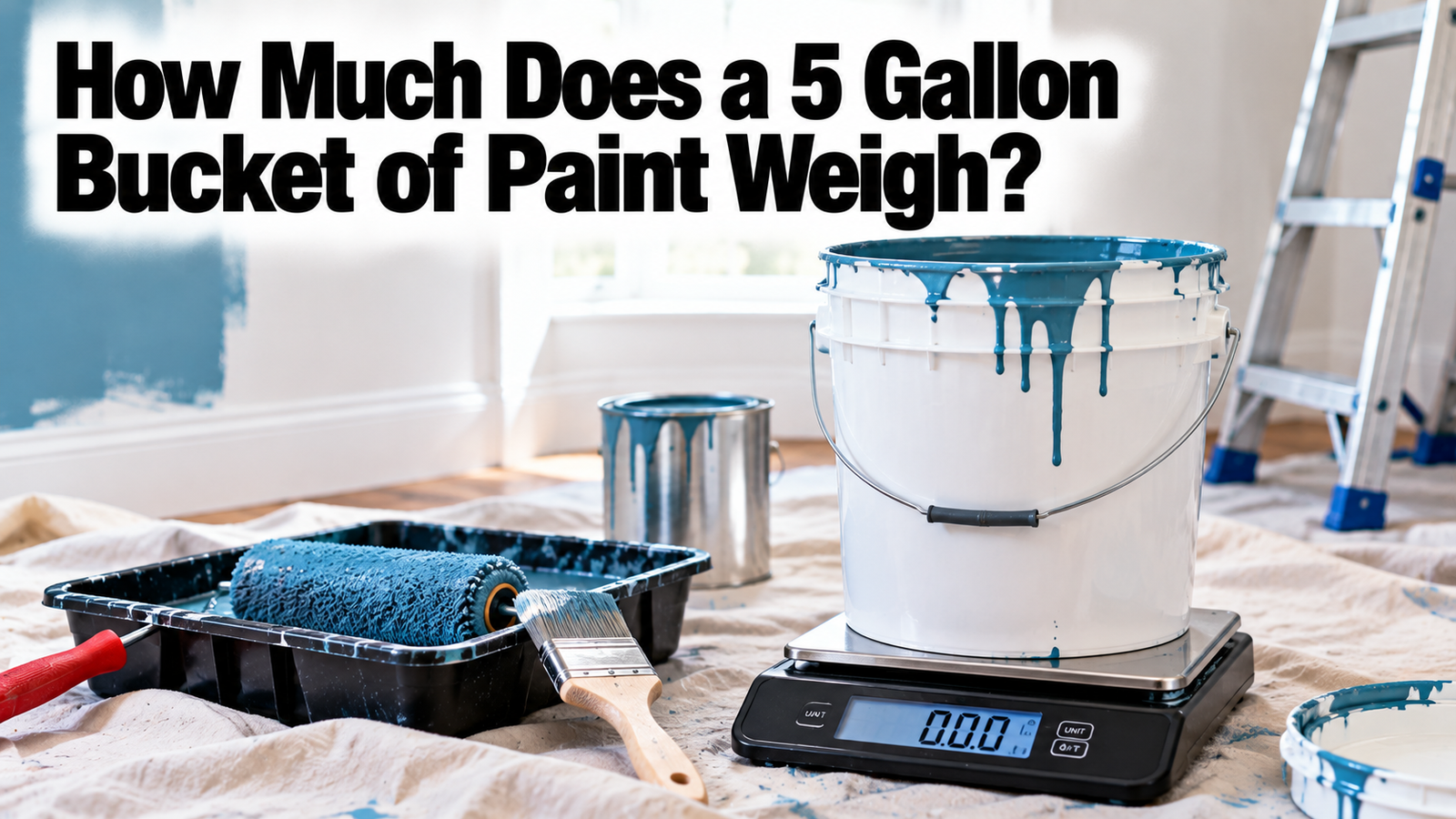

Between 50 and 60 pounds, or roughly 23 to 27 kilograms, for a standard bucket of latex or acrylic paint including the pail itself.
- Weight by product type
- Why paint weighs more than water
- Getting the exact number for your paint
- What the bucket itself adds
- Water-based paint often weighs more than solvent-based
- Is it safe for one person to lift?
- Using weight to work out how much paint is left
- How it compares to other things in the same bucket
- Where else the weight matters
- Conclusion
- Frequently asked questions
- Related Articles
That comes from the density. Water-based interior paint runs about 10 to 12 pounds per US gallon, so five gallons is 50 to 60 pounds of paint, and the plastic pail adds another one to three pounds on top.
Oil-based products sit a little lower, at roughly 45 to 55 pounds for five gallons. Heavy coatings like elastomerics go higher, past 60.
Weight by product type
These figures are for a US gallon. An imperial gallon is about 20 percent larger, so a UK five-gallon container of the same paint would weigh proportionally more.
| Product | Per gallon | 5 gallons of product | Plus plastic pail |
| Latex or acrylic interior | 10 to 12 lbs | 50 to 60 lbs | 52 to 63 lbs |
| Oil-based or alkyd | 9 to 11 lbs | 45 to 55 lbs | 47 to 58 lbs |
| Primer | 10 to 13 lbs | 50 to 65 lbs | 52 to 68 lbs |
| Elastomeric coating | 12.5 lbs and up | 62 lbs and up | 64 lbs and up |
| Wood stain | 8 to 9 lbs | 40 to 45 lbs | 42 to 48 lbs |
| Water, for comparison | 8.34 lbs | 41.7 lbs | n/a |
Two things to note before you rely on these. They are ranges rather than fixed numbers, because formulations differ substantially between brands and even between sheens in the same range. And premium paints generally weigh more than budget ones, because the extra cost goes into pigment and solids, which are the heavy parts.
Why paint weighs more than water
A US gallon of water weighs 8.34 pounds. Paint is mostly water and still comes out 20 to 45 percent heavier, which surprises people until you look at what is in it.
The pigment is the main reason. Titanium dioxide, the white pigment in almost every light-coloured paint, is dense, and a high-hide paint carries a lot of it.
Then there are the solids generally: binders, extenders, and fillers such as calcium carbonate. Everything that stays on the wall after the water evaporates has to be carried in the tin, and it is all denser than the water carrying it.
That is why the weight tracks quality. A paint that covers in two coats rather than three does so by containing more solids per gallon, and more solids means more weight.
It also means an old, part-used bucket that has lost water to evaporation is not lighter in proportion. It has simply become more concentrated.
Getting the exact number for your paint
If you need a precise figure rather than a range, the manufacturer publishes it.
Look up the product’s technical data sheet, which is on the manufacturer’s website alongside the safety data sheet. Most list a weight per gallon directly. Where they do not, they list specific gravity, which is the density of the paint relative to water.
The conversion is one multiplication. Multiply the specific gravity by 8.34 to get pounds per US gallon, then multiply by five.
A paint with a specific gravity of 1.3, for example, works out at 10.8 pounds per gallon, or about 54 pounds for five gallons before you add the pail.
For metric, multiply specific gravity by 1 to get kilograms per litre, since water is 1 kg per litre. That same paint is 1.3 kg per litre, and a 19 litre pail holds about 24.7 kilograms of it.
If the tin is already in front of you and you have bathroom scales, weighing it is quicker than any of this.
What the bucket itself adds
The container is a small but real part of the total.
A standard plastic pail weighs roughly 1.5 to 2.5 pounds empty, and closer to 3 pounds with the lid on. Thin-walled hardware store buckets sit at the lower end of that.
Steel pails are considerably heavier, commonly 7 to 10 pounds empty depending on the gauge. If you are working out a shipping weight for anything in a metal container, that difference matters.
For most purposes, adding 2 to 3 pounds to the paint weight gets you close enough.
Water-based paint often weighs more than solvent-based
This one runs against intuition, since oil sounds heavier than water.
The carrier is the reason. Water weighs 8.34 pounds per gallon, while the mineral spirits and other solvents in oil-based paint are lighter, generally around 6.5 to 7 pounds per gallon.
So at a similar pigment load, the water-based version starts from a heavier base liquid and finishes heavier overall.
The gap is not large, and pigment loading can easily override it. A heavily pigmented alkyd enamel can outweigh a thin latex. But as a general rule, do not assume the oil-based tin is the heavier one.
Is it safe for one person to lift?
This is the reason the question usually gets asked, and the honest answer is more interesting than the usual advice.
You will often read that OSHA sets a 50 pound limit for one person. It does not. OSHA states directly that it has no standard setting limits on how much a person may lift or carry, and points instead to the NIOSH lifting equation, which establishes a maximum load of 51 pounds that is then adjusted for how often you lift, whether you twist, how high the lift is, how far the load is from your body, how far you carry it, and how easy it is to grip.
So 51 pounds is a ceiling under ideal conditions, not a general permission. The Canadian Centre for Occupational Health and Safety notes that the load constant of 23 kg was set as a weight safe for about 75 percent of women and 90 percent of men when everything else is favourable, and that every unfavourable factor reduces it.
A paint bucket is unfavourable on nearly every count. It usually starts on the floor, well below knuckle height. It has a thin wire handle, which counts as a poor grip. It is often carried one-handed and out to the side, away from the body. And it is frequently carried up stairs or a ladder.
There is a further point worth knowing. The NIOSH equation explicitly does not apply to unstable loads, and CCOHS names buckets and containers of liquid as an example. The one figure everyone quotes was never designed to cover this object.
The practical conclusion: treat a full five-gallon bucket as a two-person lift, or move it with a trolley. If you must carry it alone, use both hands, keep it close, and do not carry it up a ladder.
Using weight to work out how much paint is left
The same arithmetic answers a more practical question: how much is actually left in a part-used bucket you cannot see into.
Weigh the bucket on bathroom scales. Subtract the empty pail weight, call it two to three pounds for plastic. What remains is the weight of the paint.
Divide that by the weight per gallon for the product, which you already know from the data sheet or from the ranges above. A bucket reading 26 pounds on the scales, with a 2 pound pail and paint at 11 pounds per gallon, holds about 2.2 gallons.
That is accurate enough to decide whether you have sufficient paint for another room without prising the lid off and guessing, and it beats tipping the bucket to look.
Two caveats. Dried paint stuck to the inside walls counts in the weight but is not usable, so an old bucket reads slightly high. And a bucket that has thickened through water loss is denser than the figure on the data sheet, so the calculation understates the volume slightly. Neither matters much at this level of precision.
How it compares to other things in the same bucket
For a sense of scale, a five-gallon pail of water weighs about 42 pounds, since water is the lightest thing you are likely to put in one.
Paint at 50 to 60 pounds sits well above that, which is the point people miss when they assume a bucket of paint handles like a bucket of water.
Dry sand comes in around 70 to 80 pounds in the same pail, wet sand higher again, and mixed concrete around 60 to 70. So paint is towards the heavier end of ordinary bucket contents rather than the middle.
Put differently, a five-gallon bucket of paint weighs roughly what a large bag of cement or a full carry-on suitcase does, but with a thin wire handle instead of a proper grip.
Where else the weight matters
Ladders and scaffolding have rated capacities that include you, your tools, and your materials. A 60 pound bucket eats a meaningful share of that, which is why paint gets decanted into a smaller kettle for work at height.
Shelving and storage racks have limits too, and a shelf holding four buckets is carrying around 240 pounds in a small footprint.
For vehicles, weight is rarely the issue but stability is. Carry buckets upright, on a flat floor rather than a seat, and wedge them so they cannot tip, because a lid seal is not designed to hold back a full pail lying on its side.
For shipping, the billable figure is usually the gross weight including packaging and pallet, and carriers treat paint as a regulated commodity in some cases, so check before booking freight.
Conclusion
A five-gallon bucket of standard latex or acrylic paint weighs about 50 to 60 pounds, or 23 to 27 kilograms, with the pail included. Oil-based products land a little lower and heavy coatings a little higher. If you need the exact figure, find the specific gravity on the technical data sheet and multiply it by 8.34 for pounds per gallon. And treat the full bucket as a two-person lift, because the 51 pound figure people quote applies only under ideal conditions and was never intended for a container of liquid carried by a wire handle.
Frequently asked questions
How much does a gallon of paint weigh?
Around 10 to 12 pounds for latex or acrylic, and 9 to 11 pounds for oil-based. Water alone is 8.34 pounds per gallon, and the pigment and solids in paint account for the difference.
How much does an empty 5 gallon paint bucket weigh?
About 1.5 to 2.5 pounds for a plastic pail, or roughly 3 pounds with the lid. Steel pails are much heavier, commonly 7 to 10 pounds empty depending on the wall thickness.
Can one person carry a 5 gallon bucket of paint?
Many people do, but it sits above the weight that is considered safe under ideal lifting conditions, and a paint bucket is far from ideal: low starting point, poor handle, and often carried one-handed. Use two people or a trolley where you can.
Does paint get heavier or lighter as it dries?
Lighter. Drying is water or solvent evaporating out of the film, so a dried coating weighs considerably less than the wet paint that produced it. A part-used bucket that has thickened has lost water, not gained weight.
How much does a 5 gallon bucket of primer weigh?
Usually 50 to 65 pounds, since primers carry high levels of binder and pigment. Specialist industrial primers, particularly zinc-rich and epoxy types, can be heavier still.
Related Articles
How Often Should You Paint Your House Exterior?
How to Clean Walls Before Painting: A Simple Step-by-Step