
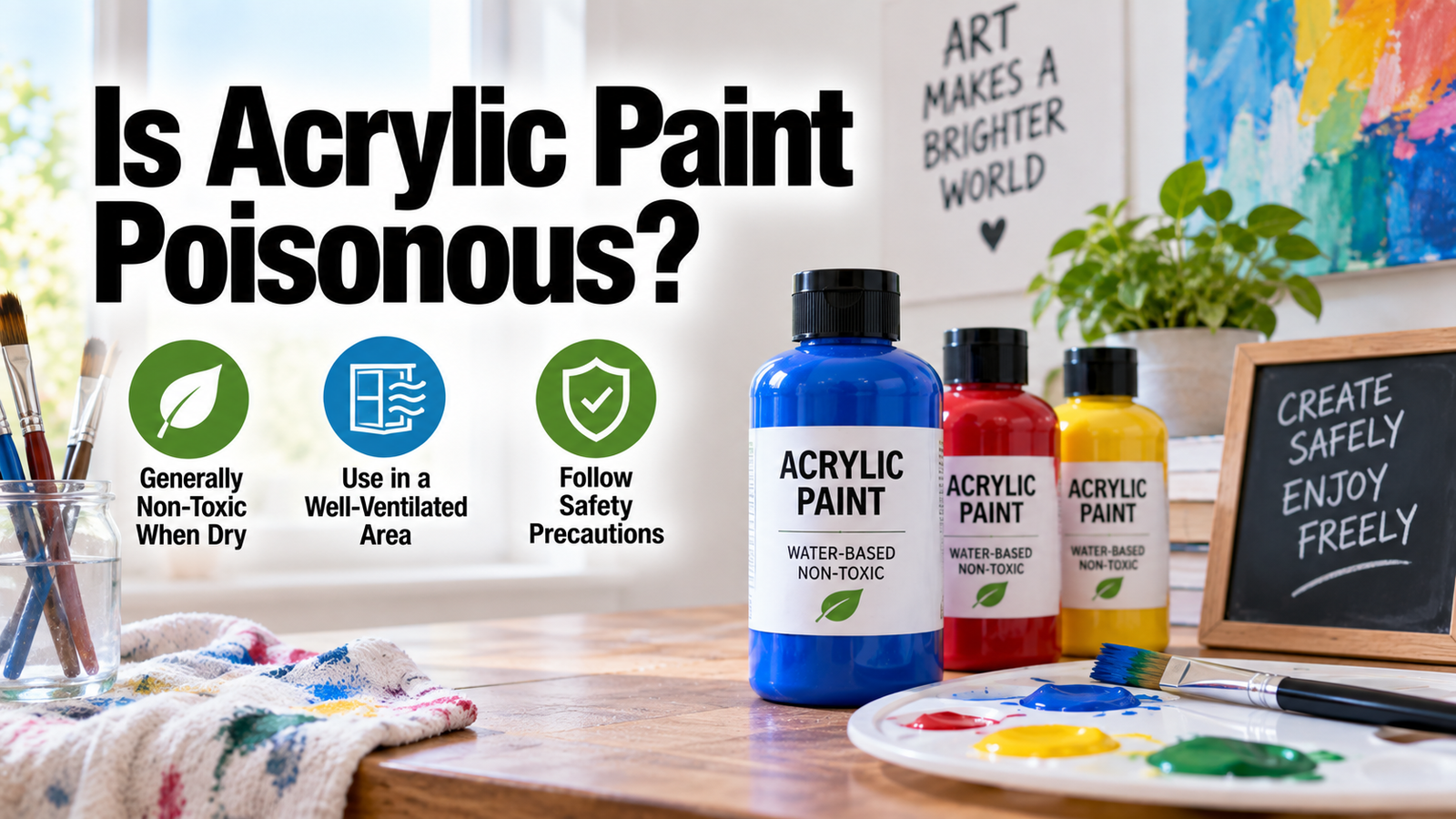

Acrylic paint is not poisonous in normal use. It’s water-based, produces minimal fumes during brushwork, and most acrylics on the shelf carry the AP non-toxic certification, meaning a toxicologist has verified they contain no ingredients in quantities harmful to humans, children included.
- The short answer, by situation
- What’s actually in acrylic paint
- Reading the label: AP, CL, and ASTM D-4236
- The pigment question: cadmium and friends
- Swallowing: kids, pets, and Poison Control
- Skin, and why acrylic isn’t body paint
- Painting with kids: the safe setup
- Fumes and ventilation
- When acrylic genuinely earns caution
- Conclusion
- Frequently asked questions
- Is acrylic paint toxic to breathe?
- What should I do if my child ate acrylic paint?
- Can I use acrylic paint on my skin or face?
- Is dried acrylic paint toxic?
- Is acrylic paint poisonous to dogs and cats?
- Related Articles
That said, “non-toxic in normal use” has fine print worth knowing: a handful of professional pigments contain heavy metals, swallowing paint in quantity is a different event than getting it on your hands, and spraying or sanding acrylic turns a safe liquid into an inhalation hazard. Here is where the real risk lives and doesn’t, how to read the safety seals on the label, and the handful of habits that keep painting as safe as it should be.
The short answer, by situation
The honest answer varies by situation, so start with the map:
| Situation | Risk level |
| Brushing on canvas in a normal room | Safe; this is the intended use |
| Paint on hands or arms | Low; wash off with soap and water |
| Child tasted a lick of AP-certified paint | Usually mild at worst; call Poison Control if unsure |
| Larger ingestion, or paint with CL / heavy-metal pigments | Call Poison Control (1-800-222-1222 in the US) |
| Airbrushing or spray application | Real inhalation hazard; respirator and ventilation required |
| Sanding dried acrylic | Dust hazard; wear a mask or wet-sand |
| Using acrylic as face or body paint | Not designed for skin; use cosmetic-grade paint instead |
What’s actually in acrylic paint
A quick look inside the tube explains the overall safety. Acrylic paint is pigment suspended in an acrylic polymer emulsion carried by water, plus small amounts of additives such as preservatives that keep the paint from spoiling in the container.
There are no strong solvents doing the carrying, which is the core difference from oil painting’s traditional companions like turpentine and mineral spirits: the hazardous part of many paint systems is the solvent, and acrylics simply don’t have one.
That’s why cleanup is soap and water and why the smell of a working acrylic session is faint. The meaningful hazards, where they exist, come from specific pigments and from specific ways of using the paint, not from the base chemistry.
Reading the label: AP, CL, and ASTM D-4236
The label tells you more than the marketing does, and two small seals from the Art and Creative Materials Institute do the heavy lifting. The AP (Approved Product) seal certifies that a board-certified toxicologist has evaluated the formula and found no materials in sufficient quantities to be toxic or injurious to humans, including children, covering both immediate and long-term health effects.
The CL (Cautionary Labeling) seal marks products that do contain ingredients requiring health warnings but are safe when used as the label directs; it appears on only a small percentage of adult art materials and is never allowed on children’s products, and CL materials shouldn’t be given to children in sixth grade or younger or to anyone who can’t read and follow the warnings.
US law also requires art materials to be evaluated for chronic hazards and labeled to the ASTM D-4236 standard, which is the conformance statement you’ll find in small print on the package. The practical rule: for kids and classrooms, AP only; for adults, CL colors are fine with the label’s precautions taken seriously.
The pigment question: cadmium and friends
The pigment question is where “is acrylic toxic” gets its only complicated answer. Most colors use synthetic organic pigments with no notable hazard, but some of the most vivid professional colors are built on heavy metals: cadmium in brilliant reds, oranges, and yellows; cobalt in deep blues; chromium in certain greens and yellows; plus manganese and nickel in scattered colors.
Two things keep this in perspective. First, the exposure route matters: these pigments pose minimal risk while being brushed from a tube onto canvas, and become genuinely hazardous mainly as inhaled dust or spray mist, or when swallowed.
Second, the industry has engineered around much of the concern: modern cadmium pigments are commonly coated to lock the metal in, and several major brands now sell cadmium-free lines that chase the same hues without the metal at all. If you’d rather skip the question entirely, buying colors labeled “hue” (imitation versions) or cadmium-free keeps a palette bright with nothing to manage.
Swallowing: kids, pets, and Poison Control
Swallowing is the scenario behind most worried searches, so here it is plainly. A small accidental taste of an AP-certified acrylic, the classic toddler-licked-the-brush event, is unlikely to cause more than minor stomach upset, precisely because AP certification tests for incidental ingestion by children.
Even so, don’t induce vomiting, wipe out the mouth, offer water, and call Poison Control (1-800-222-1222 in the US) with the product in hand; they’ll ask what’s on the label and give exact guidance free. The calculation changes with quantity and with pigment: a large amount swallowed, or any ingestion of CL-labeled or heavy-metal colors, deserves that call every time.
Pets run on the same logic: a lick of dried paint or a taste from a palette is rarely an emergency for a dog or cat, while a chewed-open tube, a large volume, or a heavy-metal color is a call to the vet or a pet poison line. Prevention costs nothing: keep food and drinks out of the painting area, never point a brush with your lips, and store paints where kids and pets can’t browse.
Quick rule for scares: small taste of AP paint, wipe, water, watch. Anything bigger, or any CL color, call Poison Control at 1-800-222-1222. The call is free and faster than searching.
Skin, and why acrylic isn’t body paint
Skin contact sits at the safe end of the spectrum with one firm exception. Paint on your hands during a session is a non-event: wash with soap and warm water, and peel or oil off any dried patches gently rather than scrubbing with solvents. Artists who work daily with CL-labeled colors have a fair reason to wear nitrile gloves, since repeated long-term contact is a different exposure than an occasional splash.
The exception is deliberate skin painting: acrylic is not formulated for faces or bodies. It isn’t tested as a cosmetic, it seals over skin as it dries, some colors carry exactly the pigments you don’t want against skin for hours, and removal from skin and hair is irritating in itself. For face painting, Halloween, and handprint crafts with young kids, use cosmetic-grade or dedicated finger paints; they exist because this line matters.
Painting with kids: the safe setup
For painting with kids, the safe setup is short and worth writing down. Buy AP-sealed paints only, and for young children prefer the washable school formulas, which are built for exactly this audience and clean out of clothes and carpets as a bonus.
Keep the session supervised at brush-chewing ages, put snacks and drinks in another room so hands get washed before anything reaches a mouth, and end every session at the sink.
Handprint and footprint crafts belong to finger paints and cosmetic-safe products, not wall or artist acrylics. And the schools rule generalizes well to homes: nothing with a CL seal for children in sixth grade or younger, ever, which in practice means the professional heavy-metal colors stay on the adult shelf.
Fumes and ventilation
Fume worries mostly belong to other kinds of paint, but the topic deserves its honest paragraph. Working acrylics release far less into the air than solvent-based systems, mainly water vapor plus trace amounts from additives, including small ammonia-like notes some people notice. Paints in general are a recognized indoor source of volatile organic compounds, which is reason enough to give any painting session moving air: a window, a fan, ordinary room ventilation.
That’s genuinely sufficient for brushwork with acrylics. People who are sensitive, pregnant, or painting large surfaces in small rooms should simply upgrade the airflow, choose AP-certified low-odor lines, and take breaks; anyone with specific medical concerns gets better answers from their doctor than from a paint tube.
When acrylic genuinely earns caution
Where acrylic genuinely earns caution is when it changes physical form:
- Spraying and airbrushing atomize the paint into breathable mist, pigment included, and the AP seal does not cover inhaling a product never meant to be inhaled. Spray only with real ventilation and a properly rated respirator, whatever color is in the cup.
- Sanding dried acrylic (common in pours, furniture work, and panel prep) creates fine dust carrying the pigment with it. Wear a dust mask or wet-sand, which keeps the particles out of the air entirely.
- Heat is not the paint’s friend: torching bubbles out of pours, heat guns on thick paint, and any burning of dried acrylic release fumes worth avoiding; keep heat brief, gentle, and ventilated, and never burn painted scrap indoors.
- Dried acrylic is an inert, stable film that’s safe to touch and live with, but it is not food-safe: painted mugs, bowls, and plates are decor, not dishware, unless the paint and sealer are explicitly rated for food contact, and most are not.
Conclusion
Acrylic paint used the way it’s meant to be used, brushed onto surfaces in a ventilated room, is one of the safest paints ever made: water-based, low-fume, and mostly certified non-toxic down to child level. The real risks are specific and avoidable: swallowing in quantity, the handful of heavy-metal colors, and any use that puts paint into the air as mist or dust. Read the seal on the label, keep AP-only for kids, respect the respirator when spraying, and keep brushes out of mouths, and the honest answer to the question stays no.
Frequently asked questions
Is acrylic paint toxic to breathe?
Not in brush use; it releases mostly water vapor with faint additive traces, and normal room ventilation handles it. Breathing becomes the concern only when paint is atomized by spraying or turned to dust by sanding, both of which call for a respirator or mask.
What should I do if my child ate acrylic paint?
Stay calm: a small taste of AP-certified paint is usually mild at worst. Wipe out the mouth, offer water, don’t induce vomiting, and call Poison Control at 1-800-222-1222 with the container in hand. Larger amounts or CL-labeled colors make that call essential.
Can I use acrylic paint on my skin or face?
No. Acrylic isn’t tested as a cosmetic, it films over skin as it dries, some colors contain pigments you don’t want in prolonged contact, and removal irritates. Use cosmetic-grade face and body paints, and dedicated finger paints for kids’ handprint crafts.
Is dried acrylic paint toxic?
The cured film is inert and safe to touch and handle. The cautions: don’t sand it without a mask or wet-sanding, don’t burn it, and don’t treat painted dishware as food-safe; acrylic on mugs and plates is decorative unless the products are explicitly rated for food contact.
Is acrylic paint poisonous to dogs and cats?
A small lick is rarely an emergency, which is the same volume logic that applies to children. A chewed tube, a large amount, or heavy-metal colors like cadmium or cobalt warrant a call to your vet or a pet poison hotline. Store paints and loaded palettes out of reach.
Related Articles
What Type of Paint Should You Use in a Bathroom?
Can You Use Latex Paint Over Oil-Based Primer? A Complete Guide
Can You Thin Acrylic Paint With Water? The Complete Guide
How Much to Paint a Hood? A Real Cost Breakdown