
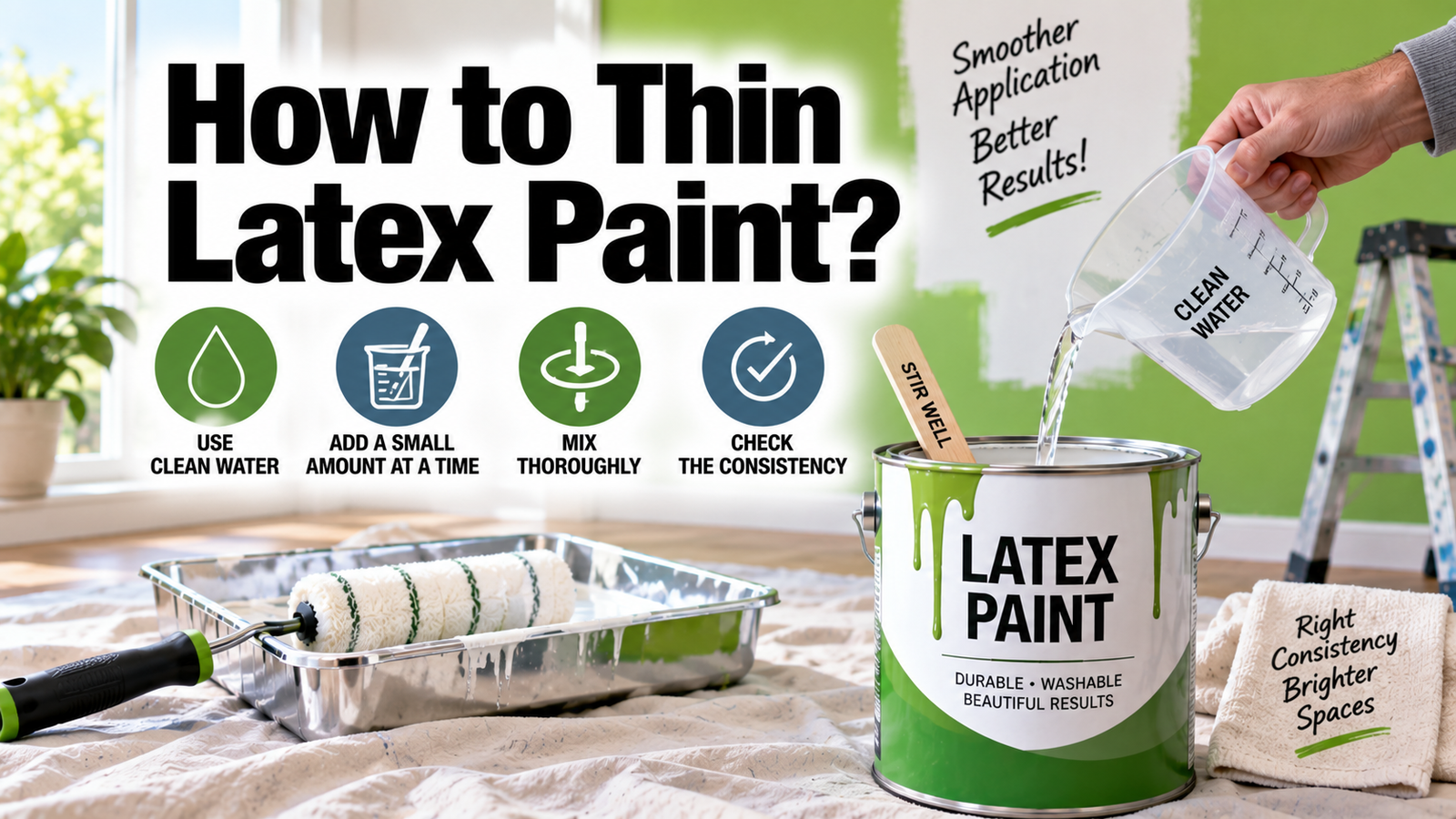

Water, added a little at a time, and almost certainly less than you think. Latex paint is water-based, so water is the correct thinner, and the maximum is printed on the tin rather than decided by the internet.
Two things are worth knowing before you pour any in. Most latex paint does not need thinning at all, particularly through an airless sprayer. And if your actual problem is brush marks, lap lines, or paint drying too fast, water is the wrong fix, because a conditioner solves those without weakening the paint.
First, work out whether you need to
Thinning is a solution to a small number of specific problems. Applied to the wrong problem it makes things worse.
Genuine reasons to thin: the paint has thickened in storage and no longer flows, your spray equipment specifies a viscosity the paint does not meet, or you want a deliberately translucent wash or glaze.
Poor reasons: the paint feels like hard work with a brush, it is drying too fast in hot weather, or you are getting roller marks. Those are flow and open-time problems, and diluting the paint treats a symptom while degrading the film.
Try the simple checks first. Stir the paint properly, for a couple of minutes, from the bottom up. Paint that has stood for months separates, and what feels like thick paint is often unmixed paint.
Warm it slightly. Paint stored in a cold garage is far more viscous than the same tin at room temperature, and an hour indoors can solve the problem entirely.
What water actually does to latex paint?
Latex paint is pigment and binder suspended in water. As the water evaporates, the binder particles coalesce into a continuous film that holds the pigment to the wall.
Add water and you change that ratio. There is less binder and less pigment in every unit of paint, so the film you lay down is thinner and carries less of what makes it work.
The consequences follow directly. Coverage drops, so you need more coats. Hide drops, so the colour underneath shows through. Adhesion and scrub resistance drop, because the film is thinner and the binder more sparse.
On a wall it also runs. Over-thinned paint sags on vertical surfaces, and the drips set into the finish.
None of this makes thinning wrong. It makes it a trade you should enter deliberately, with the smallest amount that solves your problem.
How much water is safe?
The honest answer is that your tin decides, not an article.
Manufacturers publish a maximum thinning rate on the label or in the technical data sheet, and exceeding it can void the product warranty as well as degrade the finish. Look for it before you start.
Where a limit is given, it is usually modest, and figures around half a cup per gallon are common as a starting point for brush and roller work. If you cannot find a figure, treat that as a signal that the paint is not designed to be thinned.
This is also why the ratios published online disagree so wildly, ranging from a few percent to nearly a third. They are guesses at a number the manufacturer has already specified for the specific product in your hand.
Work upward, never downward. Add a small measured amount, stir, test, and repeat. You can always add more water, and you cannot take it out.
How to thin it properly?
- Stir the unthinned paint thoroughly first, so you are judging its real consistency rather than a separated one.
- Decant into a clean bucket rather than working in the original tin, so you keep an unthinned reserve to correct with.
- Measure the water rather than splashing it in. Ounces matter at these volumes.
- Add roughly half your intended amount, stir for a full minute, and assess before adding more.
- Stir rather than whip. Beating air into latex paint creates bubbles that show up as pinholes in the finish.
- Test on a scrap of the actual material, not on cardboard alone, and let it dry before judging hide.
- Strain the paint through a fine mesh before it goes anywhere near a sprayer.
The consistency you are aiming for depends on the job, but for spraying, paint that runs off a stir stick in a smooth stream rather than dropping in blobs is roughly right.
Conditioner instead of water
This is the part most guides mention in passing and it deserves more than that.
A paint conditioner reduces viscosity without diluting the binder. It makes latex flow and level more like an oil-based paint, and it extends the wet edge so the paint has time to settle before it skins over.
Floetrol is the common product, and PPG publish exact rates rather than leaving you to guess. Their technical bulletin gives roughly 8 oz per gallon for brush and roller work, rising to 16 oz per gallon for thick paint or extreme temperatures, up to 32 oz per gallon for an airless sprayer, and 4 to 8 oz per quart for a cup gun.
For a glaze or faux finish, they specify three parts paint to one part conditioner, and note that more conditioner gives longer open time and a more translucent result.
Two useful details from the same document. It will not change the colour or sheen of most latex paints, though it can reduce the sheen of a gloss. And it extends drying time, which is the point in hot weather but a nuisance in a cold room.
The comparison is simple enough to state plainly.
| Water | Paint conditioner | |
| What it does | Dilutes everything, binder included | Lowers viscosity, leaves the binder intact |
| Durability | Reduced | Maintained |
| Hide and coverage | Reduced | Maintained or improved |
| Drying | Little change | Extends open time |
| Cost | Free | A few pounds or dollars a bottle |
| Best for | Minor thickness, sprayer feed | Brush marks, lap lines, hot or windy days |
PPG also advise mixing a small test batch first to check compatibility, which is worth doing with any additive and any paint.
Thinning for a sprayer
Start by reading the sprayer manual rather than the paint tin, because the equipment sets the requirement.
Airless sprayers often need no thinning at all. They generate enough pressure to atomise unthinned latex, and thinning is more likely to cause runs than to help. If yours is struggling, check the tip size before reaching for water.
HVLP and cup guns are the opposite case. They move paint at lower pressure and generally need genuinely thinner material, which is where most sprayer thinning questions come from.
A viscosity cup is the way to stop guessing. You fill it, time how long the paint takes to drain, and compare that figure against the number in your sprayer manual. It takes a minute and removes the argument.
Strain the paint every time. A single dried flake will block a tip mid-pass and leave a mark you have to sand out.
Test on scrap and adjust the pressure and fan pattern before you touch the actual work.
Thinning for a wash or glaze
Everything above assumes you want paint that still behaves like paint. Washes are the exception, and the rules invert.
For a colour wash on a wall, or for the diluted coat used to age furniture and let grain show through, the whole point is a thin, translucent film. Here you are deliberately past the ratios a manufacturer would sanction for normal coverage.
Ratios vary with how sheer you want it, and one part paint to one part water is a common starting point, going as far as one to three or four for a very light tint. Mix a test batch and try it on scrap, because the effect is difficult to judge wet.
Two practical points. A heavily watered wash runs badly on vertical surfaces, so work in small sections with a damp cloth in your other hand to catch drips and soften edges. And it will not protect anything, so a wash on a floor or a worktop needs a clear sealer over it.
For glazes specifically, a conditioner beats water outright. Thinning with Floetrol at the faux finishing ratio gives you translucency plus the extended open time that any blended or wiped effect depends on.
What not to use?
Do not use mineral spirits, white spirit, turpentine, or paint thinner on latex paint. Those are solvents for oil-based coatings, and in a water-based paint they will separate the emulsion and ruin the tin.
Do not use a solvent-based conditioner either. Match water-based additives to water-based paints.
Do not use hot water, which can affect the emulsion. Room temperature is fine.
And do not thin paint you intend to use as a primer sealer or a stain blocker. Those products work by film thickness, and thinning them removes the property you bought them for.
Signs you have gone too far
Poor hide is the first symptom. If the colour underneath keeps showing after two coats, the paint is too thin rather than too pale.
Runs and sags on vertical surfaces are the second, and they appear within minutes of application.
A patchy, uneven sheen once dry suggests the film is inconsistent in thickness.
A watery, weak feel when you brush it, where the paint does not load onto the brush properly, means you have passed the useful point.
If you have over-thinned a batch, the fix is to add unthinned paint back into it, which is exactly why you kept some in reserve.
Conclusion
Stir it and warm it before you thin it, because that solves the problem more often than water does. If you do thin, use water, check the maximum on the tin, and add it in small measured amounts with the paint decanted into a separate bucket. If the real problem is brush marks, lap lines, or fast drying, use a conditioner instead at the manufacturer’s stated rate, since it reduces viscosity without weakening the film. And if you are spraying with an airless, try it unthinned first.
Frequently asked questions
How much water do you add to a gallon of latex paint?
Check the tin, because manufacturers publish a maximum and exceeding it can void the warranty. Around half a cup per gallon is a common starting point for brush and roller work, added gradually rather than all at once.
Can you thin latex paint with paint thinner?
No. Paint thinner and mineral spirits are solvents for oil-based paint. In latex they break the emulsion and spoil the whole tin. Water is the thinner for water-based paint.
Is Floetrol the same as thinning?
No, and the distinction matters. Floetrol is a conditioner that lowers viscosity without diluting the binder, so it improves flow and leveling while keeping the film’s durability. Water dilutes everything, including the binder.
Do you need to thin latex paint for an airless sprayer?
Usually not. Airless sprayers atomise unthinned latex at working pressure. If yours is struggling, check the tip size and the filter before adding water.
What happens if you thin latex paint too much?
Coverage and hide drop, the paint runs on vertical surfaces, and the dried film is less durable and less scrubbable. The remedy is to stir unthinned paint back into the batch.
Related Articles
How to Thin Paint for a Spray Gun: Ratios by Paint
How Warm Does It Need to Be to Paint an Exterior?