

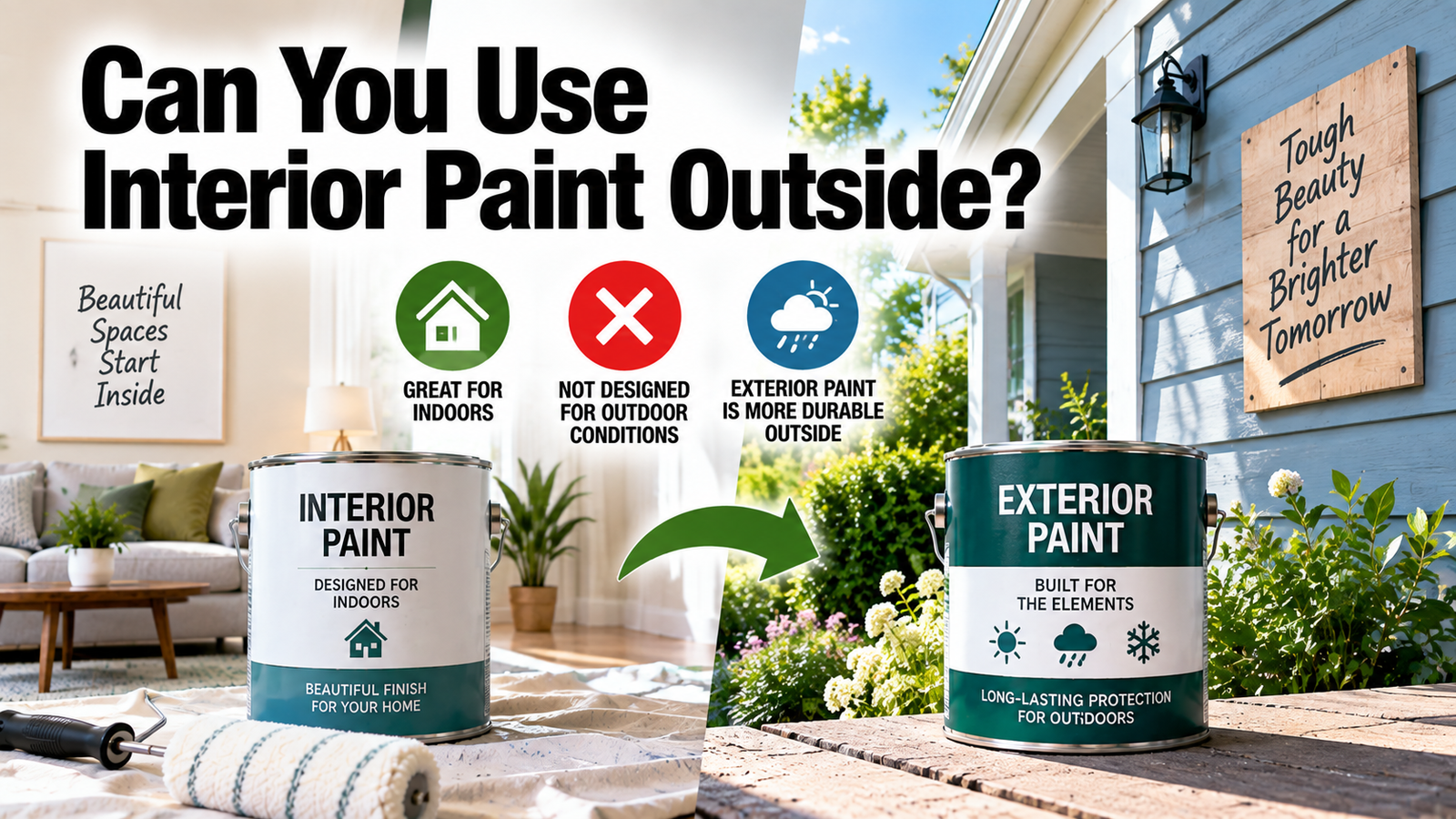

You can put interior paint on an outdoor surface, but it will not hold up. Interior paint is made for calm, dry rooms, not for sun, rain, and big temperature swings. Used outside, it usually starts to fade, crack, and peel within a few months. If you have a can of leftover interior paint and you want to save money, this guide explains why it fails outdoors, the few cases where it is fine, and what to use instead.
- Can you use interior paint outside?
- What makes exterior paint different
- Flexible binders that move with the wall
- UV blockers, mildewcides, and water resistance
- Fumes and VOCs
- What happens if you use interior paint outside
- Are there any times it is fine?
- What to use instead
- How to fix a surface already painted with interior paint
- Conclusion
- Frequently asked questions
- Related Article
Can you use interior paint outside?
Yes, you physically can, but you should not for anything you want to last. Interior paint will go onto wood, brick, or metal outside and look fine on day one. The problem shows up later. It has none of the parts that let a coating survive weather, so the finish breaks down fast and you end up repainting sooner than if you had used the right paint from the start.
Think of it this way: interior paint is built to look good and take a scrub. Exterior paint is built to take a beating from the weather. The two jobs need different recipes, and swapping one for the other outdoors almost always ends in a peeling mess.
What makes exterior paint different
Exterior paint is different because of what goes into it. All paint is a mix of pigment (the color), binder (the glue that holds it together and sticks it to the wall), a liquid carrier that evaporates as it dries, and additives (the extras that give it special powers). The binders and additives are where interior and exterior paint split apart.
Flexible binders that move with the wall
Outdoor surfaces move. Wood siding and trim expand when they heat up and shrink when they cool down, and they do it every day. Exterior paint uses soft, flexible binders that stretch and squeeze along with the surface, so the film does not split. Interior paint uses stiff, rigid binders instead, because indoor walls stay still and a hard film is easier to wipe clean. Put that rigid film outside and it cannot move with the surface, so it cracks.
UV blockers, mildewcides, and water resistance
Exterior paint is loaded with additives that fight the outdoors: UV-resistant pigments to slow fading from the sun, mildewcides to stop mold and mildew in damp spots, and water resistance to shed rain while still letting the surface breathe. Interior paint skips most of this. A few bathroom and kitchen lines carry a small, indoor-safe dose of mildew protection, but nothing close to what an outdoor wall needs.
Fumes and VOCs
There is one area where interior paint is built stronger, not weaker: air safety. Interior paint is made with low levels of VOCs (volatile organic compounds, the fumes that come off paint as it dries) to keep indoor air healthy. In the United States, the EPA caps flat interior paint at 100 grams of VOCs per liter. Exterior paint faces looser limits because the fumes escape into open air. That gap matters for the reverse question too, and it is why exterior paint is a poor pick for indoor rooms.
Quick take: exterior paint bends, blocks UV, and fights mildew. Interior paint stays smooth, scrubs clean, and keeps your air safe. Each one is tuned for the place it lives.
Here is the split at a glance:
| What it deals with | Interior paint | Exterior paint |
| Binders (the glue) | Rigid, for a smooth, scrubbable wall | Flexible, so it stretches as siding heats up and cools |
| UV protection | Little to none | Built-in, to slow fading in direct sun |
| Mildew and mold | Usually none, except bath and kitchen lines | Mildewcides added to fight damp |
| Water and rain | Not built to shed it | Sheds water while letting the surface breathe |
| VOCs and fumes | Low, capped for indoor air | Higher, since fumes escape outside |
What happens if you use interior paint outside
If you paint an outdoor surface with interior paint, the finish fails in a predictable order. Knowing the timeline helps you decide whether the shortcut is worth it.
- Fading. The sun goes to work first. Interior pigments are not made to block UV, so the color starts to wash out, sometimes within weeks in strong sun.
- Chalking. As the surface breaks down, it turns powdery. Rub your hand across it and you get a chalky residue on your palm.
- Cracking. The rigid film cannot flex with the surface as it heats and cools, so fine cracks open up across the paint.
- Mildew and staining. With no mildewcide, damp spots grow mold and dark streaks, and rain leaves marks the paint cannot resist.
- Peeling. Water gets into the cracks, the paint loses its grip, and sheets of it lift and peel away from the surface.
In a mild, dry climate you might get a year out of it. In strong sun or a wet, freezing winter, it can look rough in a single season. Either way, you will be scraping and repainting far sooner than the 5 to 12 years a quality exterior paint can give you.
Are there any times it is fine?
There are a few, and being honest about them is more useful than a flat no. Interior paint outside is a reasonable gamble when the stakes are low and you do not need it to last.
- Short-term or temporary projects. A prop, a display, a sign for a weekend event, or something you plan to toss soon. If it only needs to survive a short spell, interior paint will do.
- Covered, protected spots. A surface under a deep porch or inside a covered patio, out of direct sun and rain, will hold up longer than one out in the open, though still not as long as true exterior paint.
- A base coat you will seal over. Some people use up leftover interior paint as a first coat, then put a proper exterior paint or a clear exterior sealer on top. This can buy time, but it is a compromise. The weak layer underneath can still fail and take the top coat with it, so it is not a reliable long-term fix.
Outside of cases like these, the small saving is not worth the redo. And never use exterior paint to solve the problem indoors, since the higher fumes and mildewcides are not made for enclosed rooms.
What to use instead
For anything outdoors that you want to keep looking good, use a paint made for the job. You have two solid options.
A dedicated exterior paint
A 100% acrylic latex exterior paint is the standard choice for siding, trim, fences, and doors. It flexes with the surface, blocks UV, and fights mildew, and a good one lasts years. If you are not sure which line fits your surface and climate, the Sherwin-Williams guide to choosing exterior paint is a helpful, no-nonsense starting point. Match the paint to what you are covering, and prime bare wood or masonry first so the topcoat grips.
An interior/exterior combo paint
If you truly want one can that works both places, buy a product built for it rather than forcing an indoor paint outside. Interior/exterior acrylic paints exist for exactly this. They are a jack-of-all-trades formula: they will not beat a dedicated exterior paint on a harsh wall, but they are made to handle both settings and are a genuine option for trim, doors, shutters, and similar surfaces. Read the label, since the words “interior/exterior” on the can are what tell you it is rated for outside.
How to fix a surface already painted with interior paint
If interior paint is already outside and starting to fail, do not just brush exterior paint over the top. A fresh coat will not stick to a failing layer, and it will peel along with it. Fix it properly instead.
- Scrape and sand off all the loose, cracked, or peeling interior paint down to a sound surface.
- Wash the surface to remove dirt, chalk, and any mildew, then let it dry fully.
- Prime any bare wood, metal, or masonry with the right exterior primer so the new paint bonds.
- Apply two coats of a quality exterior paint, following the dry time on the label between coats.
It is more work than a quick recoat, but it is the only way to get a finish that lasts. Skipping the prep is how you end up doing the whole job twice.
Conclusion
You can put interior paint outside, but it is not made for weather, so it fades, cracks, and peels within months and leaves you repainting fast. Save it for temporary or well-covered projects only. For any outdoor surface you want to keep looking good, reach for a proper exterior paint, or an interior/exterior product if you need one can for both. A good result is a finish that still looks clean and tight years from now, not one season later.
Frequently asked questions
How long will interior paint last outside?
Usually a few months to about a year. In strong sun or a wet, freezing climate it can look rough in a single season, since it has no UV, mildew, or weather protection to slow the damage.
Can I seal interior paint to make it work outdoors?
A clear exterior sealer on top can buy some extra time, but it is not a real fix. The interior layer underneath can still crack and peel, taking the sealer with it, so it fails sooner than a proper exterior paint.
What is the actual difference between interior and exterior paint?
Exterior paint has flexible binders, UV blockers, mildewcides, and water resistance for outdoor weather. Interior paint has rigid binders for a smooth, scrubbable finish and lower fumes for indoor air, but none of the outdoor protection.
Can I use interior/exterior paint for both jobs?
Yes. Products labeled interior/exterior are rated for both. They will not outlast a dedicated exterior paint on a harsh wall, but they are a fair pick for trim, doors, and shutters when you want a single can.
Can I paint exterior paint over interior paint that is already outside?
Not directly. If the interior coat is failing, scrape off the loose paint, wash and dry the surface, prime the bare spots, then apply exterior paint. Painting over a failing layer just peels again.
Related Article
Is Valspar Good Paint? A Line-by-Line Honest Review
Is Behr Paint Good? An Honest Line-by-Line Verdict
Will Watered Down Acrylic Paint With Alcohol Work?
What Is Candy Paint? The 3-Stage Finish Explained