

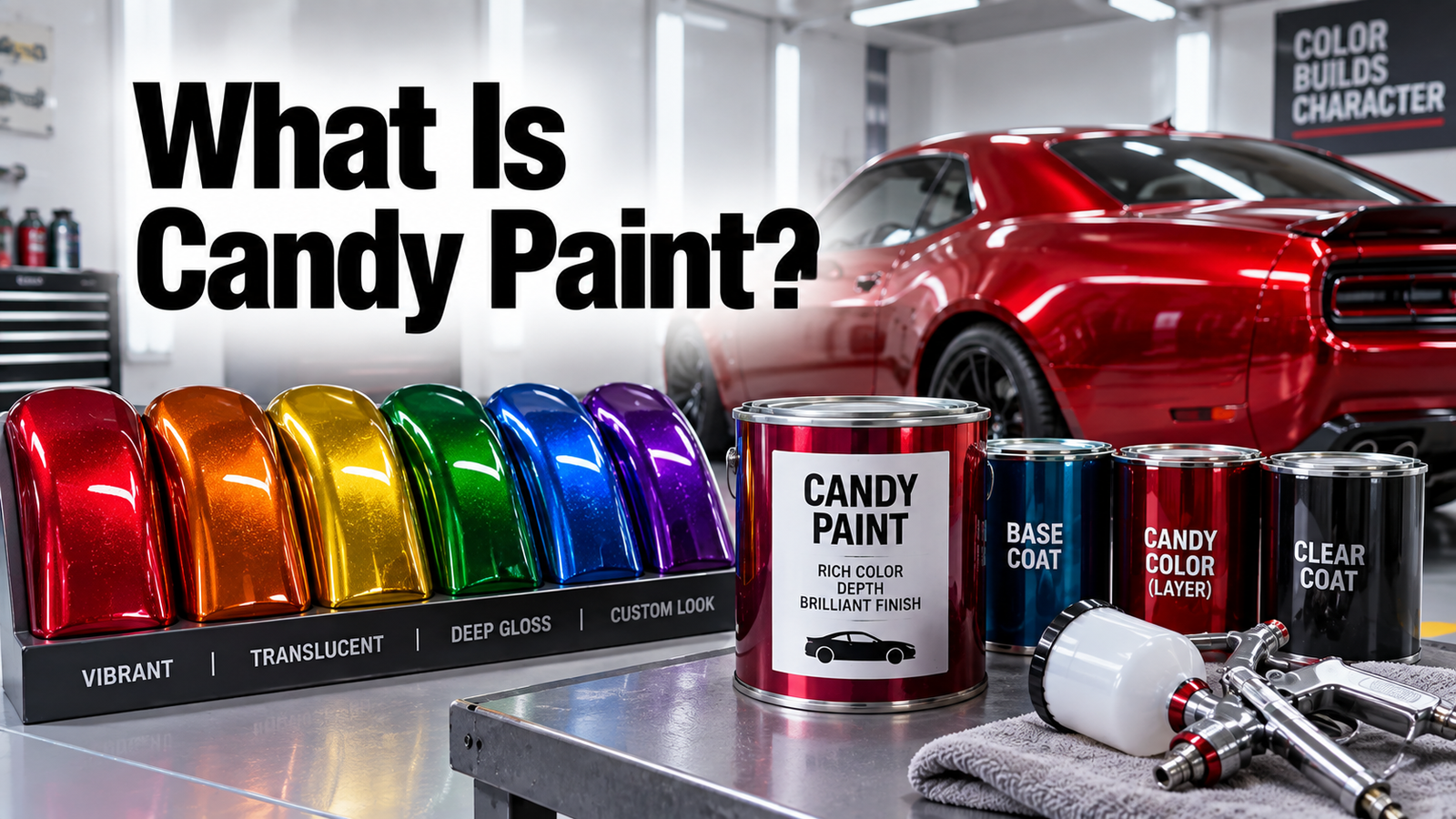

Candy paint is a translucent, tinted layer of paint sprayed over a reflective metallic base and sealed under clear coat, and that sandwich is what gives custom cars and motorcycles their deep, wet, jewel-like color, the finish people describe as looking through hard candy.
- How candy paint works
- The three stages of a candy finish
- Why the base coat changes everything
- Candy vs metallic, pearl, and regular paint
- Where candy came from
- Why candy is hard to spray
- What it costs to own
- Candy variants and easier routes
- Can you DIY a candy job?
- Conclusion
- Frequently asked questions
- Is candy paint just a color?
- How many coats does a candy paint job take?
- Why is candy paint so expensive?
- Does candy paint fade?
- Can you touch up or spot-repair candy paint?
- Related Articles
Unlike ordinary paint, which is opaque, the candy layer lets light pass through it, bounce off the metallic base underneath, and travel back out through the tint, so the color seems to glow from inside the panel and shift with the light.
It’s a three-stage system, it’s one of the hardest finishes in the industry to spray well, and it’s famously difficult to repair. Here is how candy works, where it came from, what it costs to own, and the easier variants that deliver most of the look.
How candy paint works
The trick is optical, and one comparison makes it click. A regular paint job is like colored cardboard: light hits the opaque surface and reflects straight back, so you see a flat, uniform color. Candy is like colored glass over a mirror: the tinted layer is semi-transparent, so light passes through it, strikes the sparkling metallic base coat, and reflects back out through the tint a second time.
That double trip through the color is what creates the sense of depth, the wet-looking richness, and the way a candy panel seems to change shade as the car moves through light. It’s also why the same candy tint can produce completely different finished colors depending on what’s underneath it, and why the thickness of the candy layer literally changes the color: every additional coat of translucent tint deepens and darkens the result.
The three stages of a candy finish
A candy finish is built in three stages, each of them several coats deep, which is why painters say “tri-stage” rather than counting individual coats:
- The base coat. A reflective metallic, most classically a coarse silver or a gold, sprayed in two to three coats over primer. This layer is the mirror in the sandwich; its brightness and flake size set how much the finished color will sparkle and glow.
- The candy midcoats. The candy itself is essentially clear paint carrying transparent dyes or toners instead of opaque pigment, applied over the metallic so the flake stays visible through the tinted layer. It goes on in multiple thin coats, commonly around five, with each pass deepening the color; painters stop when the panel reaches the target shade. Some builds slip a pearl or flake intercoat in here for extra dimension.
- The clear coat. Two or more coats of protective urethane clear seal the candy from UV and weather and give the finish its final gloss. On candy, the clear isn’t cosmetic; it’s the armor that decides how long the color survives sunlight.
Quick way to hold the idea: base coat is the mirror, candy is the stained glass, clear is the display case.
Why the base coat changes everything
Because the candy layer is a filter rather than a color, the base coat has enormous say in the outcome, and paint systems are built around that fact. The same transparent red sprayed over a silver base reads as a bright cherry; over gold it warms toward a burnt orange; over a black base it turns dark and jewel-like.
Candy paint manufacturers mix a whole range of dedicated base shades for their candy lines, with each candy color matched to specific bases, precisely because the pairing, not the candy alone, defines the final color. It’s also the first thing to understand before attempting a repair or asking why two “candy apple red” cars look nothing alike.
Candy vs metallic, pearl, and regular paint
Placing candy among the finishes it gets confused with makes the differences concrete:
| Finish | How it’s built | The look and the catch |
| Standard two-stage | Opaque color coat plus clear | Uniform color; easiest to spray and repair |
| Metallic | Opaque color with aluminum flake, plus clear | Sparkle in the color itself; routine to repair |
| Pearl | Mica pigments that shimmer and shift, often as a tri-coat | Soft color-shift glow; blending takes skill |
| Candy | Translucent tint over a reflective base, plus clear | Deepest, wettest color there is; hardest to spray and repair |
The quick field test: metallic and pearl sparkle within the color, while candy looks like colored depth you could reach into, and its shade visibly deepens toward panel edges and curves where the translucent film builds thicker.
Where candy came from
Candy’s history runs straight through American custom car culture. The look broke out of the 1950s California custom scene as candy apple red, built the way it still is today: meticulous bodywork, primer, a highly reflective metallic base, many coats of transparent red, and clear over everything.
From there candy spread across every hue and into hot rods, lowriders, and custom motorcycles, where it remains a signature of show-level work, and it soaked into music and slang along the way; “candy paint” in hip-hop, especially Houston’s slab culture, means exactly this finish gleaming on a cruiser.
The factory world eventually borrowed the idea too: modern production tri-coat colors, deep candy-style reds and pearl whites among them, use the same base-plus-translucent-midcoat-plus-clear construction, tamed for the assembly line.
Why candy is hard to spray
Candy’s reputation for difficulty is earned, and the reason is built into the physics: since color depth depends on film thickness, every inconsistency in application becomes visible color variation. Overlap your spray passes unevenly and the double-covered stripes read darker, the classic “tiger striping.”
Hold the gun closer on one section and that section darkens. Let a translucent, watery candy coat go on too wet and it runs far more readily than an opaque base coat would.
Working painters manage this with disciplined technique, even gun distance, consistent overlap, counted coats, and a sprayed-out test panel first, so the exact number of candy coats and gun settings are decided before the car is touched. For a first-timer, candy is a motorcycle-tank project before it’s a whole-car project.
What it costs to own
Owning candy has its own economics, and they’re worth knowing before falling in love at a car show:
- Price. A candy job costs a multiple of a standard respray: three stages of material, far more labor hours, and a skill premium. Quality candy work commonly lands in the high four figures, and show-level jobs run well into five.
- Sun. Candies historically fade faster than ordinary paint because UV attacks the transparent dyes. Modern UV-resistant clears stretch a well-kept candy’s vivid life to five-plus years and beyond, but garage parking and shade genuinely matter.
- Repairs. Spot-repairing candy is close to impossible, because a repair must duplicate the base, the exact count and thickness of candy coats, and the blend, all invisibly. In practice, damage often means repainting the whole panel or side, and custom candy sometimes means repainting the vehicle. Insurers and body shops both price accordingly.
- Washing. Treat it like the investment it is: gentle hand washes with a wax-free soap, prompt attention to chips before moisture creeps under the film, and no automatic brush washes, ever.
Candy variants and easier routes
Several variants trade some of the classic look for practicality. True urethane candy, the traditional route, mixes candy concentrate into clear for the deepest results and the least forgiveness.
Candy basecoat is a base-coat-format version of the same transparent color: it sprays on more evenly, dries faster (which means less time for dust to land in the wet film), and leaves cleaner tape lines, which makes it the better tool under graphics and flames, though it still needs a reflective base beneath and clear above.
Candy concentrates are the raw tint, letting a painter mix urethane candy, candy basecoat, or custom candy-tinted colors from one bottle. And a step further out sit the shortcuts: single-stage “candy-look” paints and color-shift vinyl wraps, which skip the three-stage system entirely and deliver a share of the effect for a fraction of the cost, the wrap being the only fully reversible option on the list.
Can you DIY a candy job?
Can a home painter do it? Honestly, yes, on the right scale and with respect for two realities. The skill reality: candy punishes inconsistency, so the path runs through practice panels and small projects, a motorcycle tank, a valve cover, a guitar body, before anything with doors, ideally using a candy basecoat system, which is the forgiving version.
The safety reality: real candy systems are sprayed materials, and the two-part urethane clears that seal them contain isocyanates, which are hazardous to breathe at any concentration a mask merely reduces. That means genuine ventilation, gloves, and a properly rated respirator as the minimum, with pros using supplied-air systems for exactly this work. Budget for wasted material while learning, spray out a test panel for every color decision, and count the practice as part of the price of the finish.
Conclusion
Candy paint is a construction, not a color: a reflective metallic base, translucent tinted midcoats that the light travels through twice, and a UV-fighting clear on top. That sandwich buys the deepest, wettest finish in the paint world and charges for it in skill, money, sun sensitivity, and repairability.
If the look is the goal, a candy basecoat system or even a quality wrap gets most of the way there with far less risk; if the real thing is the goal, budget for a practiced sprayer, a garage to park in, and the understanding that the panel glowing like hard candy is glowing because every layer under the clear was laid down exactly right.
Frequently asked questions
Is candy paint just a color?
No, it’s a construction: a translucent tinted layer over a reflective metallic base, under clear coat. Any hue can be a candy, and the same candy tint produces different finished colors over different bases, which is why the system, not the color name, defines candy.
How many coats does a candy paint job take?
Typically two to three coats of metallic base, around five thin candy coats, and two or more coats of clear, so a dozen or more passes in total. The candy count is decided on a test panel first, because each additional translucent coat visibly darkens the color.
Why is candy paint so expensive?
Three stages of material, roughly double the labor of a standard respray, and a genuine skill premium, since uneven application shows as visible striping and color shift. Repair difficulty adds ongoing cost: candy damage usually means repainting whole panels.
Does candy paint fade?
It’s more UV-sensitive than ordinary paint because sunlight attacks the transparent dyes in the candy layer. Modern UV-resistant clear coats hold vivid color for five-plus years and often much longer, with covered parking and gentle washing doing real work to extend that.
Can you touch up or spot-repair candy paint?
Rarely with an invisible result. A repair has to duplicate the base coat, the exact number and thickness of candy coats, and the blend, so shops typically repaint the entire panel or side, and full-custom candy sometimes means repainting the vehicle to keep the color uniform.
Related Articles
What Paint Is Good for Painting Clay Sculptures?