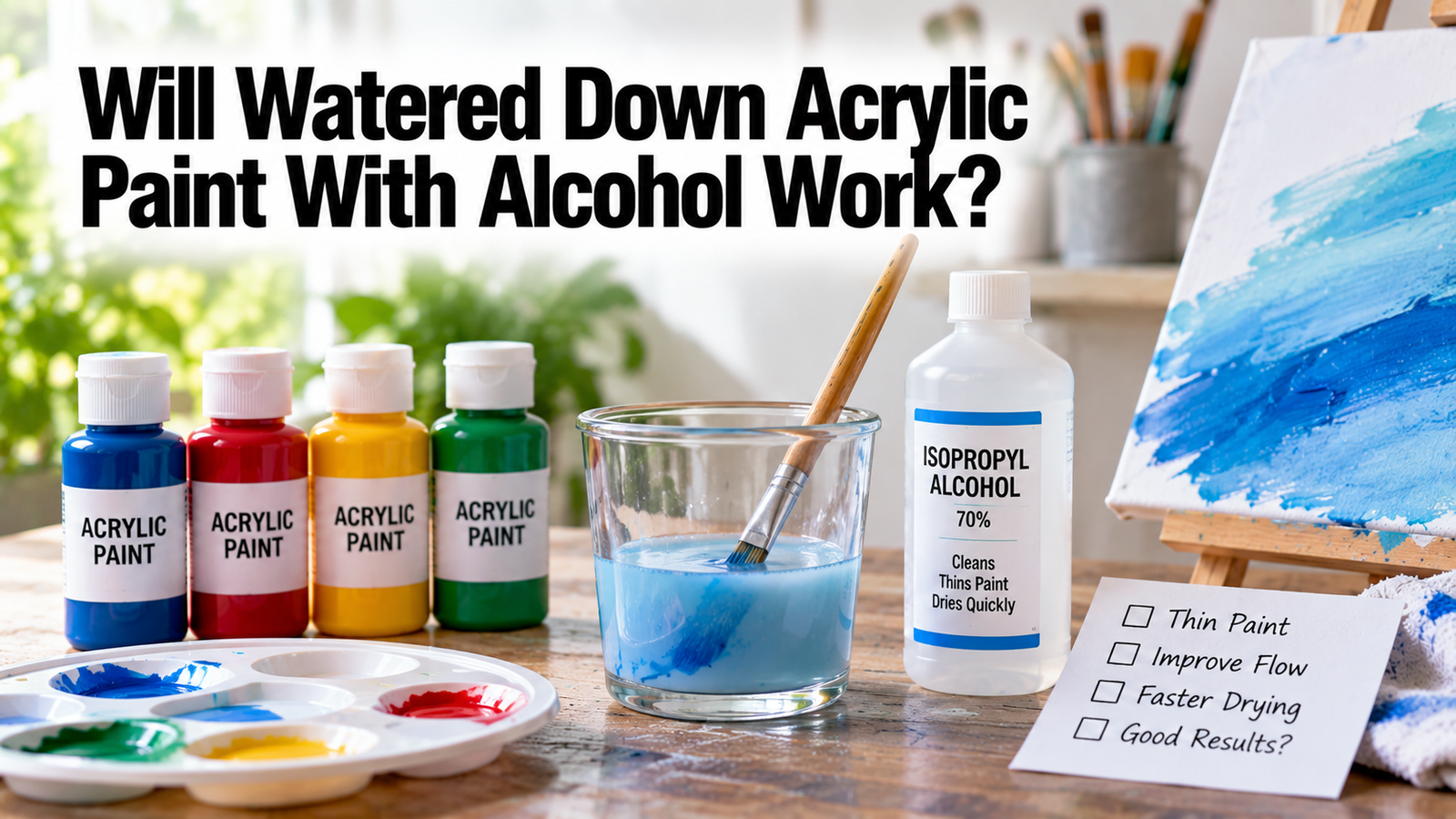

Watering down acrylic paint with alcohol works in a few specific situations and backfires in most others. On hobby and model acrylics, isopropyl alcohol is a standard airbrush thinner and performs well. On artist acrylics and house paint, alcohol attacks the binder itself: the mix can curdle in the cup, and even when it looks fine, the dried film comes out brittle, weakly attached, and prone to cracking.
- What alcohol actually does to acrylic paint
- When it works: the three real exceptions
- When it fails: anything meant to last
- The right way to thin acrylic paint
- How to add water the right way
- How much water is too much?
- Washes: why paper forgives what canvas won’t
- Already painted with an alcohol mix? Do this
- What about acrylic house paint?
- Conclusion
- Frequently asked questions
- Can I thin acrylic paint with rubbing alcohol?
- Why did my acrylic paint curdle when I added alcohol?
- Does alcohol make acrylic paint dry faster?
- What is a safe ratio of alcohol to acrylic paint?
- Will rubbing alcohol remove dried acrylic paint?
- Related Articles
If your project needs to last, thin with water (up to about 30 percent) or with an acrylic medium made for the job. Here is the chemistry behind why alcohol behaves so differently from water, the cases where it genuinely earns a place, and what to do if you’ve already painted with an alcohol mix.
What alcohol actually does to acrylic paint
Acrylic paint is a waterborne emulsion: microscopic droplets of acrylic polymer held in suspension in water, alongside pigment and additives. As the water evaporates, those polymer particles crowd together and fuse into a continuous plastic film that locks the pigment to the surface. Everything about how acrylic dries and holds depends on that fusing step going smoothly.
Alcohol disrupts it at both ends. In the wet paint, a strong dose of isopropyl destabilizes the emulsion, and the polymer can crash out of suspension, which is the curdled, cottage-cheese texture that shows up when too much alcohol hits artist paint. In the drying film, alcohol changes how the particles fuse, and the result is a coat that dries fast but brittle, with weaker adhesion, especially on flexible surfaces like canvas that the film has to bend with.
The clearest proof of the mismatch is what alcohol does to acrylic after it dries: isopropyl is one of the most effective strippers of cured acrylic paint there is. A liquid that dissolves the finished film is working against the film while it forms. Water, by contrast, is the paint’s own vehicle; adding it just gives the emulsion more of what it already contains.
When it works: the three real exceptions
That said, “will it work” has an honest yes in three cases.
- Hobby and model paints. Many model-paint systems use different binder chemistry from artist acrylics, and isopropyl is part of their standard thinning recipes for airbrushing. Some lines are alcohol-based from the factory. Thinned this way, the paint sprays fine, flashes off fast, and lets modelers build thin coats quickly. If the paint’s own instructions name alcohol, use it with confidence.
- Acrylic pouring effects. Fluid artists deliberately add drops of high-percentage isopropyl to poured acrylics to break the surface tension and open up cells and lacing. It works because the disruption is the point: a decorative pour sealed under varnish doesn’t face the flexing and handling a brushed painting does.
- Throwaway craft work. On a school project, a prop, or anything with a lifespan of weeks, a splash of alcohol to loosen thick craft paint will pass. Keep it under roughly 20 percent of the mix, expect faster drying and a slightly duller finish, and don’t use the trick on anything you want to keep.
A practical note for the airbrush case: thin gradually toward a skim-milk consistency, test the spray on scrap before touching the model, and don’t assume one brand’s recipe transfers to another, since binder systems differ even among hobby lines. The fast flash-off that makes alcohol useful here is also its constraint: mixed paint thickens in the cup sooner, so mix small batches.
When it fails: anything meant to last
Everywhere else, the answer is no, and the failure shows up in stages. In the cup, too much alcohol curdles the paint outright, and once the polymer has clumped, no amount of stirring brings it back. On the surface, an alcohol-thinned coat dries noticeably faster, which sounds convenient but kills blending time and produces hard edges.
And in the finished film, the damage is quiet: the coat can look normal for months, then crack along canvas flex lines, chip at edges, or lift when the next layer’s moisture reactivates it. Alcohol in a fresh layer can even soften the dried acrylic underneath it, smearing work you thought was safe.
Quick rule: if the piece should still look right in a year, keep the alcohol in the cleanup jar, not the paint cup.
The right way to thin acrylic paint
The right thinner depends on what you’re thinning for.
| Goal | Use this | Notes |
| Light thinning for brushwork | Clean water, up to about 30% | Distilled water is safest; add in small increments |
| Transparent glazes | Glazing medium | Thins color without removing binder |
| Airbrushing artist acrylics | Airbrush medium or flow improver | Aim for skim-milk consistency |
| Pouring and self-leveling | Pouring medium | Keeps the film strong at high dilution |
| Longer working time | Retarder or a purpose-made thinner | Additives without binder have strict limits; follow the label ratio |
| Hobby/model paint in an airbrush | The brand’s thinner or isopropyl | Alcohol is standard here; follow the maker’s recipe |
The pattern behind the table: water and additives dilute the binder, while mediums replace it. A medium is essentially the paint’s own glue without the pigment, so you can thin dramatically and still end up with a tough, well-attached film.
Binder-free additives are the strict-limit category; a purpose-made acrylic thinner ships with a hard maximum ratio (one part thinner to three parts paint) precisely because it, like water, adds no glue of its own. That’s why every serious technique that needs very fluid paint, from glazing to pouring, is built on a medium rather than on the water bottle.
How to add water the right way
Adding water well is its own small skill. Work in 5 to 10 percent increments, stirring completely before judging, because acrylic takes a moment to accept water evenly and an unmixed cup reads thicker than it is. Test each stage with a stroke on scrap: for general brushwork you want the flow of light cream, for airbrushing skim milk, and for washes something close to ink.
Distilled water is worth the small cost for artwork, since tap water’s minerals and chlorine can subtly affect color and film quality, and always mix in a separate cup rather than in the paint pot, so one over-thinned batch doesn’t take the whole supply with it.
How much water is too much?
Water has its own limit worth knowing, since the fix for avoiding alcohol shouldn’t be drowning the paint instead. Around 30 percent water by volume is the safe everyday ceiling for most acrylics; past that, especially on sealed, non-absorbent surfaces, there may be too little binder left to anchor the pigment.
Manufacturer technical guidance on over-thinning is blunt about the outcome: over-additions of water produce a weak, underbound film. High-quality professional acrylics carry more binder and tolerate more water, particularly on absorbent grounds like primed canvas or paper, but the warning signs are the same everywhere: paint that beads up instead of leveling, a chalky or powdery surface when dry, color that shifts as it dries, and layers that lift when rewet.
If you need paint thinner than the 30 percent ceiling allows, switch tools: use a fluid acrylic, an acrylic ink, or a medium instead of more water.
Washes: why paper forgives what canvas won’t
Surface changes the math too. On absorbent grounds, watercolor-style washes of heavily diluted acrylic work far better than the 30 percent rule suggests, because paper and unsealed gesso pull the thin paint in and physically grip the pigment the way they grip watercolor. That’s why acrylic wash techniques on paper are a legitimate tradition rather than a binder failure waiting to happen.
On sealed or glossy surfaces the opposite holds: there’s nothing for pigment to sink into, the binder is doing all the holding, and dilution limits need to be respected strictly. When in doubt, thin with a medium on slick surfaces and save the heavy water dilution for absorbent ones.
Already painted with an alcohol mix? Do this
Already painted something with an alcohol mix? Assess before you panic. Let the piece dry fully, then press a strip of low-tack tape onto an inconspicuous spot and peel it slowly. If no paint comes up, the surface feels bound rather than powdery, and nothing is cracking, the coat is probably serviceable; a layer of acrylic medium or varnish over the top will reinforce it and buy insurance.
If the tape lifts paint, the surface chalks onto your finger, or fine cracks are already visible, the coat has failed structurally, and the honest fix is to remove what’s loose, seal what remains with a medium, and repaint over it with properly thinned paint.
What about acrylic house paint?
The same logic covers acrylic latex house paint, since the question comes up for wall projects too. Household acrylic paint is the same emulsion chemistry in a bigger can, and alcohol does it the same harm.
If wall paint is too thick to roll or spray, add plain water in small increments, a half cup per gallon at a time, stirring fully and testing as you go, or use a latex paint conditioner made for the purpose, which improves flow without cutting the binder. Mineral spirits and other solvents belong to oil-based paint and have no place in a can of acrylic latex.
Conclusion
Alcohol-thinned acrylic works where its chemistry fits: hobby paints built for it, deliberate pour effects, and short-lived craft jobs kept under about 20 percent alcohol. For paintings, furniture, walls, and anything meant to last, it trades a few minutes of easier flow for a brittle, weakly bonded film. Thin with water up to roughly 30 percent for everyday work, reach for the medium made for your technique when you need more, and save the isopropyl for what it does best: cleaning up.
Frequently asked questions
Can I thin acrylic paint with rubbing alcohol?
For hobby and model paints made for it, yes, and it airbrushes well. For artist acrylics and house paint, no: alcohol destabilizes the binder, can curdle the mix, and leaves a brittle, crack-prone film. Use water up to about 30 percent or an acrylic medium.
Why did my acrylic paint curdle when I added alcohol?
The alcohol crashed the emulsion. Acrylic binder exists as polymer droplets suspended in water, and a strong dose of isopropyl forces them out of suspension into clumps. Once that happens the paint can’t be recovered by stirring; it has to be discarded.
Does alcohol make acrylic paint dry faster?
Yes. Isopropyl evaporates faster than water, so alcohol-thinned paint flashes off quickly, which is one reason modelers like it in airbrushes. On brushwork the same speed works against you: blending time shrinks and hard edges form before you can soften them.
What is a safe ratio of alcohol to acrylic paint?
For short-lived craft work, stay under roughly 20 percent of the mix. For hobby airbrush paints, follow the manufacturer’s own thinning recipe. For artwork or anything permanent, the safe ratio is zero; water and acrylic mediums do the thinning without the damage.
Will rubbing alcohol remove dried acrylic paint?
Yes, and effectively. Isopropyl softens and lifts cured acrylic from brushes, palettes, and non-porous surfaces, which is exactly why it makes a poor thinner: a liquid that dissolves the finished film also undermines the film while it forms.
Related Articles
How to Seal Acrylic Paint: Complete Step-by-Step Guide
Can You Use Acrylic Paint on Metal? Yes, Here’s How
How to Get Latex Paint Out of Clothes?
What Is Thinner in Paint? A Complete Guide to Types, Uses & Safety Tips