

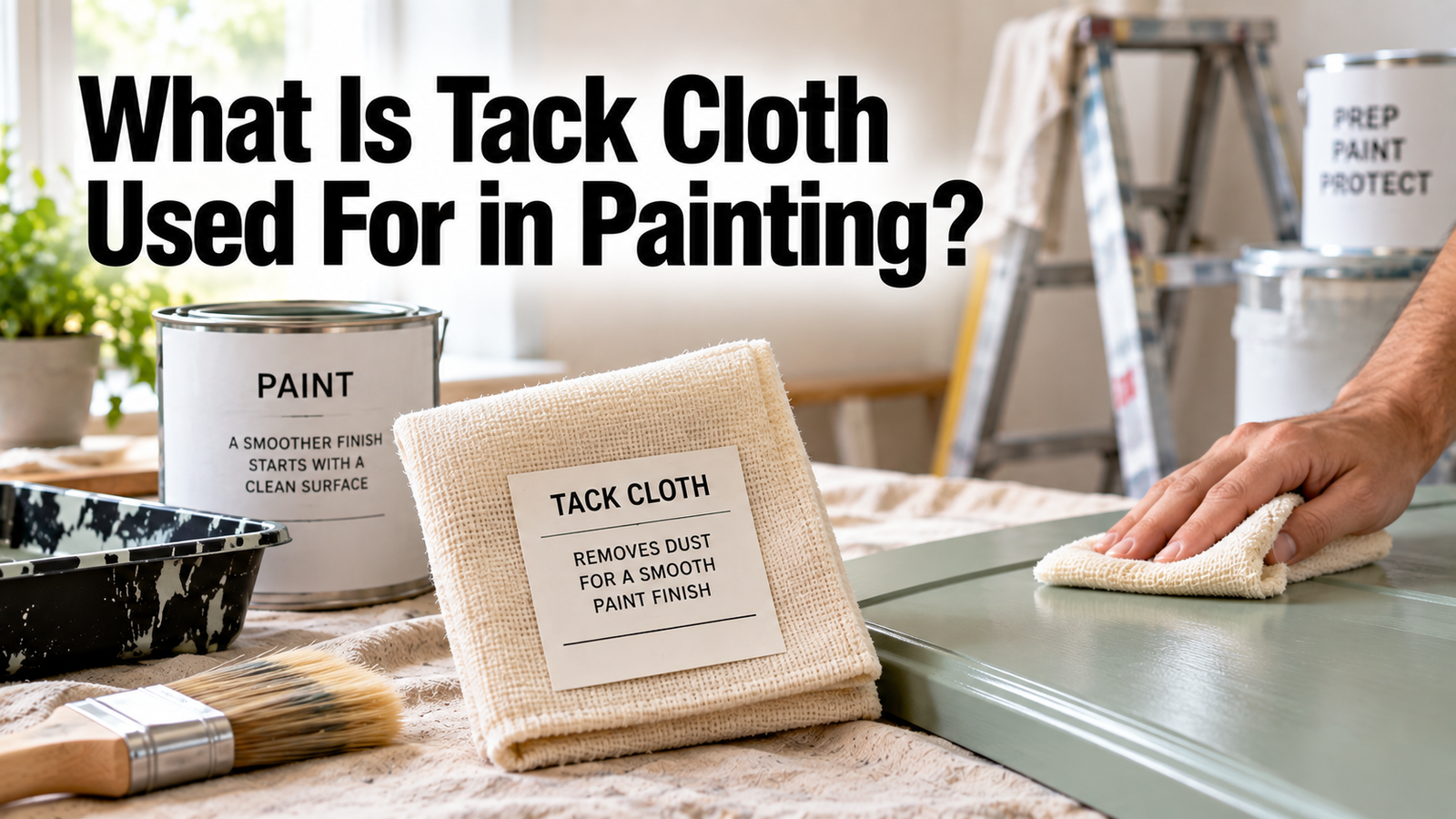

A tack cloth is a loosely woven gauze treated with a sticky resin. Its one job is to lift the fine dust off a surface immediately before you apply paint, stain, or a clear finish.
That dust is the reason it exists. Sanding leaves particles too small to see and too light to sweep, and painting over them gives you a gritty, speckled coat that no amount of extra paint will smooth out.
Used correctly it takes about a minute and makes a visible difference. Used carelessly, or on the wrong finish, it causes the exact defects it is meant to prevent.
What a tack cloth actually is
The base material is cheesecloth or a similar open-weave cotton gauze. Open weave matters, because the gaps hold the dust the cloth picks up rather than pushing it around.
That fabric is then impregnated with a tacky resin. Traditionally that meant a thin mix of varnish and mineral spirits, which is why older cloths smell faintly of solvent. Modern versions more often use a hydrocarbon resin, a paraffin wax, or a hot-melt adhesive.
The result is a cloth that feels slightly sticky and stays that way, because the treatment never fully dries. That permanent tack is what grabs particles instead of sliding over them.
Synthetic versions exist too, made from continuous filament yarns rather than cotton. They shed no lint of their own, which is useful, since a cotton cloth that sheds fibres has defeated its own purpose.
Cloths also come in different tack levels. Low tack is for the last pass before a clear coat, where any residue would show. Medium tack is the general-purpose option for sanding dust.
What it does that an ordinary rag cannot
A dry rag mostly relocates dust. It pushes some off the edge, lifts a little, and leaves a fine layer behind, often with a few of its own fibres added.
A tack cloth holds what it collects. The particles stick to the resin and stay there, so they do not resettle on the surface thirty seconds later.
A damp cloth has a different problem on bare wood. Water swells the fibres and raises the grain, leaving a surface that feels rough again and needs re-sanding. Damp surfaces also attract fresh dust from the air while they dry.
The payoff shows up in the finish. Dust trapped under paint creates raised specks, and it also sits between the paint and the surface, which weakens how well that coat grips.
Where it fits in the sequence
A tack cloth is the last step before the finish goes on, not a substitute for the steps before it.
The order that works is: sand, remove the bulk of the dust with a vacuum and brush attachment, then tack the surface, then paint within a few minutes.
Use one between coats as well. Light sanding between coats of paint or varnish produces its own dust, and that needs lifting before the next coat just as much as the first lot did.
Leaving a long gap between tacking and painting wastes the effort, since airborne dust settles back within minutes. Have the paint open and the brush ready before you pick the cloth up.
Which jobs actually need one
A tack cloth earns its keep when the finish is smooth, glossy, and viewed closely. It is wasted effort on rough work.
Furniture and cabinet doors are the clearest case. A dining table or a run of cabinet fronts gets looked at from a foot away in raked light, and a single trapped speck reads as a flaw.
Trim, skirting, and interior doors are the same job on a smaller scale. Gloss and satin paints show dust far more than matte ones do, and trim is almost always painted in a sheen.
Automotive refinishing has used tack rags for decades, as the final wipe after a wax and grease remover and immediately before the colour or clear coat goes on. On a panel that will be polished to a mirror, dust is the whole problem.
Model making and small craft pieces benefit for the same reason: the surfaces are small, the finishes are thin, and defects are proportionally huge.
Where it is not worth it: interior walls and ceilings. The areas are too large for a small cloth, the paint is usually matte, and a vacuum and a quick brush down is enough. Exterior work is the same, and outdoor conditions put fresh dust on the surface faster than you can paint it.
Rough or rustic finishes do not need it either. If the piece is meant to look weathered or hand-hewn, a speck of dust is not going to be the thing that spoils it.
How to use a tack cloth properly
- Vacuum or brush off the heavy sanding dust first. A tack cloth clogs quickly if you use it to do the bulk work, and a clogged cloth stops picking anything up.
- Check the surface is completely dry. Tack cloths are for dry dust, not damp surfaces.
- Put on disposable gloves. This keeps resin off your hands, and more usefully it keeps the oils from your skin off the workpiece, since those interfere with adhesion too.
- Unfold the cloth fully, then crumple it loosely into a pad. A tightly balled cloth only presents a small area and encourages you to press.
- Wipe with almost no pressure, in one direction rather than scrubbing back and forth. The tack does the work, not your arm.
- Refold the pad regularly to bring a clean face to the surface. A loaded cloth just carries dust around.
- Paint straight away.
Pressure is the thing that matters most. Fine Woodworking’s guidance on preventing fisheyes is to unfold the cloth, crumple it lightly, and wipe gently, because pressing hard leaves wax or resin on the surface and that residue causes the craters it was supposed to prevent.
When not to use one
This is the part most guides skip, and it matters more than the technique.
Do not use a standard tack cloth before a water-based finish. The residue is not water soluble, so even a trace repels the coating and produces fisheyes. Fine Woodworking states this plainly, and finish manufacturers agree: Target Coatings, who make waterborne products, tell users to clear sanding dust with compressed air or a vacuum and to avoid tack cloths entirely, because what the cloth leaves behind causes fisheye and related defects.
Be cautious on hard-wearing surfaces. Tackifier residue reduces adhesion slightly with solvent-based finishes as well. On a picture frame that is irrelevant. On a tabletop, a countertop, a shelf, or a floor, where the finish gets scuffed and scrubbed for years, that small loss matters. Not using tack cloths on floors is standard practice in the flooring trade for exactly this reason.
Skip them on some materials too. Glass, bare metal, and fabric are poor candidates, and the residue is more of a nuisance than the dust would have been.
If you want the convenience on a waterborne job, buy a cloth specifically sold as compatible with water-based finishes. Several manufacturers make them, and they use tackifiers that do not carry the same risk.
What to use instead
There is no single replacement, because the alternatives trade off against each other.
| Method | Best for | Watch out for |
| Tack cloth | Last wipe before oil-based paint, stain, or varnish | Leaves residue if you press hard |
| Vacuum with brush head | The bulk of the sanding dust | Leaves the finest particles behind |
| Compressed air | Carvings, mouldings, corners, floors | Puts dust in the air to resettle |
| Microfiber cloth | Water-based finishes | Holds less dust; can snag open grain |
| Rag damped with mineral spirits | Solvent-based finishes | Must flash off fully before finishing |
| Water-damped cloth | Non-porous surfaces | Raises the grain on bare wood |
In practice most finishers combine two. Vacuum for the bulk, then either a tack cloth or a microfiber for the last pass, depending on what finish is going on top.
Compressed air is the flooring and cabinet-shop answer, and it works well on carvings and mouldings where a cloth cannot reach. The catch is obvious: the dust goes into the air, and some of it lands back on the piece. Blow the work down, then give the dust a few minutes to settle elsewhere before you start finishing.
A rag dampened with mineral spirits is a solid option under solvent-based finishes. Let the solvent flash off completely before you apply anything, and never use it under a waterborne product.
Storing and handling them
A tack cloth dries out once air gets to it, and a dried cloth is just gauze.
Keep partly used ones in a sealed bag or a screw-top jar. Stored properly a single cloth handles several projects, since you only ever use a small area at a time.
They are consumable rather than washable. There is no way to clean the collected dust out without stripping the tack, so once a cloth is grey all over and no longer feels sticky, replace it.
On disposal, check the packaging. Traditional solvent-based cloths carry the usual cautions about solvent-soaked rags, so let them dry outdoors spread flat, or seal them in a metal container, and follow whatever the label says rather than dropping a fresh one straight into a bin liner.
Keep them off good surfaces when not in use. A tack cloth left on a bench or a finished tabletop will leave a mark.
Conclusion
A tack cloth lifts the fine sanding dust that a rag leaves behind, and it goes on immediately before the paint, stain, or varnish does. Vacuum first, wear gloves, crumple it loosely, and wipe with almost no pressure, because pressing is what leaves residue. Skip it entirely before water-based finishes and on hard-wearing surfaces like tabletops and floors, and reach for a vacuum, compressed air, or a microfiber cloth in those cases instead.
Frequently asked questions
Do I really need a tack cloth before painting?
Not always, but you need some way to remove fine dust. A vacuum followed by a microfiber cloth achieves the same result. What you cannot do is sand and then paint straight over the dust and expect a smooth finish.
Can you use a tack cloth with water-based paint?
Not a standard one. The residue repels water-based coatings and causes fisheyes. Either buy a cloth sold as compatible with waterborne finishes, or clean the surface with a vacuum, compressed air, or a microfiber cloth instead.
Can you reuse a tack cloth?
Yes, until it stops feeling sticky or looks uniformly grey. Use a small section at a time, refold to a clean face as you go, and store it in a sealed bag between uses so it does not dry out.
What can I use instead of a tack cloth?
A vacuum with a brush attachment for the bulk of the dust, then a microfiber cloth, compressed air, or a rag dampened with mineral spirits for the final pass. Match the choice to the finish you are applying.
Does a tack cloth work on painted surfaces?
Yes. It is just as useful between coats, after light sanding, as it is on bare wood. The same rules apply: light pressure, and not before a water-based topcoat.
Related Articles
How to Dispose of Acrylic Paint Water Safely?
How to Paint a Brick Fireplace: The Complete Step-by-Step Guide
How to Seal Acrylic Paint: Complete Step-by-Step Guide
How to Get Rid of Paint Smell Fast: 12 Proven Tips That Actually Work