

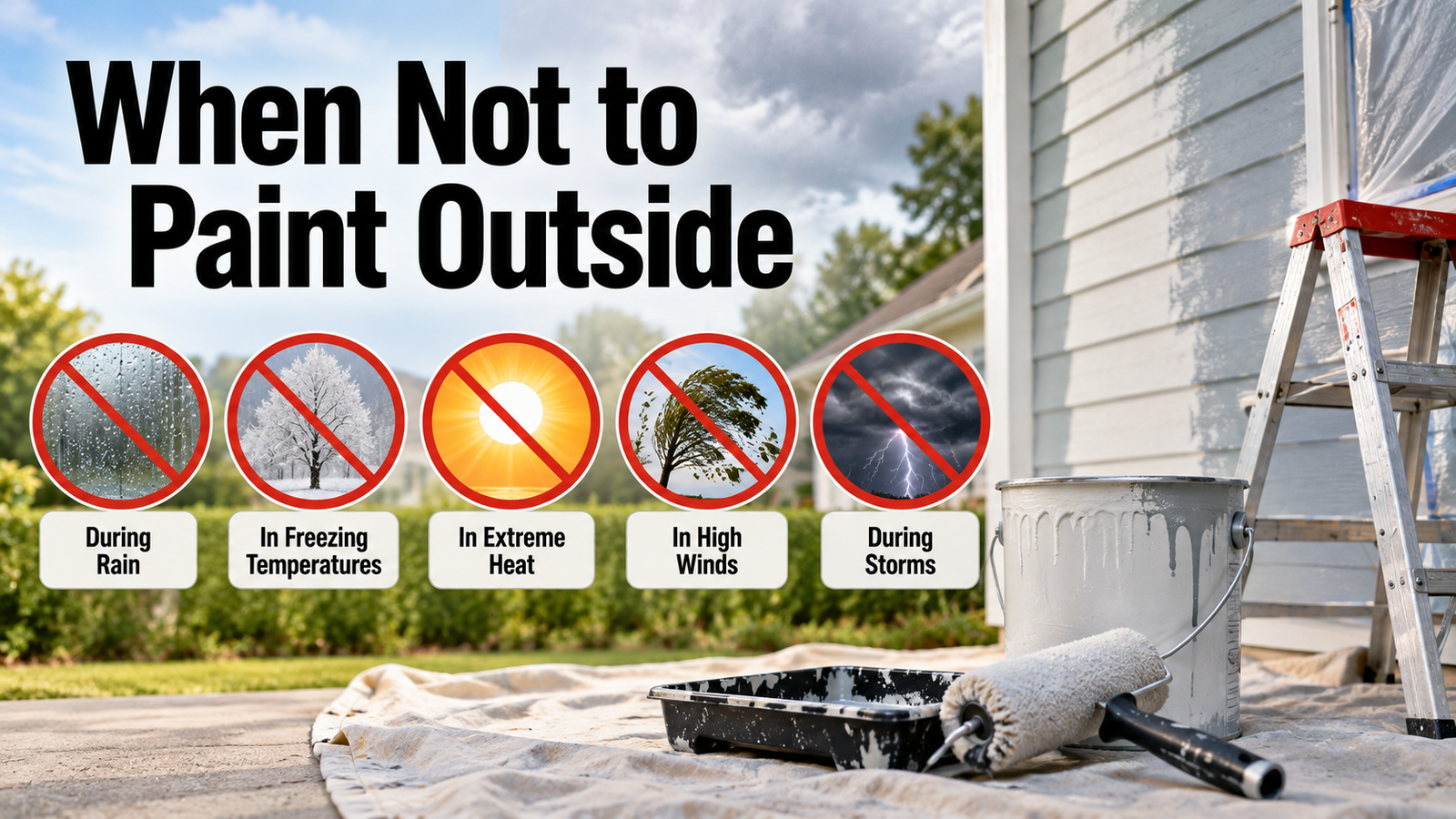

Do not paint outside when it is too cold, too hot, too humid, or too wet. In plain numbers, skip the job when the temperature is below about 50°F or above 85 to 90°F, when humidity climbs past roughly 70%, when rain is in the forecast within 24 hours, or when the surface sits within 5°F of the dew point. Painting in the wrong conditions is the fastest way to end up with peeling, blistering, or streaky paint, no matter how good the product is.
- The short answer: conditions to avoid
- When it is too cold to paint outside
- When it is too hot to paint outside
- When it is too humid, and the dew point rule
- When rain or wet surfaces rule it out
- When wind makes it a bad idea
- Wrong time of day and direct sun
- Worst seasons for exterior painting
- Conclusion
- Frequently asked questions
- Related Articles
Timing an exterior job is as much about the weather as it is about the paint. This guide walks through each condition that should make you put the brush down, with the thresholds that actually matter and why each one causes problems.
The short answer: conditions to avoid
Here is the quick version before we get into the why. Hold off on painting outside in any of these situations:
| Condition | Avoid when | Why it fails |
| Cold | Below ~50°F (or the paint’s rated minimum) | Paint can’t form a proper film; poor adhesion, cracking |
| Heat | Above ~85–90°F or hot to the touch | Dries too fast, skins over before it bonds, leaves marks |
| Humidity | Above ~70% | Slows drying, traps moisture, causes blistering and mildew |
| Dew point | Surface within 5°F of the dew point | Condensation forms under the film, ruining adhesion |
| Rain | Rain due within 24 hours, or wet surface | Washes off or blisters uncured paint |
| Wind | Above ~8–15 mph | Blows debris into paint and dries it unevenly |
When it is too cold to paint outside
Cold is one of the most common reasons a paint job fails. Most standard exterior paints need the air and surface to stay at or above about 50°F, not just while you paint but for the next 24 hours or so as the paint cures. When it is colder than that, the paint cannot form a solid film, which leads to weak adhesion, cracking, and flaking down the line.
The overnight low matters as much as the daytime high. If you paint on a mild 50°F afternoon but the temperature drops near freezing after sunset, the fresh paint can be ruined before it sets. Latex paint that freezes may never cure properly. A good rule is to make sure it will stay above the paint’s minimum for a full day, and ideally that you are painting into a warming trend, not ahead of a cold snap.
Cold-weather latex paints rated down to about 35°F exist and can stretch the season. Even so, watch both the temperature and the dew point closely, because the cure window is much less forgiving in the cold.
When it is too hot to paint outside
Heat causes the opposite problem: the paint dries too fast. When a surface is very hot, the top of the paint skins over before the layer underneath can bond, which traps solvents, leaves visible brush and roller marks, and can cause bubbles or early peeling. Most paints start to struggle once air temperatures climb into the 90s.
The surface temperature is the real number to watch, and it is often much higher than the air. A dark wall in direct afternoon sun can reach well over 100°F on an 80°F day. A simple field test: if the surface is too hot to keep your hand on comfortably, it is too hot to paint. An inexpensive infrared thermometer takes the guesswork out.
When it is too humid, and the dew point rule
High humidity keeps paint from drying because the air is already full of moisture and cannot absorb the water evaporating out of the paint. Above roughly 70% relative humidity, drying slows, moisture gets trapped in the film, and you invite blistering, poor adhesion, and mildew. A working range of about 40% to 70% humidity gives the most predictable results.
The more precise measure is the dew point, the temperature at which moisture in the air condenses onto surfaces. The widely used standard is to paint only when the surface temperature is at least 5°F above the dew point. Benjamin Moore’s exterior temperature guide explains this rule and notes that a dark wall in the sun can sit well above air temperature, which is worth checking with a thermometer.
When the surface drops within a few degrees of the dew point, invisible moisture forms under the paint and sabotages the bond. This is why paint applied late in the day so often fails: the surface cools toward evening, slips near the dew point, and dew settles into a coat that has not finished drying.
When rain or wet surfaces rule it out
Never paint if rain is expected within 24 hours, and do not paint a surface that is still damp from rain, dew, or washing. Fresh paint needs several hours of dry conditions to set. Rain that arrives too soon can wash streaks into the finish, cause blistering, or lift the paint off entirely.
After you clean or pressure-wash siding, give it enough time to dry all the way through before you open a can. Wood and other porous surfaces can hold moisture inside even when they look dry on the outside, and that trapped moisture leads to bubbling and peeling later.
Check an hourly forecast, not just the daily summary. You want a dry window that covers both the painting time and the hours the paint needs to set before any evening dampness or rain rolls in.
When wind makes it a bad idea
Wind is easy to overlook, but a breezy day causes two problems. It blows dust, pollen, leaves, and grit onto wet paint, and it dries the paint unevenly by pushing air across the surface faster in some spots than others. Both leave a rough, patchy finish.
A light breeze under about 8 mph is fine and can even help drying. Once wind gets much stronger, into the 15 mph range, it starts to affect the finish, and on a ladder it becomes a safety issue too. If the day is gusty, it is usually better to wait.
Wrong time of day and direct sun
Even on a mild day, painting in direct sun causes trouble. Sunlight heats the surface far above the air temperature and makes the paint flash dry, which locks in marks and streaks. The fix is to follow the shade: paint the west-facing wall in the morning while it is still shaded, and the east-facing wall in the afternoon, so you are never painting a surface baking in direct sun.
Time of day matters at both ends. Starting too early can mean painting over morning dew that has not burned off. Finishing too late leaves fresh paint exposed to the damp air and dew that settle in as the surface cools overnight. Aim to work the dry, mild hours of mid-morning through mid-afternoon, and stop with enough daylight left for the paint to set.
Worst seasons for exterior painting
Winter is the season to avoid in most of the country. Daytime highs rarely stay above 50°F long enough, and overnight freezes are almost certain, so standard exterior paint cannot cure. The peak of a hot, humid, stormy summer is the other tough stretch, since high heat and humidity work against a clean finish nearly every day.
Spring and fall usually offer the best windows, with milder temperatures, lower humidity, and fewer storms. That said, the calendar is only a starting point. The real test is the conditions on the day, so check the temperature, humidity, dew point, and forecast for a stable 24 to 48 hour dry stretch before you commit to a job.
Conclusion
Skip exterior painting when it is below about 50°F, above 85 to 90°F, more humid than roughly 70%, within 24 hours of rain, or when the surface is within 5°F of the dew point, and avoid wind, direct sun, and the cold of winter. Check the temperature, humidity, dew point, and hourly forecast, and aim for a stable dry window in spring or fall. Get the conditions right and the paint bonds cleanly and lasts for years instead of failing in a season.
Frequently asked questions
What is the lowest temperature to paint outside?
Most standard exterior paints need at least 50°F during application and for about 24 hours after. Some cold-weather latex formulas are rated down to 35°F, but you still need the temperature to stay above freezing overnight.
Can you paint outside when it is humid?
Light humidity is fine, but above about 70% the paint dries slowly and can blister or grow mildew. Also keep the surface at least 5°F above the dew point so moisture does not condense under the film.
How long should it be dry before it rains?
Give the paint at least 24 hours of dry weather before rain. Latex is dry to the touch in an hour or two, but it needs far longer to cure enough to resist water without washing or blistering.
Is it bad to paint in direct sunlight?
Yes. Direct sun overheats the surface and makes paint dry too fast, trapping brush marks and causing peeling. Follow the shade around the house so you are always painting a surface out of direct sun.
What is the best season to paint a house exterior?
Spring and fall are usually best, with mild temperatures, lower humidity, and fewer storms. Whatever the season, confirm a stable 24 to 48 hour dry window and check the dew point before starting.
Related Articles
How Many Gallons of Paint to Paint a Car?
Is Paint Flammable? What You Need to Know
Does Paint Expire? Complete Guide to Shelf Life, Signs & Storage Tips