
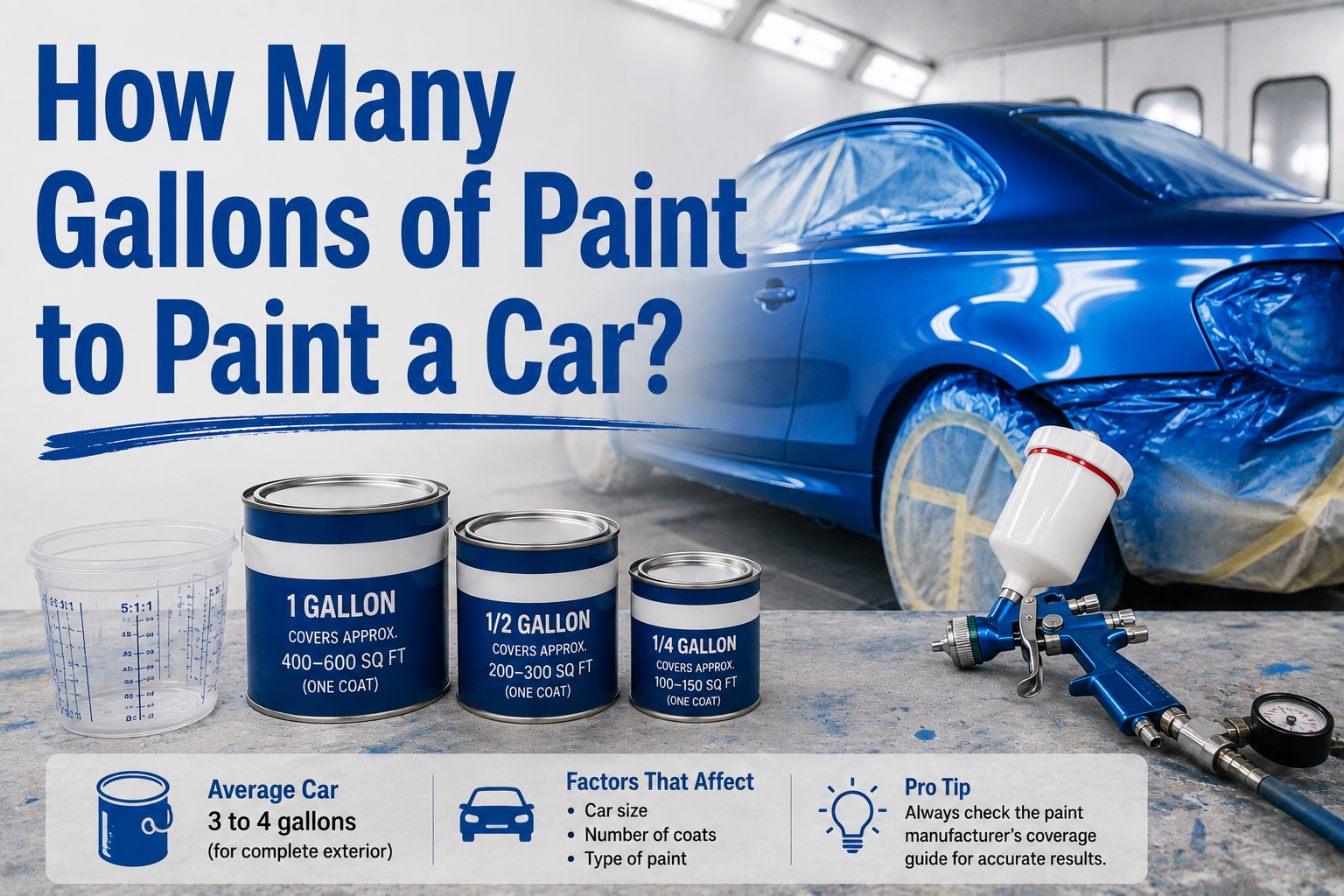

If you’re planning a DIY respray, the first practical question is how many gallons of paint you need to paint a car — and the honest answer is that it depends on your vehicle’s size, the paint system you choose, and the color you’re switching to. As a general rule, most passenger cars need somewhere between 1 and 3 gallons of total paint material (color plus clear coat), while larger trucks, vans, and SUVs can require 4 gallons or more.
- Quick Answer: Gallons of Paint by Vehicle Size
- What Determines How Much Paint Your Car Needs
- Vehicle Size and Body Style
- Single-Stage vs. Basecoat/Clearcoat Systems
- Color Change vs. Same-Color Respray
- Paint Color and Coverage
- Your Spray Equipment and Skill Level
- How Many Gallons of Paint to Paint a Car, By Type
- Motorcycles and Small Roadsters
- Compact and Midsize Sedans
- Full-Size Sedans and Small SUVs
- Mid-Size to Full-Size SUVs
- Pickup Trucks
- Vans and Oversized Vehicles
- Don’t Forget Primer, Sealer, and Reducer
- How to Calculate Your Own Paint Needs
- How Much Does a Car Paint Job Cost, Based on Gallons?
- Tips to Avoid Buying Too Much or Too Little Paint
- Frequently Asked Questions
- Conclusion
- Related Articles
Below, we’ll break that down by vehicle type, paint system, and color, then walk through a simple method for calculating your exact needs so you don’t overspend or run short mid-job.
Quick Answer: Gallons of Paint by Vehicle Size
| Vehicle Type | Single-Stage Paint | Basecoat + Clearcoat |
|---|---|---|
| Motorcycle / small roadster | 0.5–0.75 gallon | 0.5 gal base + 0.5 gal clear |
| Compact car (Civic, Corolla) | 1.5–2 gallons | 1 gal base + 1 gal clear |
| Midsize/full-size sedan | 2–2.5 gallons | 1.5 gal base + 1–1.5 gal clear |
| SUV or crossover | 2.5–3 gallons | 2 gal base + 1.5–2 gal clear |
| Pickup truck | 3–3.5 gallons | 2.5 gal base + 2 gal clear |
| Full-size van | 4–5 gallons | 3–3.5 gal base + 2.5–3 gal clear |
These figures assume two to three coats of color and clear, plus a reasonable buffer for practice and touch-ups. Treat them as a starting point — the sections below explain how to fine-tune your estimate.
What Determines How Much Paint Your Car Needs
Vehicle Size and Body Style
This is the biggest factor. A two-door compact simply has far less painted surface area than a crew-cab pickup or a cargo van, so paint volume scales directly with the vehicle’s footprint, height, and number of body panels.
Single-Stage vs. Basecoat/Clearcoat Systems
Single-stage paint combines color and gloss in one product, so you buy one material and apply it in multiple coats. Basecoat/clearcoat systems split the job into two products: a color-only basecoat (which needs fewer coats since it isn’t providing UV protection or shine) and a separate clearcoat that adds durability and depth. Basecoat systems often use less color material overall, but you’re now buying two products instead of one, and the clearcoat volume adds up quickly on larger vehicles.
Color Change vs. Same-Color Respray
Repainting a car the same color it already is typically requires less material because you’re not fighting to hide the old finish. A dramatic color change — dark to light, or vice versa — usually needs extra coats of basecoat (and sometimes a tinted primer-sealer) to achieve solid, even hide, which can push your total up by 25–50%.
Paint Color and Coverage
Solid colors like white, black, and red generally cover in fewer coats than metallics, pearls, or candy colors, which are applied in thin, controlled layers to avoid mottling or tiger-striping. If you’re going with a metallic or tri-coat finish, budget extra basecoat material accordingly.
Your Spray Equipment and Skill Level
HVLP (High Volume Low Pressure) guns transfer paint onto the panel more efficiently than older conventional guns, meaning less overspray and less wasted material. First-time painters should still plan for 10–20% extra paint to account for dialing in gun settings, test panels, and the inevitable learning curve.
How Many Gallons of Paint to Paint a Car, By Type
Motorcycles and Small Roadsters
Small-bodied vehicles like motorcycles, Miatas, and vintage roadsters have the least surface area of anything on this list. A half-gallon to three-quarters of a gallon of single-stage paint is usually plenty, and basecoat/clearcoat jobs often need well under a gallon of each component.
Compact and Midsize Sedans
For everyday cars like a Honda Civic, Toyota Corolla, or Ford Fusion, plan on 1.5 to 2 gallons of single-stage paint, or roughly 1 gallon of basecoat paired with 1 gallon of clearcoat. This is the most common category DIY painters tackle, and most paint suppliers sell “gallon kits” sized specifically for this range.
Full-Size Sedans and Small SUVs
Step up to a Camry, Malibu, or Subaru Outback and you’re looking at 2 to 2.5 gallons of single-stage paint, or about 1.5 gallons of basecoat with 1 to 1.5 gallons of clearcoat. Extra trim, larger bumpers, and more wraparound surface area account for the bump.
Mid-Size to Full-Size SUVs
Vehicles like a Ford Explorer, Jeep Grand Cherokee, or Honda Pilot sit taller and have more total panel area, pushing single-stage needs to 2.5–3 gallons, or roughly 2 gallons of basecoat with 1.5–2 gallons of clearcoat.
Pickup Trucks
Trucks like the F-150, Silverado, or RAM 1500 have large flat panels, beds, and tailgates — all of which add up. Expect 3 to 3.5 gallons of single-stage paint, or about 2.5 gallons of basecoat with 2 gallons of clearcoat. Extended or crew cabs, and anyone painting inside the bed, should round up.
Vans and Oversized Vehicles
Full-size vans (Transit, Sprinter, Express) have the most surface area of any common vehicle type, typically requiring 4 to 5 gallons of single-stage paint, or 3–3.5 gallons of basecoat plus 2.5–3 gallons of clearcoat. High-roof or extended-length versions should be estimated on the higher end of that range.
Don’t Forget Primer, Sealer, and Reducer
Paint totals alone don’t tell the whole story. Most full respray jobs also require:
- Primer/surfacer — typically 1 gallon for a sedan-sized vehicle, more for trucks and SUVs, especially if you’re working down to bare metal or filler.
- Sealer — a thin coat between primer and color that improves adhesion and color consistency; usually a quart to a gallon depending on vehicle size.
- Reducer or hardener/activator — mixed into single-stage and urethane paints at ratios set by the manufacturer (commonly 4:1 or 3:1), which adds sprayable volume beyond the raw paint you purchase.
When you’re pricing out a project, add these materials to your paint total rather than treating “gallons of paint” as the entire shopping list.
How to Calculate Your Own Paint Needs
The estimates above work for most standard jobs, but if you want a number specific to your vehicle, follow this process:
- Estimate your paintable surface area. Multiply the car’s overall length by its width, then add the hood, roof, trunk, doors, and bumpers as rough rectangles. Most sedans land between 350–450 square feet of total panel area once you account for both sides and curved surfaces.
- Check your paint’s stated coverage rate. Most automotive paints cover 250–400 square feet per gallon per coat, depending on the product and how it’s reduced. This number is on the technical data sheet from your paint supplier.
- Multiply by your number of coats. A typical job uses 2–3 coats of color and 2–3 coats of clear. If a gallon covers 300 square feet per coat and your car has 400 square feet of surface, one coat needs about 1.3 gallons — so three coats need roughly 4 gallons of sprayable material (paint plus reducer/activator combined, not raw paint alone).
- Add a 15–20% buffer. This covers overspray, test panels, and any touch-ups after final assembly.
Worked example: A midsize sedan with 400 square feet of surface area, sprayed with a basecoat that covers 350 sq ft per gallon per coat, needs about 1.15 gallons per coat. At 2 coats, that’s roughly 2.3 gallons of sprayable basecoat mixture — which, after reducing to spray viscosity, often works out to purchasing 1 to 1.5 gallons of raw basecoat concentrate, consistent with the ranges in the table above.
How Much Does a Car Paint Job Cost, Based on Gallons?
Material costs vary widely by brand and finish, but as a rough planning guide:
- Single-stage urethane: roughly $150–$300 per gallon
- Basecoat: roughly $150–$350 per gallon (more for metallics, pearls, and custom mixes)
- Clearcoat: roughly $120–$250 per gallon
- Primer/sealer: roughly $100–$200 per gallon
For a midsize sedan using basecoat/clearcoat (about 1 gallon of each, plus primer), total paint material costs typically fall between $400 and $800 before factoring in reducers, hardeners, sandpaper, tape, and spray gun supplies. Trucks and vans can push materials-only costs well past $1,000.
Tips to Avoid Buying Too Much or Too Little Paint
- Buy your color coat in one batch. Metallics and custom mixes can vary slightly between production runs, so purchasing all your basecoat at once helps avoid visible color shifts between panels.
- Round up on clearcoat, not color. Clearcoat is easier to use extra of (it protects and adds gloss) without changing your car’s appearance, so it’s the safer place to overbuy slightly.
- Ask about return policies before ordering extra color. Some paint suppliers will accept unopened cans back; others won’t, especially for custom-mixed colors — check before you over-order.
- Spray a test panel first. This tells you how far your specific paint, gun, and technique actually stretch before you commit the whole job.
- Keep a labeled leftover can. Save a small amount of your exact mixed color for future touch-ups, since re-mixing an identical match later can be difficult.
Frequently Asked Questions
How many gallons of paint does it take to paint a whole car? Most passenger cars need 1 to 3 gallons of total paint material (color plus clearcoat combined), depending on size and paint system. Compact cars sit at the lower end; SUVs and trucks need more.
Is one gallon of paint enough to paint a car? One gallon can be enough for a compact car if you’re using a basecoat/clearcoat system, since the basecoat portion alone may only need 1 gallon. For single-stage paint or larger vehicles, one gallon is usually not enough on its own.
How many gallons of paint do I need for a truck? Standard pickup trucks typically need 3 to 3.5 gallons of single-stage paint, or about 2.5 gallons of basecoat plus 2 gallons of clearcoat. Larger crew-cab trucks and vans need more.
Do I need more paint for a color change than a same-color respray? Yes. Changing to a significantly different color usually requires extra basecoat coats — and sometimes a tinted sealer — to fully hide the original finish, which can add 25–50% more color material to your total.
How much clear coat do I need compared to basecoat? Clearcoat needs are similar to or slightly less than basecoat needs by volume, since clear typically goes on in 2–3 coats just like color. On most vehicles, plan for roughly the same gallon amount of clear as you’re buying in basecoat, rounding up slightly for safety.
Can I just buy a quart to touch up a small area? Yes — quarts and even smaller aerosol cans work fine for spot repairs, small panels, or touch-ups. Gallon quantities only become necessary once you’re covering an entire vehicle or multiple large panels.
Conclusion
Getting the gallon count right before you start is what separates a smooth, well-covered paint job from a mid-project supply run — or a garage full of leftover paint you’ll never use. As a baseline, budget 1.5 to 2 gallons for a compact car, 2 to 3 gallons for a midsize sedan or SUV, and 3 to 5 gallons for a truck or van, adjusting up for color changes, metallic finishes, and beginner overspray.
Don’t forget to add primer, sealer, and reducer to your total material list and cost estimate. If you’re ready to start your project, measure your vehicle’s panels, check your chosen paint’s coverage rate per gallon, and order with a 15–20% buffer so you can finish the job in one confident, uninterrupted session.
Related Articles
How to Make Puffy Paint at Home: A Complete Guide
What Is Eggshell Paint? A Complete Guide to Finish, Uses, Pros & Cons
What Is Latex Paint? Meaning, Types & Uses Explained
Is Acrylic Paint Washable? Complete Guide to Removing It From Any Surface