
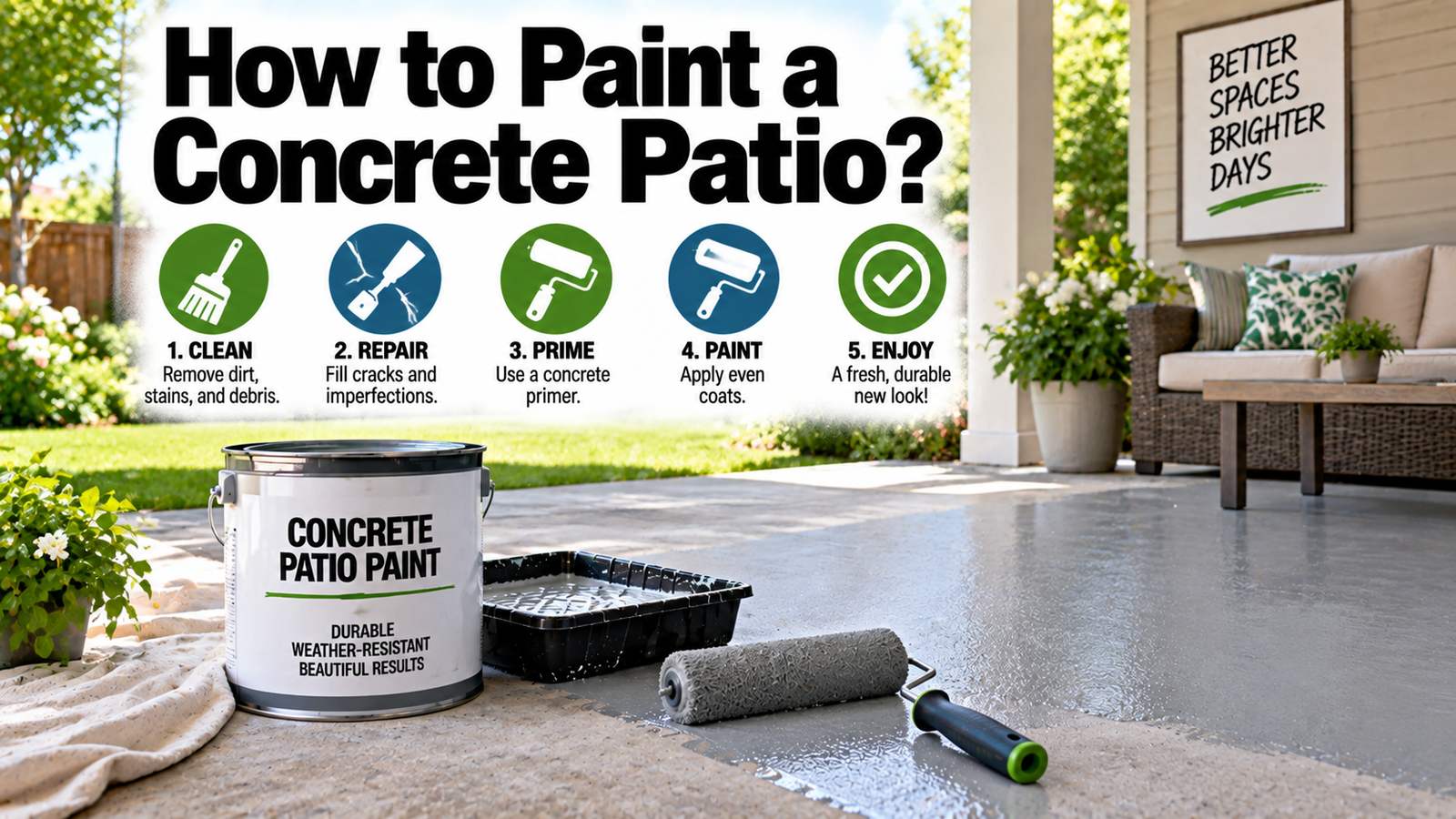

To paint a concrete patio, clean and etch the bare slab, fill any cracks, prime it, then roll on two thin coats of concrete paint, letting each one dry fully before the next. That’s the whole job in one line. The part most people get wrong isn’t the painting, it’s the prep. Get the surface right and a rolled-on finish is quick and satisfying. Skip it and the paint peels within a season. This guide walks you through each step in order, with real timing so you can plan your weekend.
- What you need before you start
- Step 1: Clear and deep-clean the patio
- Step 2: Etch the concrete
- Step 3: Fill cracks and let it dry
- Step 4: Prime the surface
- Step 5: Paint two coats
- Which paint should you use?
- How long does it take, and what does it cost?
- How to make the paint last
- Conclusion
- Frequently asked questions
- Related Articles
What you need before you start
Gather your supplies first so you’re not running to the store mid-project. Here’s the short list:
- Cleaning gear: a stiff broom or leaf blower, a scrub brush, and a pressure washer if you have one (a garden hose and elbow grease also work).
- Concrete cleaner or degreaser to lift dirt and oil out of the pores.
- An etching solution to open up the surface so paint can grip.
- Concrete crack filler and a putty knife for repairs.
- Concrete bonding primer.
- Concrete or masonry paint (more on picking the right one below).
- A roller with an extension pole, a brush for edges, painter’s tape, and a tray.
- Safety gear: gloves, eye protection, and a mask, since etching solutions contain acid.
For paint, plan on one gallon covering roughly 350 to 400 square feet in a single coat. You’ll do two coats, so measure your patio and buy accordingly. A standard 400 square foot patio usually needs two gallons.
Step 1: Clear and deep-clean the patio
Cleaning is the single most important step, so don’t rush it. Move all the furniture and planters off the slab, then sweep or blow away leaves, dust, and loose grit. Next, wash the surface. A pressure washer does the best job on porous concrete, but a hose with a stiff brush and some concrete cleaner works too.
Apply the cleaner, give it about 20 to 30 minutes to break down grime, scrub it in, then rinse everything off. Oil and grease spots need a degreaser or they’ll bleed through your paint. Once it’s clean, let the patio dry completely before you go further. Bare concrete can hold moisture longer than it looks.
Quick test: pour a little water on the concrete. If it beads up, there’s an old sealer or coating you’ll need to strip or etch off first. If it soaks in, you’re working with bare concrete and can move on.
Step 2: Etch the concrete
Etching opens up the tiny pores in the concrete so the primer and paint can lock in. On a smooth or previously sealed slab, this is what stops the paint from peeling later. Pour the etching solution on in small batches, or use a pump sprayer, and scrub it in with a brush or floor scrubber.
You might see a little fizzing or hear a sizzle. That’s the acid reacting, and it’s normal. Keep it off your skin and out of your eyes. When you’re done, rinse thoroughly and let the surface dry. Give it a full 24 hours at least. This step is easy to skip and easy to regret, so don’t.
Step 3: Fill cracks and let it dry
Now fix the flaws. Press concrete crack filler into any cracks or chips with a putty knife and smooth it flush with the surface. Filling first means your finished patio looks even instead of patched.
Cracks and repairs need real drying time, often up to 48 hours, before you paint over them. Check the product label. Painting over a damp repair traps moisture and leads to bubbling down the line.
Step 4: Prime the surface
Primer is the bridge between concrete and paint, and on a porous slab it makes a real difference in how well the color sticks and how long it lasts. Use a concrete bonding primer. Most go on thin and milky and roll out easily.
Tape off the edges of the house, posts, or anything you don’t want painted. Cut in the borders with a brush, then roll the primer across the open area. Let it dry per the label, usually around four hours, before your first coat of paint.
Step 5: Paint two coats
This is the fast, fun part. Pour the paint into a tray, cut in the edges and any cracks with a brush, then roll the rest in even, overlapping strokes. On a horizontal surface you can pour a little directly and spread it out. A single coat goes on in about 15 to 20 minutes for a small patio.
Here’s where patience pays off. Let the first coat dry before the second. Most acrylic and latex concrete paints feel dry to the touch in 30 to 60 minutes and are ready for a second coat in 2 to 4 hours. Two thin coats always beat one thick one. They cover better, level out, and hold up longer.
Keep in mind that outdoor paint reads lighter than the sample, and lighter still on a flat surface catching the sky. If you’re between shades, going one step darker often lands closer to what you pictured.
Which paint should you use?
Use paint made specifically for concrete or masonry. Regular exterior house paint tends to crack and peel on a slab because it can’t flex the way concrete does as it heats up and cools down. Concrete-rated paints contain binders built to expand and contract with the surface.
Here’s how the main options compare:
| Type | Best for | What to expect |
| Acrylic latex | Most home patios and porches | Easy to roll on, water cleanup, hides small flaws |
| Epoxy | Heavy wear, oil or grease, garage-style slabs | Very tough and stain-resistant, more prep and steps |
| Masonry | Rough or textured concrete | Thick body that fills tiny pits, good grip |
| Concrete stain | A natural, see-through color | Soaks in instead of coating, won’t peel, less prep |
For most patios, a low-luster acrylic latex porch and floor paint is the sweet spot: durable, forgiving, and easy to apply. If your slab takes heavy abuse or you want maximum stain resistance, an epoxy-based coating steps it up. A popular choice like Behr Porch & Patio Floor Paint can be tinted to almost any color and often covers well, though textured concrete still needs a brush to work paint into the low spots.
How long does it take, and what does it cost?
Plan for the project to span several days, not a single afternoon. The painting itself is quick. The waiting is what stretches it out. Between cleaning, etching, crack repair, priming, and two coats, each with its own drying window, most people spread the job across 6 to 7 days start to finish.
There’s also a difference between dry and cured. Your patio feels dry within hours, but acrylic and latex paints take two to three weeks to fully cure and reach their hardest, most scuff-resistant state. Walk on it gently after a day or two, but hold off on dragging heavy furniture back for a couple of weeks.
Cost-wise, doing it yourself is cheap. Materials for a typical patio run about $150 to $200 total, which works out to roughly $2 to $6 per square foot depending on the paint you choose. Hiring a pro adds labor on top of that. A good concrete paint gallon usually costs somewhere between $30 and $50.
How to make the paint last
A painted patio typically holds up for 3 to 5 years, with high-traffic paths wearing first. A few habits stretch that out:
- Paint in good weather. Aim for mild temperatures, ideally between 50 and 90 degrees, and check the forecast. You want at least 24 to 48 hours of dry weather after your last coat, and no rain on wet paint.
- Add a sealer. A clear concrete sealer over the cured paint adds a protective layer against UV, water, and foot traffic.
- Keep it clean. Sweep regularly and rinse off spills so grit doesn’t grind away the finish.
- Touch up early. Catch small worn spots and repaint them before they spread into peeling patches.
For grip on a surface that gets wet, look for a paint with an anti-skid additive or mix one in, especially near a pool or steps.
Conclusion
Painting a concrete patio comes down to prep and patience. Clean the slab well, etch it, fill cracks, prime, then roll two thin coats of concrete-rated paint and let each dry. Expect the job to span several days and the finish to last 3 to 5 years with a little upkeep. Do the boring steps properly and you get an even, durable color that turns a tired gray slab into a space you actually want to sit on.
Frequently asked questions
Do I need to etch concrete before painting?
Yes, on smooth or previously sealed concrete. Etching opens the pores so paint can grip and not peel. If a water test shows the surface has an old coating, strip or etch it first. Bare, porous concrete still benefits from etching for a longer-lasting bond.
How long should paint dry before a second coat?
For most acrylic and latex concrete paints, wait 2 to 4 hours between coats. The surface should feel dry to the touch first. Check the label, since exact times vary by product, temperature, and humidity. Cooler or damp weather stretches the wait.
Can you paint a concrete patio without priming?
You can, but you shouldn’t. Primer bonds the paint to porous concrete and dramatically improves how long the finish lasts. Skipping it is the fastest route to peeling. A concrete bonding primer is cheap insurance for the whole project.
How long does a painted concrete patio last?
Usually 3 to 5 years, with heavy-traffic areas wearing first. A clear sealer over the paint, regular cleaning, and early touch-ups all extend that. Good prep at the start matters more than anything for how long the finish holds up.
What’s the best paint for a concrete patio?
A low-luster acrylic latex porch and floor paint suits most patios: durable, easy to apply, and good at hiding flaws. For heavy wear or oil resistance, choose an epoxy-based coating. Avoid regular exterior house paint, which cracks and peels on concrete.
Related Articles
How to Paint a Garage Floor: Step-by-Step Guide