
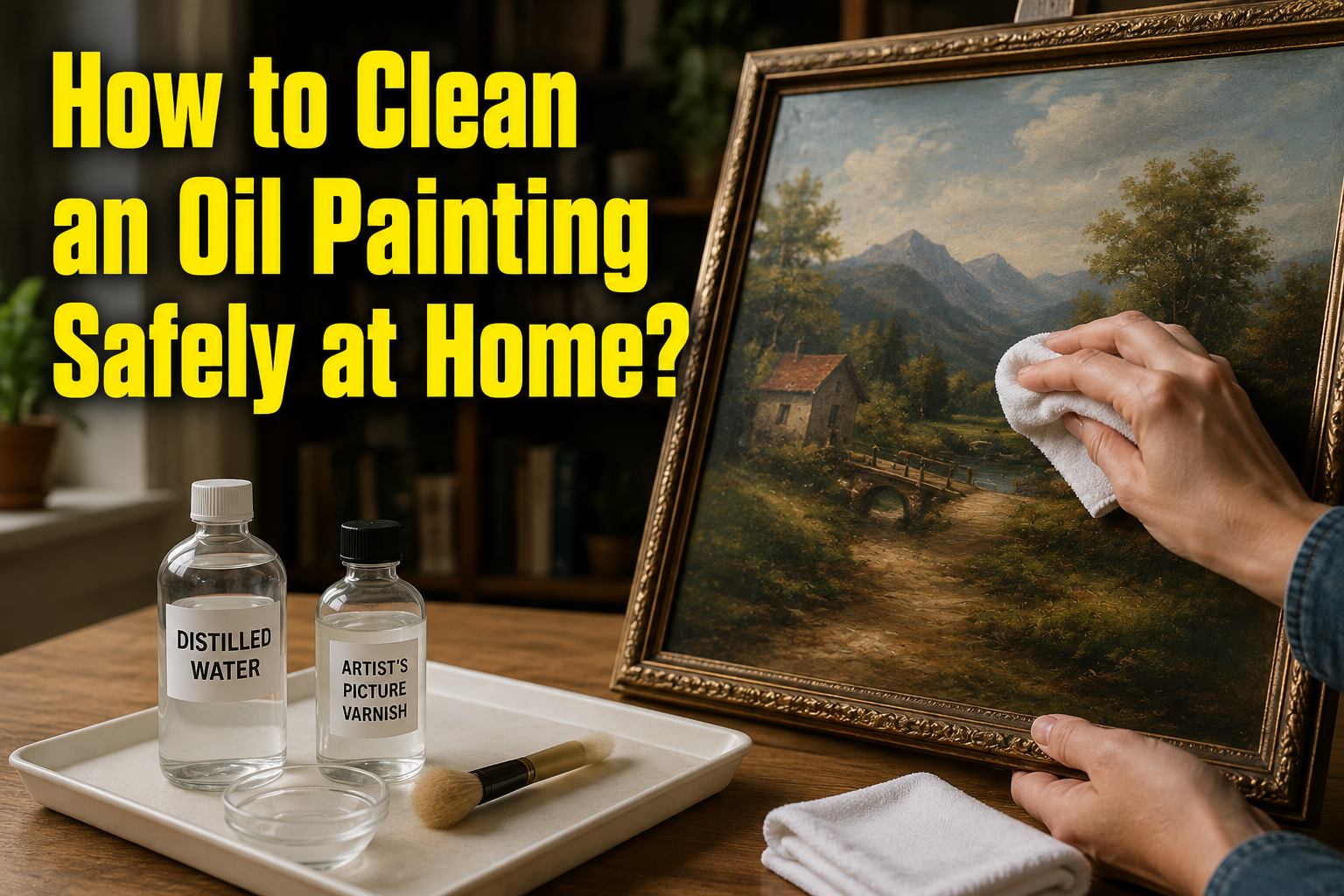

The safe way to clean an oil painting at home is to gently dust it with a soft, dry brush. That lifts the film of dust and cobwebs that dulls a painting, without putting the paint itself at risk.
Everything past dusting, water, soap, solvents, and especially removing the yellowed varnish, is irreversible work that belongs to a professional conservator. Conservators have a saying worth remembering: neglect is safer than inexpert cleaning. When in doubt, do less.
This guide walks through the one method you can safely use at home, dry dusting, plus how to inspect and protect the painting, what you must never put on it, and how to tell when a piece needs a conservator instead of a brush.
Why you have to be careful: cleaning cannot be undone?
An oil painting is built in layers: a support such as canvas or a wood panel, a ground or primer, the paint, and usually a clear varnish on top. Most of the dust and grime you see rests on that varnish, which is meant to be a protective, replaceable layer. The familiar yellow or brown haze on an older painting is usually that varnish darkening with age, not the colors underneath.
That layered structure is also why cleaning is best left mostly alone. Because the varnish is designed to be renewed, a conservator can dissolve an old, yellowed coat and lay on a fresh one without touching the paint, using tests and materials chosen for that exact painting.
At home you have none of that, and the worst part is that damage often hides: a wipe today can loosen paint that only flakes away weeks or months later.
The reason to be careful is simple: cleaning a painting cannot be reversed, and even a cautious attempt can cause permanent damage. Water can swell and shrink the canvas and loosen paint so it flakes, sometimes weeks later.
Solvents that dissolve old varnish will just as happily dissolve paint. This is why serious cleaning, from removing grime to taking off yellowed varnish, is a conservator’s job, and why home care stops at gentle dusting, a limit spelled out in Natural Pigments’ best-practice notes on cleaning paintings.
Inspect the painting before you touch it
Before you do anything, look the painting over in good light. Check for paint that is cracking, lifting, or flaking, for tears, dents, or bulges in the canvas, for soft or powdery patches, and for any sign of mold.
Tilt a lamp so the light rakes across the surface from the side, which throws small shadows and makes lifting flakes and fine cracks much easier to see. If the surface is unstable in any way, stop and take it to a conservator, because even light dusting can knock loose paint off.
Take a photo first, so you can compare before and after and judge whether the piece needs a professional. Note whether it is varnished or bare, and whether it is on canvas, a panel, or paper. A bare, unvarnished painting, or an oil on paper, is far more fragile, so keep to the lightest dry dusting and never bring any moisture near it.
Set up and protect the painting
Give yourself room to work slowly. Take the painting off the wall and lay it flat on a padded surface, or prop it securely on an easel, in a clean, well-lit spot. Viewing it off the wall, in different light, also helps you see where the dirt actually is.
Slip a sheet of parchment paper or a clean cloth underneath to catch falling dust. Wear clean cotton or vinyl gloves so the oils on your fingers never touch the paint, and handle the painting by its edges.
Turn off fans and air vents so you are not blowing dust back onto the surface, and keep packing materials, tape, and anything sticky away from the front of the painting.
How to handle and move the painting safely?
How you carry a painting matters as much as how you dust it. Lift it with two hands by the frame or the wooden stretcher bars, never by the top edge alone and never with a hand pressed against the canvas, which can dent or crack the paint.
Keep your fingers off the painted surface, carry one piece at a time, and set it down face-up on a padded surface rather than leaning it face-first against anything rough.
How to dust an oil painting safely?
Gentle dry dusting is the one cleaning method that is safe to do yourself, and for most paintings it is all that is needed. Use a soft, clean, dry brush, a sable artist brush or a soft, natural-bristle brush is ideal.
Do not use a brush you have painted with, since dried paint on the bristles can mark the surface, and never use a stiff brush or a feather duster, whose bristles can scratch the paint or snag and lift raised areas.
Brush lightly with long, overlapping strokes, working first in one direction and then across it, so the dust lifts away rather than pressing in. Match the brush to the painting, a bigger soft brush for a large canvas so you are not there for hours, a small one for a little piece, and feel the bristles first to be sure they are soft and completely dry.
Tilt the top of the painting toward you a little so loose dirt falls down onto the parchment instead of resettling. Dust the frame and the back of the canvas gently as well. For the great majority of paintings, careful dusting like this is the whole job.
What about a damp cloth or a cleaner?
It is tempting to reach for a damp cloth or a mild cleaner when dusting does not lift a film, but this is where home cleaning goes wrong most often. Conservators advise keeping water and cleaners off a painting entirely, because moisture can lift paint, swell the canvas, and cause flaking that may not show up until later, and a damp cloth can catch and pull at raised brushwork.
Grimy smoke or nicotine films and any spots of mold are special cases that need a professional, since mold is both a health risk and a sign of moisture damage. If a stable, varnished painting still looks dull after a careful dusting, treat that as the moment to consult a conservator rather than experiment. Keep your own cleaning dry, and let a professional handle anything more.
Does it differ for old, modern, or unvarnished paintings?
The dusting method is the same, but a few types deserve extra care. An older varnished painting is the one most likely to look yellow or grimy, and that is exactly the coat a conservator can safely renew.
A modern or contemporary oil is often left unvarnished, so there is no protective layer between your brush and the paint, and a thick, textured impasto surface has raised ridges that snag easily. An oil sketch on paper is the most delicate of all. For any of these, keep strictly to the lightest dry dusting and never introduce moisture.
Never put these on a painting
Most damage to home-cleaned paintings comes from using the wrong thing. Keep all of these away from the surface:
- Household and glass cleaners, ammonia, and abrasive or cream cleansers, which strip varnish and dull the paint.
- Solvents of any kind, including turpentine, mineral spirits, rubbing alcohol, and acetone, which dissolve varnish and paint alike.
- Soap and water, and oils of any kind, which can swell the canvas, lift paint, or leave a residue that attracts more dirt.
- Kitchen remedies such as bread, raw potato, onion, garlic, or saliva, which are unpredictable and can pull at the paint or leave residue behind.
- Erasers, paper towels, tissues, rough rags, sponges, and feather dusters, which scratch the surface or shed onto it.
- Any attempt to remove yellowed varnish, retouch, or revarnish, which is irreversible conservation work.
The core rule: if gentle dry dusting will not do it, stop. Cleaning a painting cannot be undone, and neglect is far safer than an inexpert attempt. When there is any doubt about a painting’s value or condition, leave it untouched until a conservator can look at it.
When to call a professional conservator
Some jobs are simply not do-it-yourself. Take a painting to a conservator if it has any real financial, historical, or sentimental value, if the paint is cracking, lifting, or flaking, if there are tears, mold, or water damage, or if grime, yellowing, or a smoke and nicotine film will not come off with gentle dusting.
A conservator can test each layer, clean it safely, and revarnish it if needed, which is the care a valued painting deserves.
You can find a qualified specialist through the American Institute for Conservation’s find-a-professional tool, which lets you search by specialty, including paintings. Do not be surprised if a conservator recommends leaving a fragile painting as it is for now, because cleaning methods keep improving and an untouched painting can be treated more safely later.
Everyday care that keeps cleaning to a minimum
A little prevention means far less cleaning. Hang paintings out of direct sunlight and away from heat, damp, and grease, so not above a radiator, a fireplace, or a stove, and not in a steamy bathroom or kitchen.
Keep them off cold, damp exterior walls, which can trap moisture behind the canvas. Aim for steady temperature and humidity rather than big swings, which crack paint over time.
Dust the surface lightly once or twice a year, check any stored paintings now and then for dust or damp, keep your fingers off the paint, and for a precious piece, ask a framer about protective glazing to shield it from dust and smoke.
Conclusion
Cleaning an oil painting at home really means one thing done well: gentle dusting with a soft, dry brush. Inspect the painting first, protect it while you work, and keep water, soap, solvents, and kitchen tricks away from the surface entirely.
Anything a careful dusting will not fix, from grime to yellowed varnish, is a job for a conservator, not a cloth. Because cleaning cannot be undone, the safest approach is almost always to do less.
Frequently asked questions
Can I clean an oil painting with soap and water?
No. Conservators advise keeping water and soap off oil paintings, because moisture can swell the canvas and loosen paint so it flakes, sometimes later. Safe home cleaning means dry dusting with a soft brush, and nothing wet.
How do I remove the yellow tint from an old oil painting?
You usually cannot do this safely at home, because the yellow is aged varnish, and removing it means dissolving varnish without harming the paint. That is irreversible solvent work for a professional conservator, not a home task.
What is the safest way to dust a painting?
Use a soft, clean, dry brush, such as a sable brush, with light overlapping strokes, tilting the painting so dust falls away. Avoid feather dusters, stiff brushes, and dust cloths, which scratch or snag the paint.
Can I use bread or a potato to clean a painting?
It is best not to. These kitchen remedies are unpredictable and can leave residue or pull at the paint. Stick to gentle dry dusting, and let a conservator handle anything a dusting will not fix.
When should I take a painting to a conservator?
Whenever it is valuable, old, or sentimental, whenever the paint is cracking, flaking, or torn, or whenever grime, yellowing, smoke, or mold will not lift with gentle dusting. A conservator can treat it safely, and cleaning cannot be undone.
Related Articles
How to Make Skin Color With Paint (Easy Mixing Guide)
How to Clean Oil Paint Brushes (Solvent & Oil-Free)
How to Get Paint Off Concrete (Wet, Dried & Stubborn)
How to Remove Gold Leaf From Paper and Paintings?