
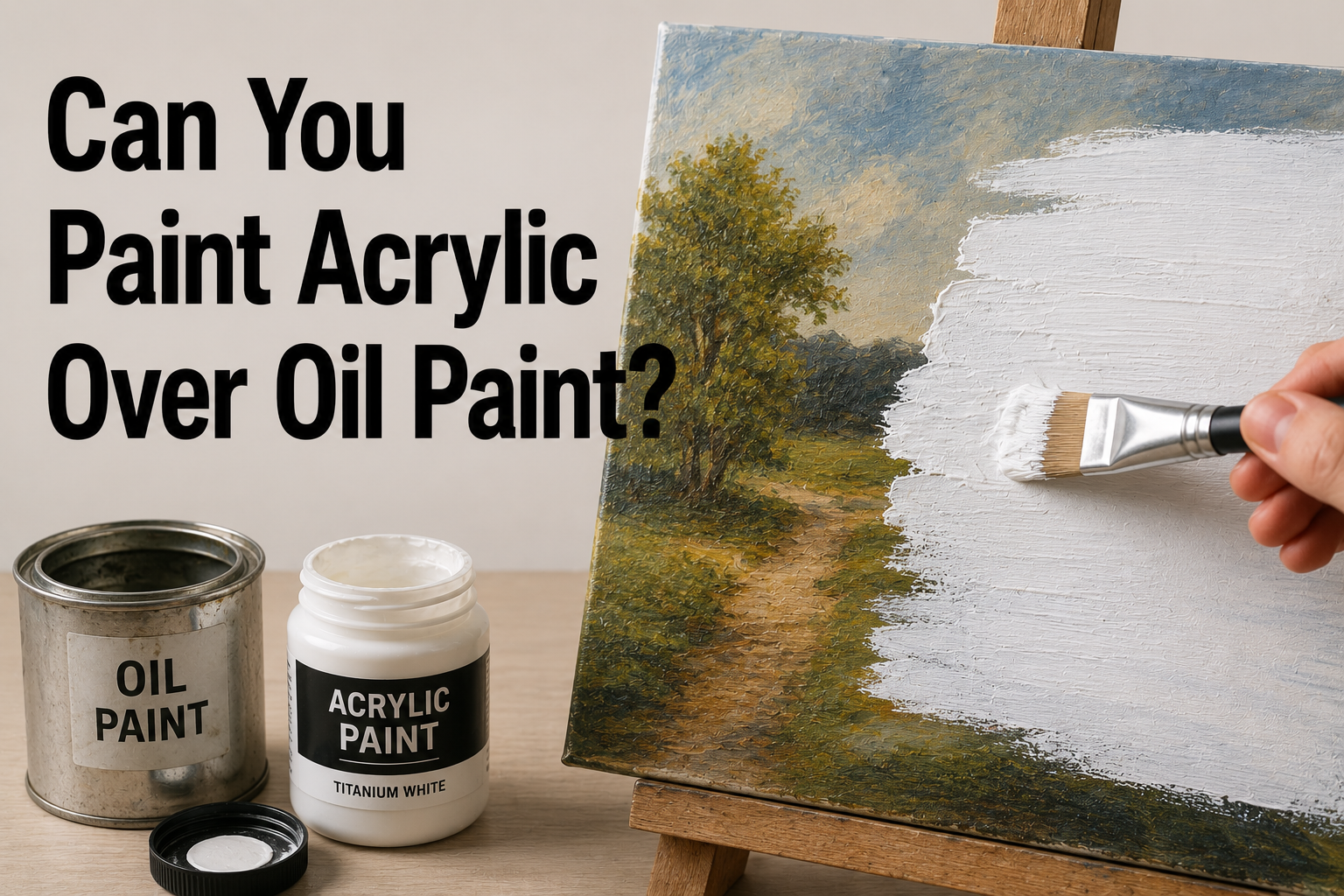

If you’ve ever picked up a can of acrylic paint and wondered, can you paint acrylic over oil paint, you’re not alone — and the honest answer depends on what you’re painting. Slap acrylic over a dried oil-based wall without prep, and it can peel within days. Try it on a fine art canvas, and it’s even riskier. But with the right prep (or the right technique swap), it is possible in most situations. Below, we’ll break down exactly when acrylic-over-oil works, when it doesn’t, and the step-by-step process to get a finish that actually lasts — whether you’re repainting a door frame or working on canvas.
- The Quick Answer: It Depends on What You’re Painting
- Why Acrylic Doesn’t Stick to Oil-Based Paint
- Oil and Water Repel Each Other
- Oil Paint Cures for Years, Not Days
- It Breaks the “Fat Over Lean” Rule
- The Surface Is Simply Too Smooth
- How to Tell If a Painted Surface Is Oil-Based
- Step-by-Step: Painting Acrylic (Latex) Over Oil-Based Paint on Walls, Trim, or Furniture
- Step 1: Clean the Surface Thoroughly
- Step 2: Let the Oil Paint Fully Cure
- Step 3: Deglass the Surface
- Step 4: Apply a Bonding Primer
- Step 5: Apply the Acrylic Topcoat
- Fine Artists: What to Do Instead of Acrylic Over Oil
- Common Mistakes to Avoid
- Frequently Asked Questions
- Final Thoughts
- Related Articles
The Quick Answer: It Depends on What You’re Painting
There are really two different questions hiding inside this one keyword, and the answer changes depending on which one you’re asking.
On Walls, Trim, Cabinets, or Furniture: Yes — With Proper Prep
Home painters switch from oil-based to acrylic (latex) paint all the time, usually because oil-based paints have become harder to find, take longer to dry, and release stronger fumes. This is completely doable, but only if you rough up the glossy oil surface and use a bonding primer designed for the switch. Skip that prep, and the acrylic paint will slide right off the slick, non-porous oil finish.
On a Fine Art Canvas: Not Recommended
For painters working in fine art, the rule flips. Oil paint contains linseed or another drying oil as its binder, and that oil layer never fully stops curing — it continues to harden and slightly shift for months or even years. Acrylic paint dries to a flexible plastic film almost immediately. Layering a fast-drying, inflexible acrylic skin on top of a slow-curing, still-moving oil layer sets the painting up to crack or flake, sometimes within weeks. The safe order for fine art is the opposite: oil over acrylic, never acrylic over oil.
Why Acrylic Doesn’t Stick to Oil-Based Paint
Understanding the “why” makes it much easier to prep correctly, whether you’re working on a wall or a canvas.
Oil and Water Repel Each Other
Acrylic paint is water-based. Dried oil paint is, essentially, a hardened film of oil. Water-based products struggle to grip an oily surface for the same reason a sauce won’t stick to a well-seasoned cast-iron pan — the surface actively resists it.
Oil Paint Cures for Years, Not Days
Oil paint feels dry to the touch within a few days to a couple of weeks, but conservators note that the chemical curing process (oxidation and polymerization) continues for a long time afterward, gradually changing the paint film’s density and flexibility. Sealing that still-curing layer under acrylic traps it and interferes with how it hardens.
It Breaks the “Fat Over Lean” Rule
Traditional oil painting follows a “fat over lean” principle: each layer should be more flexible (fattier) than the one beneath it, so the painting doesn’t crack as it ages. Acrylic dries to a rigid film almost instantly, so putting it over oil paint that’s still slowly curing underneath violates that rule and sets up long-term cracking.
The Surface Is Simply Too Smooth
Paint needs a bit of texture — what painters call “tooth” — to grip. Cured oil paint dries to a fairly smooth, low-porosity surface, giving the next coat very little to physically hold onto without help from sanding or a bonding agent.
How to Tell If a Painted Surface Is Oil-Based
Before you touch a wall, door, or piece of trim, confirm what you’re dealing with — old homes especially may have layers of oil-based paint underneath newer coats.
- Dampen a cotton ball with denatured alcohol or a mild household solvent.
- Rub it firmly on an inconspicuous spot of the painted surface for about 20–30 seconds.
- If paint comes off on the cotton ball, you’re dealing with latex/acrylic paint.
- If nothing transfers, the surface is very likely oil-based, and you’ll need the prep steps below.
If your home was built before 1978, have any peeling or sanded paint tested for lead before you start scraping or sanding it.
Step-by-Step: Painting Acrylic (Latex) Over Oil-Based Paint on Walls, Trim, or Furniture
Step 1: Clean the Surface Thoroughly
Wash the surface with a degreasing cleaner (TSP or a TSP substitute works well) to remove grease, dust, and grime. Rinse and let it dry completely — any residue will interfere with adhesion just as much as the oil paint itself.
Step 2: Let the Oil Paint Fully Cure
If the oil-based paint is freshly applied, wait at least a few weeks — ideally 30 days — before working over it. Painting too soon traps uncured paint underneath and invites peeling later.
Step 3: Deglass the Surface
Oil-based paint typically dries to a satin, semi-gloss, or gloss sheen, and that shine is exactly what acrylic paint can’t grip. Scuff-sand the entire surface with 150–220 grit sandpaper (or use a liquid deglosser/sanding solution for detailed trim) until the sheen turns matte and even. Wipe away all dust with a tack cloth.
Step 4: Apply a Bonding Primer
This is the step most DIY guides skip, and it’s the one that actually makes the switch reliable. Use a high-adhesion bonding primer or a shellac-based primer, both of which are formulated to grip glossy, non-porous surfaces like cured oil paint and give the topcoat something to hold onto. Apply one even coat and let it dry fully per the label’s instructions.
| Product Type | Best For | Typical Dry Time |
|---|---|---|
| Bonding primer (acrylic-based) | Walls, trim, doors | 1–4 hours |
| Shellac-based primer | Stains, glossy surfaces, odor-blocking | 30–45 minutes |
| Oil-based primer | Heavy stains, exterior wood | 8–24 hours |
Step 5: Apply the Acrylic Topcoat
Once the primer is fully cured, apply your acrylic (latex) paint in thin, even coats using a brush, roller, or sprayer, allowing recommended dry time between coats. Two coats will generally give you the most even, durable finish.
Fine Artists: What to Do Instead of Acrylic Over Oil
If you want the properties of both mediums in one painting, work in this order:
- Start with acrylics. Block in your composition, underpainting, and base colors in acrylic — it dries fast, so you can rework it quickly.
- Let the acrylic dry completely. This usually only takes minutes to a few hours, not weeks.
- Switch to oil paint for the final layers. Add your detail work, glazes, and blended passages in oil once the acrylic beneath is fully dry. Oil paint bonds well to a dried acrylic film and gives you longer working time for smooth transitions.
- Never go back to acrylic after switching to oil. Once you introduce oil paint to a layer, finish the painting in oil.
If you’ve already started a piece in oil and want an acrylic look on top, your safest option is to start a new layer on a separate support, or accept that you’ll be working entirely in oil going forward.
Common Mistakes to Avoid
- Skipping the sanding step because the surface “looks fine.” Gloss you can’t easily see still repels paint.
- Using an all-purpose primer instead of a bonding or shellac primer. Standard primers aren’t designed to grip slick oil-based surfaces.
- Rushing dry times between coats, especially with oil-based products, which dry more slowly than acrylic.
- Assuming a wall is latex without testing it, especially in homes built before the 1990s where oil-based paint was standard.
- Painting acrylic directly over a still-curing oil painting because it feels dry to the touch — surface-dry and fully cured are not the same thing.
Frequently Asked Questions
Do I need to prime before painting acrylic over oil-based paint? Yes. A bonding or shellac-based primer is essential — without it, acrylic paint has almost nothing to grip on a cured oil-based surface, and peeling is likely.
Can I skip sanding if I use a bonding primer? It’s not required for every bonding primer, but light sanding still improves adhesion by giving the surface texture. For glossy surfaces, sanding plus primer is the most reliable combination.
How long should oil-based paint dry before painting acrylic over it? Give it at least a few weeks, and ideally 30 days, to reduce the risk of trapping uncured paint under the new coat.
Will acrylic paint eventually peel off oil-based paint even with primer? Properly primed and prepped surfaces hold up well and are commonly used by professional painters. The failures you hear about almost always trace back to skipped prep, not the paint itself.
Can you paint acrylic over oil paint on a canvas or art piece? Generally, no — it’s not recommended for fine art because the two mediums cure at very different rates and can crack or flake over time. Paint oil over acrylic instead, not the other way around.
What’s the difference between acrylic and latex paint for this project? “Latex” and “acrylic” are often used interchangeably for wall paint; both are water-based and require the same prep when applied over oil-based paint. In fine art contexts, “acrylic” specifically refers to the polymer-based artist paint, which behaves differently from house paint but follows the same oil-and-water adhesion rules.
Final Thoughts
So, can you paint acrylic over oil paint? On walls, trim, and furniture, the answer is yes — as long as you clean, sand, and prime with a bonding or shellac-based product before adding your topcoat. On a fine art canvas, it’s best avoided altogether; work in acrylic first and finish in oil instead. Skipping prep is the single biggest reason acrylic-over-oil jobs fail, so take the extra hour for sanding and priming rather than repainting the whole surface a few months from now. If you’re about to start a project, test your surface with the denatured alcohol trick above, pick up a bonding or shellac primer, and you’ll set yourself up for a finish that actually holds.
Related Articles
How to Get Rid of Paint Smell Fast: 12 Proven Tips That Actually Work
How to Paint a Brick Fireplace: The Complete Step-by-Step Guide
Can You Paint Ceramic Tile? A Complete Step-by-Step Guide
Does Paint Expire? Complete Guide to Shelf Life, Signs & Storage Tips