

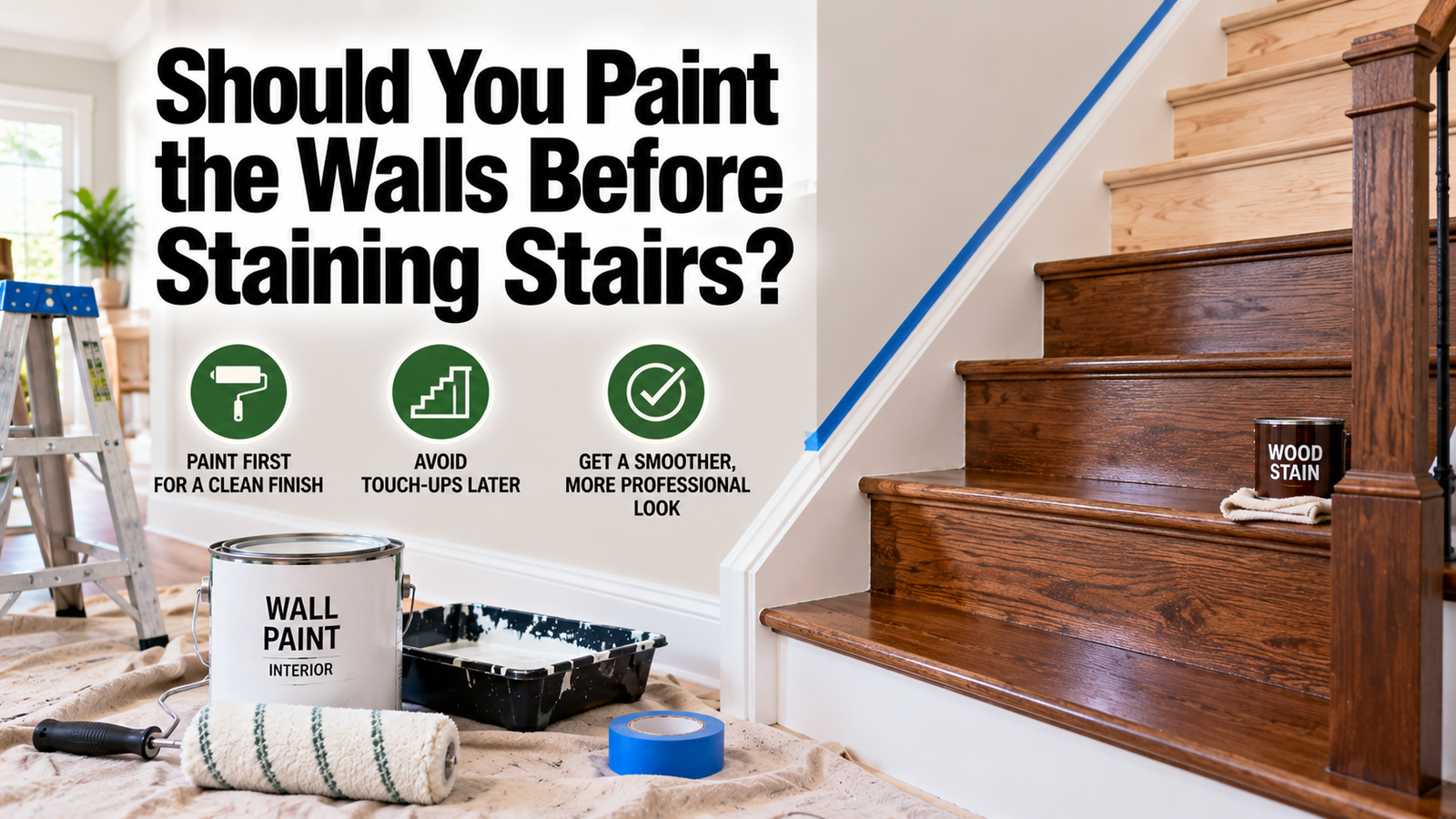

No. Stain and seal the stairs first, then paint the walls. That runs against the usual decorating instinct, which says work from the top down and leave the woodwork until last. It also contradicts a good deal of advice online. The reason it is right comes down to one question: which mistake is easier to undo.
Paint splashed onto cured polyurethane wipes or scrapes off. Stain splashed onto a finished wall means repainting. And paint that lands on bare wood you intend to stain may never come off properly at all.
The principle that decides it
Every sequencing decision in decorating is really a question about reversibility. You do the irreversible, messy, dusty work first, and the delicate finishing work last.
Staining is the irreversible operation here. Stain is a penetrating product designed to soak into porous material and stay there. A wall is porous. Once stain reaches painted plaster it has gone into the film and the substrate, and no amount of wiping brings it back.
Wall paint is the reversible one. It sits on the surface, it is opaque, and a drip on a hard cured finish comes off with a fingernail, a plastic scraper, or a rag and some white spirit.
There is a version of this argument from the trade that puts it more sharply: the preparation you do for stain work covers the preparation you need for painting, but the reverse is not true. Sanding stairs back leaves you ready to paint. Painting first leaves you with a wall you now have to protect through the messiest part of the job.
The dust problem
Refinishing stairs generates a lot of dust, and dust is the enemy of every wet finish.
Sanding treads, handrails, and spindles produces fine wood dust that travels, hangs in the air for hours, and settles on everything in the stairwell. If the walls are freshly painted, that dust lands in paint that has not fully cured and embeds in the surface.
The same dust is worse in a wet polyurethane film, where it shows as a gritty, speckled finish that has to be sanded back and recoated.
So the rule is broader than paint versus stain: all the sanding happens before any finish coat goes on anywhere. Prep the stairs, prep the walls, vacuum thoroughly, and only then start applying anything wet.
That ordering also explains why the answer changes if the walls need major work. Skimming and sanding plaster produces far more dust than painting does, and that work belongs at the front of the job alongside the stair sanding.
The mistake that cannot be fixed
Here is the point that settles the argument, and it is the one most guides miss.
You will read that paint splatter on raw wood simply sands off. On a tread you are about to drum-sand, that is broadly true. Almost everywhere else it is not.
Paint and primer are liquid. On bare timber they wick into open grain and into the end grain at joints. Sanding removes the surface film and leaves the residue sitting below it, invisible until you apply stain.
Then the stain cannot penetrate where the paint got in. What you get is a pale blotch with a hard edge, in exactly the shape of the original splash. On a stained handrail or a visible stringer it is glaring, and the only real fix is to strip and start again.
Reverse the order and the equivalent accident is trivial. Stain gets on a raw wall that has not been painted yet, and the primer covers it.
So the sequence protects the surface where a mistake is permanent, at the cost of exposing the surface where a mistake takes two minutes.
Decide what is stained and what is painted first
The sequence only works if you have settled which components get which finish, because that determines what needs priming and what needs protecting.
The common arrangement is two-tone: stained treads and handrail, painted risers, stringers, and spindles. It wears well, since the walked-on surfaces are the ones with a hard clear finish, and the painted parts are the ones that show scuffs least.
All-stained is the traditional look and the most demanding. Every component has to take stain evenly, which means the wood has to match reasonably and the sanding has to be consistent.
All-painted is the simplest job and the one where this whole question evaporates. It also hides mismatched or damaged timber, which is often why people choose it.
Whatever you pick, write it down before you start. Deciding halfway through that the stringers would look better stained, after you have primed them, means stripping.
One practical note on treads. Painted treads wear through where feet land, and touching them up means taking the stairs out of use again. If the treads are solid timber and worth showing, stain and poly is the more durable choice as well as the better-looking one.
The full sequence
For a typical job with stained treads and handrail, painted risers and spindles, and painted walls:
- Carpentry and repairs first. Replace damaged treads, fix squeaks, fill and plug.
- Sand everything on the staircase that needs it, and do any plaster repair and sanding on the walls in the same phase.
- Vacuum the entire stairwell thoroughly, then tack the wood surfaces immediately before finishing.
- Prime the components that will be painted, including risers, stringers, and spindles. Priming these before staining gives you a hard, non-absorbent surface that stain will not soak into.
- Stain the treads and handrail, and wipe back the excess.
- Apply at least one sealing coat of polyurethane over the stain, and preferably all of them.
- Paint the walls, then the previously primed stair components, cutting cleanly to the finished woodwork.
- Apply the final coat of polyurethane to the treads if you held one back, once everything else is finished and the dust has settled.
Step four is the one people skip and regret. Priming the risers before staining costs an hour and turns them from an absorbent hazard into a surface that shrugs stain off.
When painting the walls first is right
The rule has genuine exceptions.
If you are painting the stairs rather than staining them, normal decorating order applies and the argument disappears. Paint on paint is reversible in both directions, so work top down: ceiling, walls, then woodwork.
If the walls need substantial replastering, get the wet trades and their dust out of the way before any finish goes on the stairs, then treat the painted wall as a surface to protect.
If the stair work is a light refresh rather than a full refinish, with minimal sanding and a small area of stain, the dust argument weakens and the sequence matters less.
And if the stairs are the only route to the room you are painting, practicality may override everything. Freshly finished treads cannot be walked on for a day or more, and that can strand you.
How long the whole job takes
Sequencing matters more when the stages have long waits attached, and this job has several.
Sanding a straight flight takes most of a day by hand, less with a detail sander, considerably more if there is old paint or varnish to strip.
Stain needs to be wiped back within minutes of application, then left to dry before finishing. Most wood stains want at least a few hours and some want overnight before a topcoat.
Polyurethane is the long pole. Each coat needs several hours to dry and light sanding between coats, and three coats on treads means two or three days of not walking on them. Full cure to the point of taking normal traffic is longer again, often a week.
Wall painting is quick by comparison, and that is another argument for putting it at the end. Two coats and a day is a small addition to a job whose critical path is the stair finish.
Budget a week for a full refinish plus wall repaint, and longer if you can only work evenings. The most common failure is rushing the poly and walking on it too early, which prints the finish and means sanding back.
Protecting each from the other
Whichever order you choose, the joint between the stair and the wall is where the trouble happens.
Run low-tack tape tight into the seam where the riser or stringer meets the wall, and press the edge down firmly with a filling knife so nothing creeps underneath.
A wide drywall knife held against the wall as a moving shield beats tape for staining a stringer. You get a clean line and no adhesive residue.
Work in short sections and wipe stain back promptly. Stain that sits and dries where it should not is far harder to remove than stain caught wet.
Take tape off as soon as the final coat is on rather than leaving it to cure. Benjamin Moore make this point in their staircase guide, noting that tape left too long can damage wood surfaces including risers, treads, and handrails.
Cover the treads properly while you paint. Rosin paper or canvas taped down beats plastic sheeting, which slides underfoot on stairs and is genuinely dangerous.
Conclusion
Stain and seal the stairs before you paint the walls. Paint on cured polyurethane comes off easily, stain on a painted wall means repainting, and paint that soaks into bare wood destined for stain leaves a blotch you cannot sand out. Do all the sanding, on both the stairs and the walls, before any wet finish goes anywhere. Prime the components that will be painted before you stain the ones that will not. Then paint the walls last, cutting to finished woodwork you no longer have to worry about.
Frequently asked questions
Do you stain or paint stairs first?
Stain first, then paint. Stain is penetrating and permanent where it lands, while paint sits on the surface and comes off a cured finish easily. Prime any components you plan to paint before staining, so the stain cannot soak into them.
Should you paint walls before or after refinishing floors?
The same logic applies, and most finishers prefer to sand and finish floors before the final wall coats, because floor sanding produces enormous amounts of dust. Some painters prime walls first, then finish the floor, then apply finish wall coats.
Can you sand paint off wood before staining?
Partially. Sanding removes the surface film, but paint that has wicked into open grain stays below the surface and blocks stain, leaving a pale patch. It is far easier to avoid the splash than to fix it.
How long after staining stairs can you paint the walls?
Wait until the polyurethane is hard enough to resist marking, which usually means at least 24 to 48 hours, and check the tin. Working against soft finish risks pressing dust and brush marks into it.
What if the stairs are the only way upstairs?
Finish alternate treads, let them cure, then do the rest, so there is always a usable step. It doubles the time but keeps the house functional.
Related Articles
Can You Die From Sleeping in a Freshly Painted Room?
Will Watered Down Acrylic Paint With Alcohol Work?