
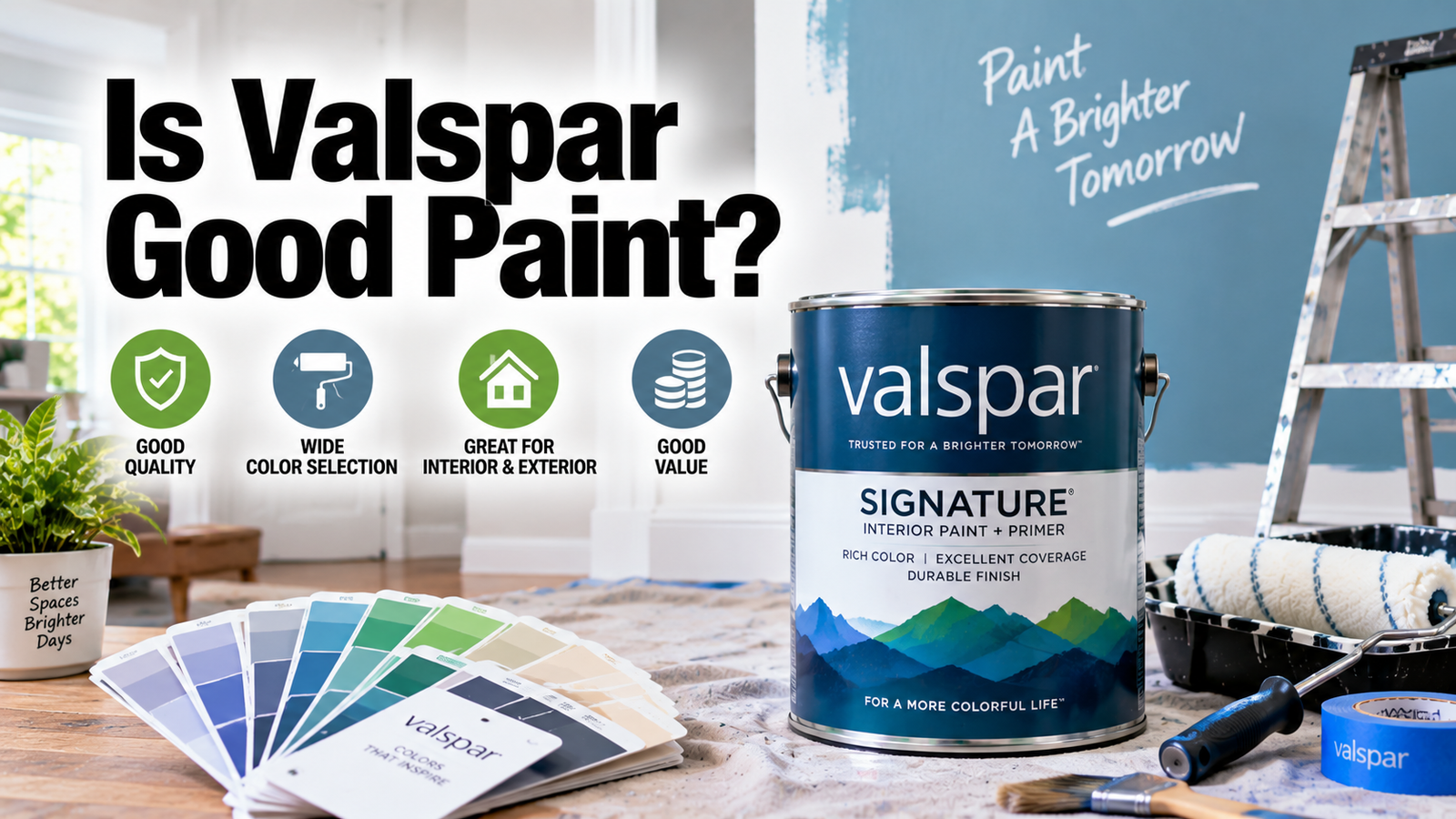

Valspar is a solid mid-range paint, and how good it is depends almost entirely on which line you buy. The brand runs a clear ladder from budget to premium, and the gap between the bottom and the top is wide. The flagship interior line, Reserve, earns high marks for one-coat coverage and durability and competes with paints that cost far more. The entry-level lines are cheaper for a reason and draw the coverage complaints that fill review pages. So the useful answer is not a flat yes or no; it is knowing which Valspar to reach for.
- Who makes Valspar, and where you buy it?
- The Valspar lines, from budget to premium
- Finishes, warranties, and what the labels mean
- Prep and technique matter more than the brand
- What Valspar does well?
- Where Valspar falls short?
- What owners and pros actually say?
- How Valspar compares to Behr and Sherwin-Williams?
- Which Valspar should you buy?
- Conclusion
- Frequently asked questions
- Is Valspar as good as Sherwin-Williams?
- Which Valspar paint is the best?
- Why does my Valspar paint need so many coats?
- Is Valspar or Behr better?
- Where can you buy Valspar paint?
- Related Articles
This guide walks through the lineup, what owners and pros actually report, where Valspar shines and where it struggles, how it stacks up against Behr and Sherwin-Williams, and which line fits which job. Prices below are rough retail figures that move with sales, so treat them as ballpark, not gospel.
Who makes Valspar, and where you buy it?
Sherwin-Williams has owned Valspar since a 2017 acquisition, and the brand sits in a specific spot in that company’s world: it is the paint Lowe’s sells. Lowe’s holds the exclusive big-box deal for Valspar and stocks the full catalog, tinted at the in-store paint desk. That arrangement shapes the whole experience. You get competitive per-gallon pricing and frequent Lowe’s paint sales, but not the specialist paint-store staff you would find behind a dedicated Sherwin-Williams counter. It is a trade-off built into the price.
One practical upside of the Lowe’s tie-in: the paint desk tints any Valspar base free, including color matches from rival brands’ chips you bring in. That convenience is a big part of why the brand stays a top seller.
The Valspar lines, from budget to premium
Valspar’s quality tracks its price tiers closely. Here are the interior lines most shoppers compare, cheapest to priciest.
| Line | Rough price/gal | Where it fits |
| Simplicity / Express Coat | About $20 to $24 | Entry level, aimed at landlords, flippers, and tight budgets. Expect two-plus coats and modest durability. |
| Ultra | Around $30 | The low-cost paint-and-primer with Scrub Shield. A step up in washability, still a two-coat paint. |
| Signature | About $38 to $45 | The popular mid-tier with ScuffShield and a lifetime limited warranty. Good all-round pick, usually two coats. |
| Reserve | About $50 to $65 | The flagship self-priming line. One-coat coverage, best durability and fade resistance, high scrub rating. |
The takeaway from the ladder is simple: most of the disappointment reported online comes from the bottom two tiers, and most of the praise comes from Reserve and, to a lesser degree, Signature. When people argue about whether Valspar is any good, they are often comparing different rungs without realizing it. There is also a cabinet and furniture enamel and exterior lines such as Duramax; this guide stays focused on the interior wall paints most searches are about.
Finishes, warranties, and what the labels mean
Valspar sells each line in the usual sheen range, and the choice matters as much as the line. Flat and matte hide wall flaws but are harder to wipe, so they suit low-traffic bedrooms and ceilings. Eggshell and satin are the everyday middle ground for living spaces. Satin and semi-gloss shed moisture and take scrubbing best, which is why they are the right call for kitchens, bathrooms, trim, and doors. A cheaper line in the correct sheen often outperforms a pricier one in the wrong sheen for a given room.
The warranties read impressively, and it helps to know what they cover. Several Valspar lines carry a lifetime limited warranty, but that guarantee is about the paint performing as described when applied correctly, not a promise that any color covers in one coat or never shows wear.
The paint-and-primer label works the same way: it means the paint is self-priming over sound, previously painted surfaces in good shape, not that you can skip a real primer over bare wood, patches, stains, or a drastic color change. Read those two claims narrowly and you will avoid the expectations that fuel a lot of the harsher reviews.
Prep and technique matter more than the brand
A fair amount of paint disappointment is really application disappointment, and that is true of every brand, not just Valspar. Coverage complaints often trace back to skipping primer on a bare or patched wall, going over a dark color with a light one without an undercoat, rolling coats too thin to save paint, or not letting the first coat dry before the second. Deep colors especially need a gray-tinted primer underneath to reach full richness, whatever brand sits on top.
Before you judge a can, give it a fair test: clean the surface, prime where the surface is bare or the color change is big, use a quality roller cover, and apply the coats at the thickness the label calls for. Do that and a mid-tier Valspar will look far better than a premium paint applied carelessly. Blaming the paint is easy; matching the product and the prep to the job is what actually decides the result.
What Valspar does well?
- Coverage on the premium line. Reserve is widely praised as a genuine one-coat paint on most colors. It is noticeably thick, almost pudding-like in the tray, which helps it cover in a single pass and drip less on the roller.
- Durability and washability up top. Reserve and Signature carry scuff and stain resistance and hold up to cleaning in kitchens, bathrooms, and hallways. Reserve’s scrub rating sits in the range paint testers associate with premium products.
- Color range and matching. Valspar’s color selection is broad and generally well regarded for accuracy, and Lowe’s will match competitor colors into a Valspar base at no charge.
- Low odor and low VOC. The upper lines are low-VOC or zero-VOC and several are third-party certified for indoor air quality, which matters for occupied rooms.
- Value against pricier brands. At sale prices, Reserve often lands well below premium competitors while delivering comparable coverage, which is the core of its appeal.
Where Valspar falls short?
- The cheap lines underperform. The most common complaint, thin coverage that needs three coats, clusters around the budget tiers. On those lines, the low price often disappears into extra paint and labor.
- Deep and bold colors can struggle. Reds, blues, and other strong tints are a known weak spot; they may need a tinted undercoat and an extra coat to cover evenly, which good paint-desk advice should flag but does not always.
- Consistency complaints. Recent reviews include reports of a once-reliable line suddenly covering poorly, along with visible brush and roller marks in high-gloss whites, suggesting the experience is not perfectly uniform batch to batch.
- Less expert support at the counter. The Lowe’s model means you are less likely to get the seasoned troubleshooting a dedicated paint store offers, which can leave DIYers to solve problems like poor adhesion on their own.
What owners and pros actually say?
Pull the reviews together and a consistent picture forms. Homeowners who chose Reserve tend to be happy: they mention one-coat coverage on textured walls, quick drying, low smell, and easy cleanup. Painters and decorators generally rate the premium and mid tiers as good paint that covers well and finishes nicely, while singling out the trade and budget lines as much weaker and warning about strong colors specifically.
The negative reviews are real and worth respecting. They concentrate on the cheaper lines and on deep colors, and they describe watery coverage, multiple coats, and paint that scratches or shows marks. The pattern is less “Valspar is bad” and more “the low tiers and bold colors underdeliver, and buyers were not steered to the right product.” Read that way, the mixed reviews are largely consistent with the price-tier story rather than a contradiction of it.
How Valspar compares to Behr and Sherwin-Williams?
Valspar’s closest rival is Behr, the paint Home Depot sells, and the two are natural head-to-head picks because of that big-box symmetry. Both offer strong premium lines at competitive prices, and choosing between them often comes down to which store you prefer and which is running a sale. Behr’s top lines are frequent favorites in consumer testing, and Valspar Reserve is a credible match on coverage and durability.
Against Sherwin-Williams’ own premium paints, or Benjamin Moore, Valspar’s pitch is value. Lines like Benjamin Moore Aura and Sherwin-Williams Emerald cost substantially more per gallon at full price, and Valspar Reserve positions itself as most of that performance for less money, especially on a Lowe’s sale.
What you give up versus a dedicated paint store is the specialist advice and, some would argue, the very top end of durability. For many interior repaints, that is a reasonable trade; for a demanding job or a tricky surface, the extra support can be worth paying for.
Which Valspar should you buy?
- For most interior walls: Reserve, if the budget allows. It is the line that earns Valspar its good reputation, and its one-coat coverage often offsets the higher price in paint and time saved.
- For a value whole-home repaint: Signature. It covers well, resists scuffs, and carries the lifetime warranty, usually in two coats.
- For kitchens and bathrooms: Reserve or Signature in satin or semi-gloss, which handle moisture and cleaning better than flatter finishes.
- For rentals, flips, and tight budgets: Simplicity or Ultra, with eyes open. Cheaper per gallon, but plan for extra coats and shorter life.
- For deep or bold colors: Step up a tier and ask the paint desk for a tinted primer or undercoat, whatever line you choose, to avoid the strong-color coverage problems.
Prices and availability shift often, so check current figures on Valspar’s paint pages at Lowe’s before you buy, and compare finishes and warranties on the official Valspar site.
The honest one-liner: Valspar Reserve is very good paint, Signature is solid, and the budget lines are where the brand earns its harsher reviews.
Conclusion
Yes, Valspar can be good paint, as long as you buy the right line. Reserve delivers premium one-coat coverage and durability at a mid-range price, Signature is a dependable value, and the budget tiers are cheap in both senses.
Match the line to the job, step up a tier for bold colors and hard-wearing rooms, and shop a Lowe’s sale, and Valspar competes well with anything at its price. Buy the cheapest can on the shelf expecting flagship results, and the disappointing reviews will be yours too.
Frequently asked questions
Is Valspar as good as Sherwin-Williams?
Not quite at the very top, but close for the money. Sherwin-Williams owns Valspar and positions it as the value brand at Lowe’s. Valspar Reserve rivals pricier premium paints on coverage; what you trade away is specialist paint-store support and a sliver of top-end durability.
Which Valspar paint is the best?
Reserve is the flagship interior line, with one-coat coverage, the best durability and fade resistance, and a high scrub rating. Signature sits just below it as the popular value pick. Both far outperform the budget Simplicity and Ultra lines.
Why does my Valspar paint need so many coats?
Usually because it is a budget line or a deep color. The cheaper tiers are two-plus-coat paints, and strong reds and blues often need a tinted undercoat plus an extra coat. Reserve is the line marketed for genuine one-coat coverage.
Is Valspar or Behr better?
They are close rivals, Valspar at Lowe’s and Behr at Home Depot, both with strong premium lines at competitive prices. Behr’s top paints test very well, and Valspar Reserve matches up on coverage and durability. Store preference and current sales often decide it.
Where can you buy Valspar paint?
Lowe’s is the main retailer and stocks the full catalog, tinted at the paint desk, which will also color-match rival brands’ chips for free. Some lines appear at Ace Hardware and independent dealers, but Lowe’s has the exclusive big-box deal.
Related Articles
What Is Elastomeric Paint? A Complete Guide
How to Unclog a Spray Paint Can (Step-by-Step Fix)
How to Unclog a Spray Paint Can (Step-by-Step Fix)
What Is Thinner in Paint? A Complete Guide to Types, Uses & Safety Tips