
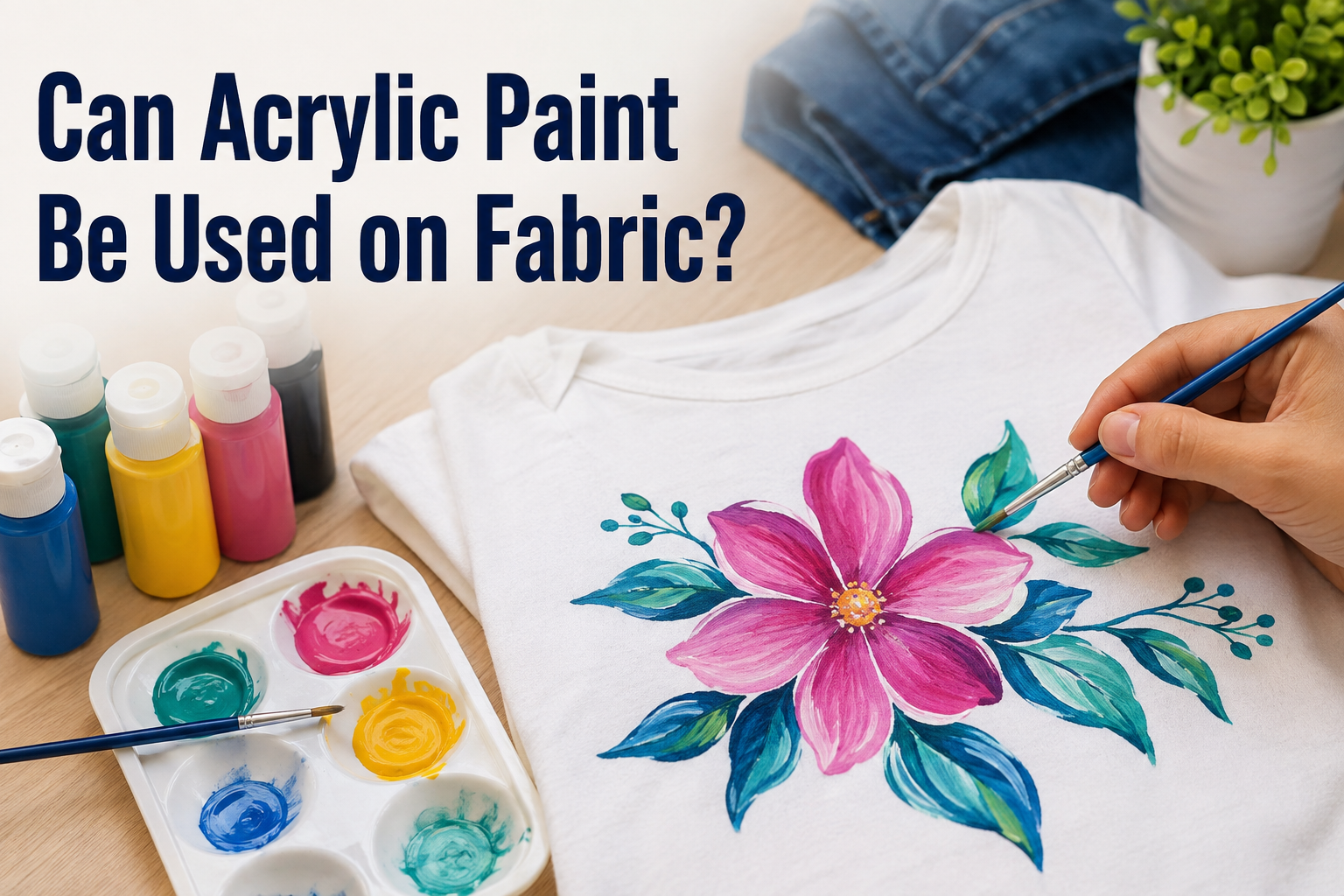

Yes. Acrylic bonds permanently to fabric and will not wash out once it has dried and cured. That part is settled.
- What happens if you use acrylic straight from the tube?
- What fabric medium actually does?
- How much medium to mix in?
- How to paint on fabric with acrylic?
- Do you need to heat set it?
- Which fabrics take acrylic well?
- How to stop the design cracking?
- How to wash painted fabric?
- When to use fabric paint or dye instead?
- Conclusion
- Frequently asked questions
- Related Articles
The catch is feel, not permanence. Straight from the tube, acrylic dries into a stiff plastic film sitting on top of the weave, and it cracks wherever the fabric bends. Mixing in fabric medium solves that, and the rest of the job comes down to prep, thin coats, and setting it properly before the first wash.
What happens if you use acrylic straight from the tube?
The paint sticks. It also stops the fabric behaving like fabric.
A thick patch of unmixed acrylic dries into a hard, slightly plasticky panel. On a tote bag or a canvas shoe you may not care. On a t-shirt it feels like a sheet of laminate against your skin, and it will not move with the garment.
Cracking follows. Every time the painted area folds, the film flexes, and a stiff film has nowhere to go. Long unbroken lines of paint split first, because there is more distance for the fabric to stretch underneath. Short strokes survive much better than long ones.
Washing accelerates all of it. A machine agitator can stretch a garment past what the paint film can follow, which is where flaking usually starts.
What fabric medium actually does?
Fabric medium, also sold as textile medium, is an acrylic medium tuned for cloth. It carries binder like any medium, so it thins the paint without weakening it.
Three things change when you add it. The dried film becomes far more flexible, so it bends with the fabric instead of resisting it. The paint penetrates into the fibres rather than sitting on the surface, which is what keeps the hand of the fabric soft. And it controls bleeding, so a thinned colour holds its edge instead of wicking along the weave.
It also buys you a little working time, which helps when you are blending on an absorbent surface that pulls paint off the brush quickly.
What it does not do is change the colour. It dries clear, though everything you paint on fabric dries slightly lighter than it looks going on.
How much medium to mix in?
One part paint to one part medium is the standard starting point, and both Golden and Liquitex recommend it. Adjust from there.
Add more medium for delicate fabrics or anything worn against skin, since a higher proportion gives a softer finish. Add less when you need opaque coverage, because medium makes the colour more transparent as it goes up.
| Approach | Mix ratio | Heat set? | Best for |
| Acrylic on its own | None | No | Items that never bend or get washed |
| Acrylic + fabric medium | About 1:1 | Usually not needed | T-shirts, tote bags, most clothing |
| Acrylic + heat-set medium | About 1:1 | Required | Garments washed often |
| Ready-made fabric paint | None needed | Check the label | Small designs and first attempts |
Two colour choices matter here as well. Transparent and semi-opaque colours dry softest. Titanium white, and every iridescent or metallic colour, tends to stiffen fabric more than the rest of the palette.
How to paint on fabric with acrylic?
- Wash and dry the fabric first, with no fabric softener. New textiles carry sizing, a finish that stops paint gripping the fibres.
- Slide cardboard or plastic inside the garment. It stops paint bleeding through to the back and stops the fabric sticking to your table. Stretch sweatshirts and thick knits slightly over the board so the paint can sink in.
- Mix your colour with fabric medium on a palette, roughly 1:1, stirring gently. Fast stirring whips in air, and bubbles dry as pinholes.
- Test on a scrap of the same fabric. Absorbency varies enormously between cotton, denim, and polyester, and the test tells you how much the colour will spread.
- Paint in thin coats and build up rather than loading it on. Two thin layers beat one thick one for both flexibility and coverage.
- Let it dry fully. Touch dry takes anywhere from five minutes to two hours depending on the fabric, but give it several hours before you handle it.
- Set it if your medium calls for setting, then leave it to cure before washing.
A light mist of water on the fabric before painting helps the colour penetrate. Go easy, because too much water and the colour will bleed along the weave.
Do you need to heat set it?
This depends entirely on which medium you bought, and the two major brands answer it differently.
Liquitex Fabric Medium bonds without heat. Their guidance is that no heat setting, steaming, or chemical fixing is needed, and the item can be hand or machine washed once dry.
Golden GAC 900 requires it. Heat fuses the medium into the fabric, and skipping the step costs you both launderability and softness. Golden’s product guidance gives starting points by fabric type: low heat at around 230°F for three to five minutes on delicate synthetics, medium at roughly 300°F for one to two minutes on silk, polyester, and wool, and high at close to 390°F for fifteen to thirty seconds on cotton, rayon, and leather. The rule is lower heat for longer, or higher heat for less time. Iron on the reverse side, and test on a scrap first so you do not scorch the garment.
A clothes dryer is the low-effort route if you have several pieces to set. A domestic dryer on its highest setting tops out around 135°F, so it needs roughly 40 minutes, while a hotter commercial machine at a laundromat does the job in about 20.
One safety point belongs here. Heat-setting GAC 900 gives off low levels of formaldehyde, so it needs ventilation: a vented clothes dryer handles itself, but ironing or heat pressing should happen in an open room with a fan moving air outside, and not around children or pets.
Which fabrics take acrylic well?
Natural fibres with a loose weave are the easy case. Cotton, cotton and polyester blends, linen, denim, canvas, and felt all let paint sink between the threads and grip from inside.
Silk, wool, velvet, corduroy, suede, and leather all work too, with more care over heat if you are setting the paint. Most synthetics take it, though they are less absorbent, so the paint sits nearer the surface.
Stretch fabrics are the hard case. Lycra, spandex, and heavy jersey move far more than a paint film can, so keep designs small, keep the paint thin, and expect some cracking over time on anything that gets pulled on and off.
Anything waterproofed or treated will fight you. Sizing, water repellent finishes, and softeners all block adhesion, which is why the pre-wash matters.
How to stop the design cracking?
Cracking is the main way painted fabric fails, and almost all of it traces back to how the paint went on.
Keep every coat thin. A thick deposit has no way to flex with the cloth beneath it, and thickness does more damage than any other single factor.
Break long lines up. A continuous stroke across a whole chest panel has to stretch along its entire length every time the wearer moves, and it will split somewhere. Shorter strokes, even butted against each other, hold far better.
Think about where the design sits. Elbows, knees, shoulders, and waistbands move the most, so put detailed work on flatter, calmer areas: a back panel, a chest pocket, the side of a bag.
Get the paint into the weave rather than onto it. Working it in with a stiff brush, pre-misting the fabric, and using enough medium all help the colour anchor between the fibres, where it flexes with the cloth instead of bridging across the top of it.
How to wash painted fabric?
Wait before the first wash. Liquitex recommend at least four days after the paint has dried, and that is the whole point of the wait: the film is touch dry within hours but takes days to reach full strength.
After that, keep it gentle. Liquitex’s fabric painting guidance is to hand wash and hang dry where possible, turn the item inside out, skip the pre-soak, and avoid hot water, which softens and loosens the paint film. If you machine wash, use a gentle or permanent press cycle on cold.
Two more habits help. Do not wash painted items alongside heavy, coarse things like jeans, since the abrasion works on the design. And if you ever need to iron the garment again, use a low setting with a pressing cloth, or iron from the reverse side.
When to use fabric paint or dye instead?
Purpose-made fabric paint is already mixed and set up for cloth, so it is the simpler choice for a small design or a first attempt. Acrylic plus medium wins on colour range and on cost, especially if you already own the paint.
Dye is a different tool entirely. Paint sits in and on the fibres and always adds some stiffness, while dye chemically colours the fibre itself and leaves the fabric feeling untouched. For colouring a whole garment rather than putting a design on it, dye is the right answer every time.
Conclusion
Acrylic works on fabric, and it works permanently, as long as you mix it with fabric medium rather than using it neat. Wash the fabric first, mix roughly half paint and half medium, build the design in thin coats, and check whether your medium needs heat to set. Then leave it four days before the first wash, and keep that wash cold, gentle, and inside out. Do that and a painted garment will outlast most printed ones.
Frequently asked questions
Will acrylic paint wash out of fabric?
No. Once dried and cured, acrylic is permanent on fabric and will not wash out. What it can do is crack or flake if it was applied thickly without fabric medium, which looks like the design wearing away rather than washing out.
Can I use acrylic paint on fabric without fabric medium?
You can, and it will stay put, but the painted area will be stiff and will crack where the fabric bends. It is a reasonable trade for a tote bag, a banner, or a costume. It is a poor one for anything worn regularly.
How long should acrylic paint dry on fabric before washing?
Give it at least four days after the paint feels dry. It reaches touch dry within a couple of hours, but the film needs several days to harden properly, and washing early is the most common cause of a design lifting.
Do I have to iron acrylic paint to set it on fabric?
Only if your fabric medium says so. Golden GAC 900 requires heat setting, while Liquitex Fabric Medium does not. Check the bottle, and if you do iron, work on the reverse side with good ventilation.
What kind of acrylic paint is best for fabric?
Soft body or fluid acrylics work best because they penetrate the weave rather than sitting on it. Heavy body paint works too but needs more medium. Craft acrylics are fine for casual projects and cost far less.
Related Articles
How to Remove Gold Leaf From Paper and Paintings?
How to Get Latex Paint Out of Clothes?