

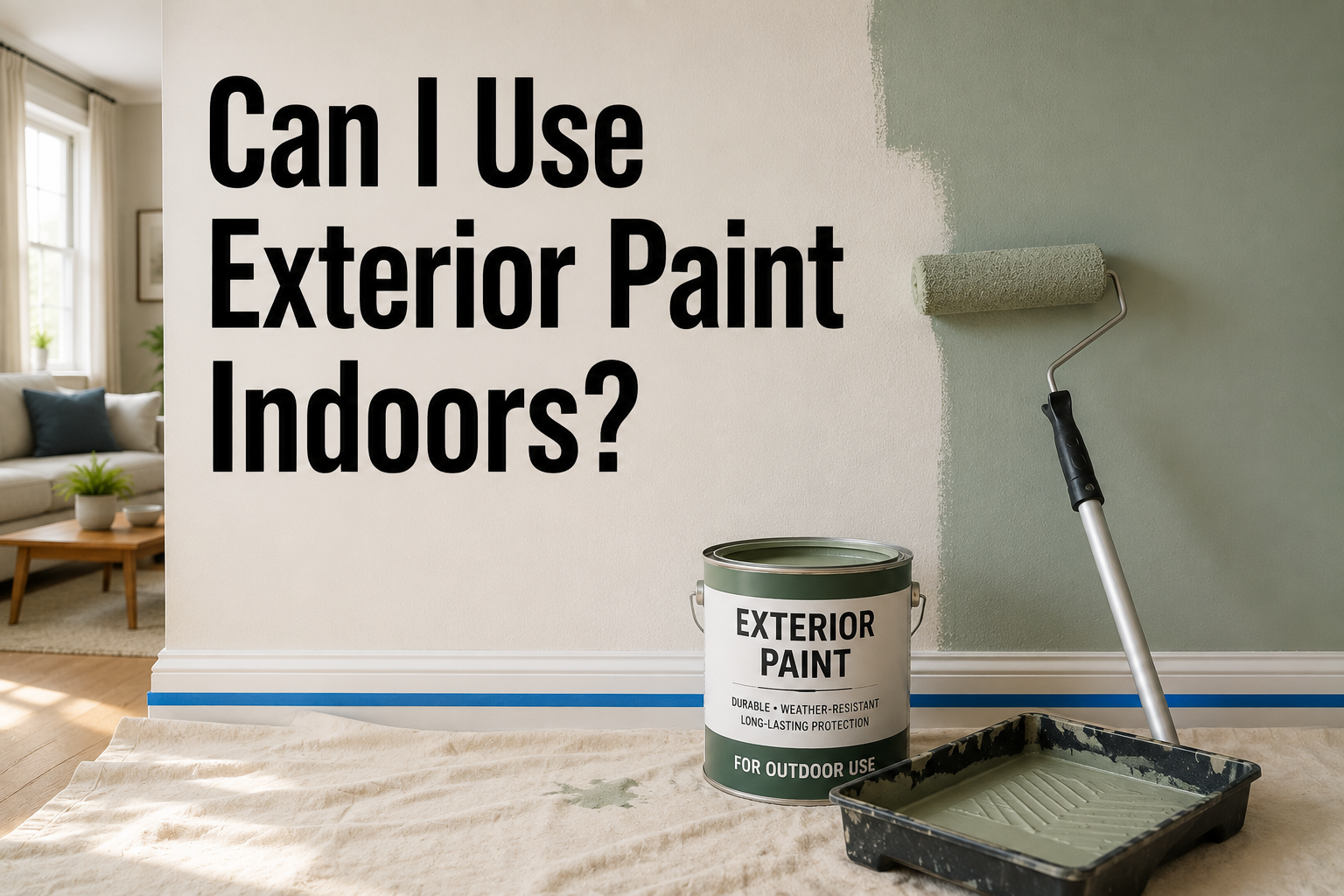

If you’ve got half a can of exterior paint sitting in the garage, it’s a fair question: can I use exterior paint indoors instead of buying a whole new can of interior paint? The short answer is no — exterior paint is not designed for enclosed living spaces, and using it indoors can affect your air quality, your walls, and your wallet. But the full answer is more useful than a flat “don’t,” so let’s walk through exactly why that’s the case, where the rare exceptions live, and what to do if you’ve already rolled it onto a wall.
- Can I Use Exterior Paint Indoors? The Short Answer
- What Makes Exterior Paint Different From Interior Paint
- Interior Paint vs. Exterior Paint at a Glance
- What Actually Happens When You Use Exterior Paint Indoors
- Health Risks From VOCs and Off-Gassing
- Poor Adhesion, Peeling, and Flaking
- Trapped Moisture and Mold Risk
- Slower Curing and Lingering Odor
- Are There Any Exceptions?
- Garages, Sheds, and Unfinished Spaces
- Low-VOC and Zero-VOC Exterior Paints
- Metal Doors, Trim, and High-Moisture Areas
- Already Painted Indoors With Exterior Paint? Here’s How to Fix It
- What About Using Interior Paint Outside?
- How to Choose the Right Paint for Your Next Project
- Frequently Asked Questions
- Final Thoughts
- Related Articles
Can I Use Exterior Paint Indoors? The Short Answer
Technically, exterior paint will stick to an interior wall and dry into a paint film — nothing about the product physically prevents you from applying it inside. The issue isn’t whether it can go on your wall; it’s what happens after it does. Exterior paint is engineered for constant airflow, sunlight, and temperature swings, none of which exist in a closed bedroom or hallway. Without that outdoor environment to work with, the same chemistry that makes it durable outside becomes a liability indoors.
What Makes Exterior Paint Different From Interior Paint
Interior and exterior paints look similar in the can, but they’re built around different jobs, which means different resins, additives, and drying behavior.
Chemical Additives and VOC Levels
Exterior formulas typically rely on higher concentrations of volatile organic compounds (VOCs) and mildewcides to survive rain, humidity, and mold-friendly conditions outside. Outdoors, wind and open air disperse those compounds quickly. Indoors, in a room with limited airflow, those same compounds can linger in the air you breathe for days or even weeks after the paint feels dry to the touch.
Durability vs. Flexibility
Exterior paint is formulated to flex with temperature swings and resist UV breakdown, cracking, and chalking. Interior walls don’t face that kind of stress, but they do face something exterior paint isn’t built for: constant touching, cleaning, and scrubbing. Interior paints are engineered to be washable and scuff-resistant in a way most exterior formulas are not.
Sheen, Texture, and Finish
Exterior paints are usually thicker-bodied to build a protective film in one or two coats, which often dries with a glossier, less uniform finish than interior-grade products. On an interior wall under indoor lighting, that difference in sheen and texture is much more noticeable than it would be on siding or trim viewed from the street.
Interior Paint vs. Exterior Paint at a Glance
| Feature | Interior Paint | Exterior Paint |
|---|---|---|
| Primary goal | Comfortable, safe, washable surfaces | Weather and UV resistance |
| VOC levels | Generally lower | Generally higher |
| Flexibility | Moderate | High (handles expansion/contraction) |
| Mildew resistance | Minimal | Built-in mildewcides |
| Washability | High | Lower, prone to marking |
| Curing environment | Stable indoor temp/humidity | Open air, temperature swings |
| Best used | Walls, ceilings, trim, cabinets | Siding, fences, decks, doors, shutters |
What Actually Happens When You Use Exterior Paint Indoors
Health Risks From VOCs and Off-Gassing
The most immediate concern is air quality. Freshly applied exterior paint indoors can release noticeably stronger fumes than interior paint, and that off-gassing doesn’t stop the moment the surface feels dry — it can continue at lower levels for weeks. Short-term exposure has been linked to headaches, dizziness, throat and eye irritation, and worsened symptoms for people with asthma or allergies. Children, pets, older adults, and pregnant women are typically more sensitive to elevated indoor VOC levels than healthy adults.
Poor Adhesion, Peeling, and Flaking
Interior drywall and plaster are more porous and less rigid than exterior siding or masonry. Exterior paint’s thicker resin doesn’t always bond evenly to these surfaces, and because it’s formulated to expand and contract with outdoor temperature changes, it can behave unpredictably on a wall that never experiences that kind of stress. Over time, this mismatch commonly shows up as peeling, bubbling, or flaking — especially around corners, trim, and high-touch areas.
Trapped Moisture and Mold Risk
Exterior paint is built to shed water from the outside surface of your home. Applied indoors, that same water-resistant film can trap moisture between the paint and the wall instead of letting it escape, which is a particular problem in kitchens, bathrooms, and laundry rooms where humidity is already higher. Trapped moisture behind a paint film creates favorable conditions for mold growth, which can be far more expensive to remediate than the cost of the paint you were trying to save.
Slower Curing and Lingering Odor
Exterior paint is designed to cure with the help of sunlight, warmth, and open airflow — none of which a typical interior room provides. Indoors, that same paint can take noticeably longer to fully cure, and the odor associated with an uncured exterior paint film tends to persist far longer than the smell of a properly cured interior paint job.
Are There Any Exceptions?
Most guides treat this as an all-or-nothing rule, but there are a few situations where the line is genuinely blurrier.
Garages, Sheds, and Unfinished Spaces
A detached, unheated garage or storage shed behaves much more like an exterior space than a living room — it’s typically better ventilated, less insulated, and not used for extended periods of time. Exterior paint is more tolerable here than in a bedroom or kitchen, though a garage that’s attached to your house, heated, or used as a workspace should still be treated like an interior space and painted accordingly.
Low-VOC and Zero-VOC Exterior Paints
Paint manufacturers now offer low-VOC and zero-VOC exterior lines. These reduce (but don’t eliminate) the chemical exposure concern, since the paint’s durability additives and resin type haven’t changed — only the VOC content has. A low-VOC label makes exterior paint somewhat less risky indoors, but it doesn’t resolve the adhesion, sheen, or moisture-trapping issues, so it’s still not a genuine substitute for interior paint.
Metal Doors, Trim, and High-Moisture Areas
Exterior-grade paint is sometimes intentionally used on interior metal doors, radiators, or high-traffic trim precisely because of its extra durability, but this is a deliberate, small-scale professional choice — not a blanket recommendation for walls or large surfaces, and it’s typically done with proper ventilation and a paint labeled safe for that specific application.
Already Painted Indoors With Exterior Paint? Here’s How to Fix It
If you’ve already rolled exterior paint onto an interior wall, it’s a fixable mistake, not a structural problem. Here’s the right way to correct it:
- Ventilate the room immediately. Open windows and run fans for at least 24–48 hours before doing anything else, and longer if you notice a strong odor.
- Let the paint fully cure. Give it several days to a week before sanding or priming, since disturbing an uncured film releases more fumes into the air.
- Lightly sand any glossy or uneven areas to help the next coat of primer adhere properly.
- Apply a stain-blocking, high-adhesion primer — a shellac-based or high-bond acrylic primer is typically the most reliable choice for sealing in odor and creating a surface interior paint can grip.
- Repaint with a proper interior paint in your desired color and sheen once the primer has fully dried.
Following these steps seals in any remaining VOCs, corrects the surface for adhesion, and gets you back to a normal, healthy interior finish.
What About Using Interior Paint Outside?
It’s worth addressing the reverse scenario too, since it comes up just as often. Interior paint on an exterior surface won’t create a health hazard, but it also won’t hold up. Without UV stabilizers, mildewcides, and flexible resins, interior paint applied outdoors tends to fade, chalk, and crack far faster than exterior-grade products, often within a single season of sun and weather exposure. If you’re painting anything outside — siding, trim, a fence, a shed — stick to a paint rated for exterior use.
How to Choose the Right Paint for Your Next Project
- Match the paint to the environment, not just to what’s left in the garage. Interior spaces need interior paint; exterior surfaces need exterior paint.
- Check the VOC content on the label, especially in bedrooms, nurseries, or homes with allergy or asthma concerns.
- Choose sheen based on the room. Kitchens and bathrooms benefit from satin or semi-gloss interior paint for washability and moisture resistance; bedrooms and living rooms often look better in eggshell or matte.
- Buy only what you need. If leftover exterior paint is the temptation, consider using it up on fences, planters, or outdoor furniture instead of stretching it indoors.
Frequently Asked Questions
Can I use exterior paint in my garage? A detached, unheated garage can tolerate exterior paint reasonably well since it’s ventilated more like an outdoor space. An attached, heated, or frequently occupied garage should be painted with interior-grade paint instead.
Is it dangerous to sleep in a room painted with exterior paint? It can be, especially in the days immediately after painting. Elevated VOC levels in an enclosed, occupied room can cause headaches, irritation, or breathing discomfort, so it’s best to ventilate thoroughly and avoid extended time in the room until the paint has fully cured.
How long do I need to air out a room painted with exterior paint? Plan on at least several days of active ventilation, and be aware that lower-level off-gassing can continue for a few weeks. If odor is still noticeable after a week of ventilation, priming and repainting with interior paint is the more reliable fix.
Can I use exterior paint on interior trim or doors? It’s occasionally done for extra durability on high-traffic trim or metal doors, but it should be a deliberate, well-ventilated choice for a small surface — not a substitute for interior wall paint.
Does low-VOC exterior paint change the answer? It reduces chemical exposure but doesn’t fix the underlying issues with adhesion, finish, or moisture behavior on interior surfaces, so it’s still not recommended as a true substitute for interior paint.
What primer should I use to cover exterior paint applied indoors? A shellac-based or high-adhesion, stain-blocking primer is typically the most effective choice, since it seals in residual odor and gives interior paint a surface it can properly bond to.
Final Thoughts
So, can you use exterior paint indoors? You can apply it, but you shouldn’t — the higher VOC content, mismatched durability, and moisture-trapping behavior make it a poor fit for enclosed living spaces, even though it’s built to survive far harsher conditions outside. If you’ve already made the mistake, ventilate the room, let the paint cure, prime with a stain-blocking primer, and repaint with proper interior paint to fully resolve it.
And if you’re just staring at a leftover can wondering whether it’s worth the risk, it isn’t — save it for a fence, shed, or planter, and pick up a can of interior paint made for the room you’re actually working on. If you’re planning your next interior or exterior painting project and want it done right the first time, reach out to a local painting professional for guidance on the best products for your space.
Related Articles
How to Dispose of Acrylic Paint Water Safely?
Can You Thin Acrylic Paint With Water? The Complete Guide
What Paint to Use for Face Painting: The Complete Beginner’s Guide
Do You Sand Primer Before Painting? A Complete Step-by-Step Guide