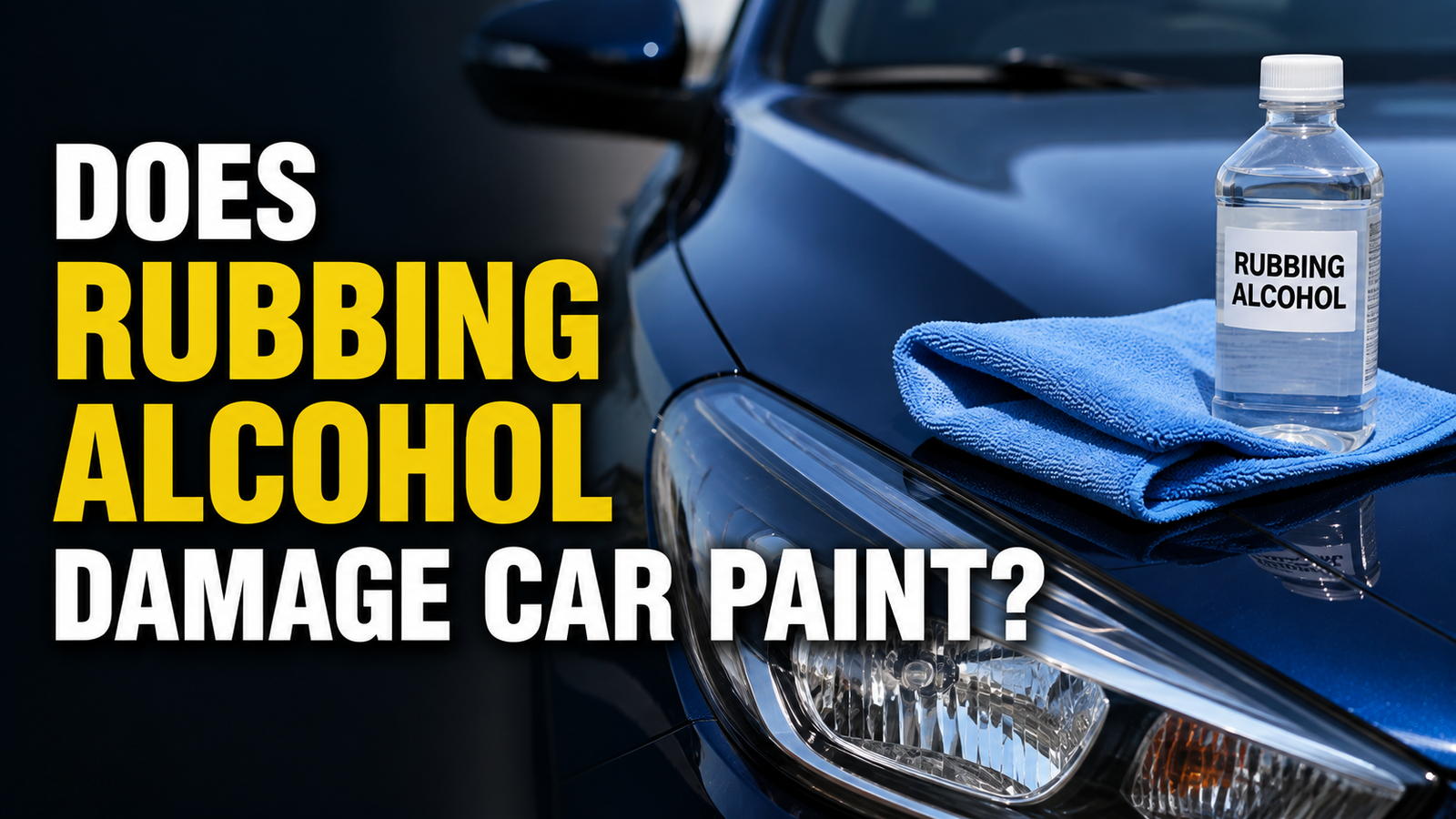

If you’ve ever reached for a bottle of rubbing alcohol to wipe down your car before waxing, or to remove a sticky residue from a bumper sticker, you’ve probably paused and wondered: does rubbing alcohol damage car paint? It’s a fair question, because rubbing alcohol is a powerful solvent, and most of us have learned to be cautious about what touches our car’s finish.
- What Is Rubbing Alcohol?
- How Car Paint Is Structured?
- How Rubbing Alcohol Affects Paint?
- Factors That Determine the Damage Risk
- When Rubbing Alcohol Is Considered “Safe” to Use?
- When Rubbing Alcohol Is Risky or Should Be Avoided?
- Signs of Alcohol Damage on Car Paint
- Safer Alternatives to Rubbing Alcohol
- How to Safely Use Rubbing Alcohol on a Car? (If Necessary)
- What to Do If You Suspect Alcohol Damage?
- Frequently Asked Questions (FAQ)
- Conclusion
- Related Articles
The short answer is that rubbing alcohol can damage car paint, but whether it actually will depends heavily on how it’s used. Concentration, contact time, and the condition of your paint all play a role in determining whether you’ll end up with a clean, prepped surface or a dull, damaged one.
This guide walks through everything you need to know, from how car paint is built to how alcohol interacts with it, so you can make an informed decision before you pick up that bottle.
What Is Rubbing Alcohol?
Rubbing alcohol generally refers to isopropyl alcohol (IPA), a clear, fast-evaporating liquid known for its strong degreasing and disinfecting properties. It’s different from ethanol-based alcohols, which are more commonly found in beverages and some cleaning products, because isopropyl alcohol is specifically formulated to be undrinkable and highly effective at dissolving oils, waxes, and grime.
Rubbing alcohol is typically sold in a few common concentrations:
| Concentration | Common Use |
|---|---|
| 70% IPA | Household cleaning, disinfecting surfaces |
| 91% IPA | Stronger degreasing, electronics cleaning |
| 99% IPA | Industrial or specialized cleaning tasks |
In the automotive world, detailers often use diluted isopropyl alcohol as a “panel wipe” to strip away wax, oils, and silicone residues before applying paint correction products, ceramic coatings, or fresh wax. This is where the confusion often starts, because professionals use it carefully and in controlled amounts, while everyday car owners might reach for a full-strength bottle without realizing the difference matters.
How Car Paint Is Structured?
To understand why rubbing alcohol can be risky, it helps to know what’s actually sitting on top of your car’s metal body. Modern automotive paint isn’t a single layer; it’s a system of several layers working together.
- Primer — the base layer that helps paint adhere to the metal and resist corrosion.
- Base coat — the layer that gives the car its actual color.
- Clear coat — a transparent, protective top layer that adds gloss and shields the base coat from UV rays, dirt, and minor abrasions.
The clear coat is the layer most exposed to the outside world, and it’s also the layer most vulnerable to chemical exposure. Since it’s designed to be transparent and glossy rather than thick and armored, solvents like rubbing alcohol can interact with it more easily than you might expect, especially if the clear coat is thin, aged, or already weakened by sun exposure and weather.
How Rubbing Alcohol Affects Paint?
Isopropyl alcohol works as a solvent, which means its job is to break down and dissolve substances like wax, sealant, oil, and residue. That’s exactly why detailers like it as a prep tool. However, that same solvent action doesn’t always stop at the surface contaminants; if left in contact with the clear coat for too long, or used at high concentrations, it can start to soften or micro-etch the clear coat itself.
In short, the effect of rubbing alcohol on paint typically falls into a spectrum:
- Quick, diluted contact — usually removes wax and oils without harming the clear coat.
- Prolonged or repeated contact — can dull the finish over time.
- Undiluted, extended exposure — may soften the clear coat, cause slight discoloration, or leave visible dull patches.
The key distinction is that a fast wipe with a diluted solution behaves very differently than pouring or spraying full-strength alcohol onto a panel and letting it sit. Time and concentration are really the two variables that decide whether rubbing alcohol helps or hurts your paint.
Factors That Determine the Damage Risk
Not every car, and not every bottle of rubbing alcohol, will produce the same result. Several factors combine to determine how risky a given application really is.
| Factor | Lower Risk | Higher Risk |
|---|---|---|
| Concentration | Diluted (around 10% IPA) | Undiluted (70–99% IPA) |
| Contact time | Quick wipe, immediately removed | Left to sit or soak |
| Paint condition | New, healthy clear coat | Aged, faded, or already damaged paint |
| Climate | Cool, shaded conditions | Hot sun or high temperatures |
| Existing protection | Fresh wax, sealant, or ceramic coating | Bare or unprotected paint |
Heat is an often-overlooked factor. Alcohol evaporates faster in warm conditions, which can sometimes reduce contact time, but it can also cause more aggressive chemical activity on the surface while it’s still wet, especially if the car has been sitting in direct sunlight.
Similarly, older paint that has already been weakened by years of UV exposure is far more susceptible to solvent damage than a newer, well-maintained finish.
When Rubbing Alcohol Is Considered “Safe” to Use?
Despite the risks, rubbing alcohol does have a legitimate place in car care when it’s used correctly. Professional detailers commonly rely on a diluted isopropyl alcohol solution, often mixed at around a 10% alcohol to 90% water ratio, as a panel wipe before applying wax, sealant, or ceramic coating. This helps ensure the surface is completely free of oils and residues so the new protective product bonds properly.
To keep things on the safer side, a few best practices are generally recommended:
- Always dilute the alcohol rather than using it at full strength.
- Test on a small, inconspicuous area first to check for any adverse reaction.
- Apply quickly and avoid letting the solution sit on the paint.
- Wipe the area dry immediately after application rather than allowing it to air-dry.
When followed carefully, this approach minimizes the chances of any noticeable damage while still achieving the degreasing effect that makes alcohol useful in the first place.
When Rubbing Alcohol Is Risky or Should Be Avoided?
On the other hand, there are clear situations where rubbing alcohol becomes a genuine risk to your car’s finish. Using it at full strength, such as straight from a 70% or 91% bottle without diluting it, significantly increases the chance of dulling or softening the clear coat.
Extended contact time is another major red flag. If alcohol is sprayed on and left to sit for several minutes while you’re distracted, or if it pools in a crevice and doesn’t fully evaporate, the risk of visible damage rises. This is especially true on:
- Older vehicles with faded or thinning clear coat
- Cars that have been repainted with lower-quality paint jobs
- Panels that already show signs of wear, chalking, or oxidation
- Vehicles that are frequently exposed to intense heat or direct sunlight
Repeated use over time can also have a cumulative effect, gradually wearing down the protective qualities of the clear coat even if no single application causes obvious harm.
Signs of Alcohol Damage on Car Paint
If you’re not sure whether a previous cleaning session has already affected your paint, there are a few telltale signs to look for.
- Dull or hazy spots where the paint has lost its usual gloss.
- Discoloration or fading in the specific area that was treated.
- Softening or slight tackiness of the clear coat, noticeable when running a finger over it.
- Fine swirl marks or scratches that appear more prominent, since a softened clear coat is more easily marred during wiping.
These signs are usually most visible in direct sunlight or under bright garage lighting, where subtle changes in gloss and texture stand out more clearly against the surrounding paint.
Safer Alternatives to Rubbing Alcohol
If the goal is simply to clean or prep your car’s surface, there are several alternatives that carry a lower risk than rubbing alcohol.
| Alternative | Best For |
|---|---|
| pH-balanced car soap | Routine washing without stripping wax |
| Dedicated automotive panel wipes | Pre-wax or pre-coating prep, formulated for paint safety |
| Clay bar treatment | Removing embedded contaminants without harsh solvents |
| Wax and sealant removers | Stripping old protection before reapplying new products |
These products are generally formulated with automotive paint in mind, which means they’re designed to clean effectively while minimizing the risk of softening or dulling the clear coat, something generic rubbing alcohol wasn’t specifically made for.
How to Safely Use Rubbing Alcohol on a Car? (If Necessary)
If you’ve decided that rubbing alcohol is genuinely the right tool for a specific task, such as removing sticker residue or prepping a small area before coating, following a careful process can help reduce the risk of damage.
- Dilute the alcohol. Mix roughly one part isopropyl alcohol to nine parts water for a gentler solution.
- Test a small area first. Apply to a hidden spot, such as inside a door jamb, and check for any reaction after a few minutes.
- Apply with a soft microfiber cloth. Avoid spraying large amounts directly onto the panel.
- Work quickly. Don’t let the solution sit on the paint for more than a few seconds to a minute.
- Wipe the area dry immediately with a clean, dry microfiber towel.
- Reapply wax or sealant afterward, since the alcohol will have stripped any existing protection.
Following these steps helps ensure that any exposure is brief and controlled, which is the single biggest factor in preventing damage.
What to Do If You Suspect Alcohol Damage?
If you notice dullness, discoloration, or a slightly soft texture after using rubbing alcohol, don’t panic right away, as many minor cases can be corrected. Start by thoroughly washing and drying the affected area, then inspect it closely in good lighting.
For minor dullness, a light machine or hand polish is often enough to restore gloss by removing a very thin layer of the affected clear coat.
If the damage seems more severe, such as noticeable discoloration, tackiness, or an uneven texture that doesn’t respond to polishing, it’s worth having a professional detailer or auto body shop assess the area. They can determine whether the clear coat needs correction, or in more serious cases, whether the panel requires repainting.
Frequently Asked Questions (FAQ)
Can rubbing alcohol remove paint completely? Typically not on its own. Rubbing alcohol is more likely to dull, soften, or slightly discolor the clear coat rather than strip paint down to the primer or metal, especially with brief, diluted use. However, prolonged exposure to concentrated alcohol on already-compromised paint can cause more significant surface damage over time.
Is hand sanitizer also harmful to car paint? Yes, since most hand sanitizers contain a high percentage of isopropyl or ethyl alcohol, similar cautions apply. Accidental spills should be wiped up and rinsed promptly to avoid prolonged contact with the clear coat.
Does rubbing alcohol damage plastic trim or rubber seals? It can, particularly with repeated use. Alcohol may dry out and discolor certain plastics and rubber components over time, so it’s worth being just as cautious with trim pieces as with painted panels.
How long can rubbing alcohol sit on paint before causing damage? There’s no universal time limit since it depends on concentration, paint condition, and climate, but as a general rule, the shorter the contact time, the lower the risk. Wiping it off within seconds to a minute is far safer than letting it sit for several minutes or longer.
Conclusion
So, does rubbing alcohol damage car paint? The honest answer is that it can, but it doesn’t always have to. Used undiluted, left sitting for too long, or applied repeatedly to already-aging paint, rubbing alcohol has real potential to dull, soften, or discolor your car’s clear coat. Used carefully, in a diluted form, applied quickly, and wiped off promptly, it can be a genuinely useful tool for prepping surfaces before waxing or coating.
As a general rule of thumb: dilute it, limit the contact time, and whenever possible, reach for a product specifically formulated for automotive paint instead. That way, you get the cleaning benefits without gambling with your car’s finish.
Related Articles
Can You Paint Air Dry Clay Before It Dries? Full Guide
Can You Paint Over Thompson’s Water Seal? Full Guide
Can You Use Latex Paint Over Oil-Based Primer? A Complete Guide